



|
|
|
|
|
|
|
|
|
|
|


| . |  |
. |
|
|
|
 by Loren B. Thompson Arlington, Va. (UPI) Aug 1, 2008
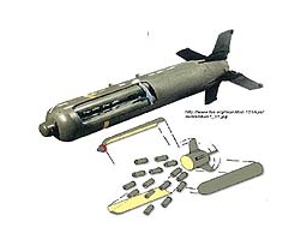
Some of the saddest stories to come out of recent military conflicts concern children who found the unexploded remains of cluster bombs. Cluster bombs are designed to neutralize a wide area by carpeting it with many small explosive devices, called sub-munitions. But some of the sub-munitions on older cluster bombs fail to detonate, and can lie unnoticed for months or years until children pick them up. The result, all too often, is dead children, or lost limbs, blindness and other tragic wounds. U.S. Secretary of Defense Robert Gates recently approved a new policy to reduce the danger that cluster bombs pose to non-combatants by setting a timetable for phasing out unreliable munitions and using only systems that detonate or go dormant quickly. Unfortunately, by the time the new policy became public, the world community was well on its way to signing a treaty on cluster munitions that could have the unintended effect of killing civilians rather than protecting them. The problem is that a group of more than 100 countries met during May in Dublin, Ireland, and agreed in principle to a ban on cluster bombs so broad that it may force the United States and other major military powers to rely on much bigger bombs for neutralizing contested areas. The draft treaty, which could be signed as early as December, needs to be amended to permit use of newer cluster munitions that were designed to destroy only military targets. These newer munitions pose little danger to children, because they automatically explode or shut down shortly after release, but the draft treaty would ban them anyway. How did this happen? Not surprisingly, politics was involved. The idea of prohibiting cluster munitions has been actively discussed in the international community ever since a treaty was approved in 1997 banning land mines. But the process for pursuing that goal developed into two parallel tracks, and several of the biggest military powers -- China, Russia, India and the United States -- have not been participating in the so-called Oslo Process that produced the draft treaty in May. The major military powers that did participate, mostly Europeans, saw to it their newest cluster munitions were not banned at the May meeting. But under the planned criteria for prohibition, every cluster bomb in the current U.S. arsenal would become illegal, including weapons carefully designed to pose little danger to civilians. The most important American cluster munition that could be affected is the Sensor Fuzed Weapon carried on many U.S. fighters and bombers. Each SFW is designed to destroy multiple enemy military vehicles in a wide area using 40 sub-munitions called skeets. A combination of laser range finder and dual-band infrared seeker enables the sub-munitions to attack only those targets matching the characteristics of military vehicles, and if none is found, there are two separate self-destruct modes to assure the bomb-lets will not remain unexploded. A third mechanism disables the sub-munition when batteries lose power a few minutes after release, making it safe even if it is not destroyed. A single Sensor Fuzed Weapon equipped with 40 skeet sub-munitions can reliably destroy an entire enemy air defense site. Using the older Combined Effects Munition to do the same job would require 16 cluster bombs carrying a total of 3,200 sub-munitions. And since the sub-munitions on the older bomb have a 6 percent dud rate, 180 would remain scattered around the target site for some hapless child to find months or years later. The dud rate for SFW is less than 1 percent, and any unexploded skeets would be quickly rendered harmless by lack of electrical power. It makes no sense at all for the international community to prohibit systems like the Sensor Fuzed Weapon, because they pose minimal danger to non-combatants and any ban would force war fighters to shift to more powerful munitions that cause much greater carnage in war zones. (Loren B. Thompson is chief executive officer of the Lexington Institute, an Arlington, Va.-based think tank that supports democracy and the free market.)
Related Links The latest in Military Technology for the 21st century at SpaceWar.com
|
|
|
| The content herein, unless otherwise known to be public domain, are Copyright 1995-2014 - Space Media Network. AFP, UPI and IANS news wire stories are copyright Agence France-Presse, United Press International and Indo-Asia News Service. ESA Portal Reports are copyright European Space Agency. All NASA sourced material is public domain. Additional copyrights may apply in whole or part to other bona fide parties. Advertising does not imply endorsement,agreement or approval of any opinions, statements or information provided by Space Media Network on any Web page published or hosted by Space Media Network. Privacy Statement |
 del.icio.us
 Digg
Digg Reddit
 Google