



|
|
|
|
|
|
|
|
|
|
|


| . |  |
. |
|
|
|
 by Loren B. Thompson Arlington VA (UPI) Jan 6, 2009
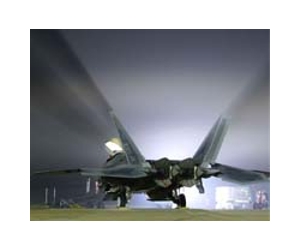
Lockheed Martin Chief Executive Officer Robert J. Stevens made waves in the media recently by suggesting his company's F-22 fighter might serve as a substitute for nuclear weapons in deterring aggression. Stevens told a defense and aerospace summit that the stealthy, twin-engine fighter could "dissuade an adversary without the application of nuclear weapons," acting in a "deterrence fashion" to avert violence without requiring the need to threaten nuclear attack. Critics were quick to pounce. Former Pentagon weapons tester Thomas Christie said Stevens was "grasping at straws" in his pursuit of a justification for buying more of the planes. Aerospace analyst Richard Aboulafia said the capabilities of the F-22 "hardly rival the kind of fear you inspire from the threat of nuclear incineration." However, as any expert on deterrence can tell you, Stevens was probably right for one simple reason: credibility. Nobody really believes the United States will use its nuclear weapons unless national survival is at stake. Look at the historical record. North Korea attacked South Korea in 1950 when America had a near-monopoly in atomic weapons. North Vietnam delivered the biggest military defeat in American history in the mid-1970s during an era when the United States could have destroyed all of Indochina with 1 percent of the nuclear warheads in its arsenal. Al-Qaida launched the Sept. 11, 2001, attacks despite America's nuclear might. Obviously, effective deterrence requires more than just the ability to blow up the world several times over. Adversaries have to believe that a country will actually use its arsenal in response to aggression, otherwise they will not be deterred. I used to teach nuclear strategy at Georgetown University, and wrote a 600-page doctoral dissertation on the subject, so I know a fair amount about the past failures of nuclear deterrence. For example, the Eisenhower administration tried to deter Soviet aggression by threatening "massive retaliation," only to find that the aggression it faced never really justified using nuclear weapons. Once the Soviet Union built up its own nuclear arsenal, it became obvious that any U.S. use of such weapons might prove suicidal. Under President John F. Kennedy, the United States embraced a policy of "graduated deterrence" that called for having proportional responses at each rung on the "ladder of escalation." In other words, if the Soviet Union attacked with tanks in Central Europe, the United States would respond in kind with superior forces. If the Soviets attacked with guerrillas in Southeast Asia, the United States would respond with counterinsurgency forces such as the Green Berets. Nuclear weapons would be reserved mainly for situations in which the other side was threatening nuclear use too. Thus, 90 percent of the U.S. military budget during the Cold War was spent on non-nuclear forces, to provide a credible deterrent posture across the full spectrum of potential threats. The Lockheed Martin F-22 Raptor fighter fits comfortably into this framework. Because it is more survivable, agile and versatile than other fighters, it can achieve air dominance even in places where adversaries have a big numerical advantage. Once air dominance is established, enemies are left naked to the other instruments of U.S. military power without being able to attack our own forces. The F-22 is also equipped to conduct an array of secondary missions such as missile defense, reconnaissance and network attack, enabling the precise tailoring of effects that contributes to effective deterrence. But what really makes it a powerful deterrent -- unlike nuclear weapons, in most cases -- is that enemies know the U.S. government will not hesitate to use it. That has to influence how potential aggressors weigh their options. (Loren B. Thompson is chief executive officer of the Lexington Institute, an Arlington, Va.-based think tank that supports democracy and the free market.)
Related Links The latest in Military Technology for the 21st century at SpaceWar.com
|
|
|
| The content herein, unless otherwise known to be public domain, are Copyright 1995-2014 - Space Media Network. AFP, UPI and IANS news wire stories are copyright Agence France-Presse, United Press International and Indo-Asia News Service. ESA Portal Reports are copyright European Space Agency. All NASA sourced material is public domain. Additional copyrights may apply in whole or part to other bona fide parties. Advertising does not imply endorsement,agreement or approval of any opinions, statements or information provided by Space Media Network on any Web page published or hosted by Space Media Network. Privacy Statement |
 del.icio.us
 Digg
Digg Reddit
 Google