


|
|
|
|
|
|
|
|
|
|
|


| . |  |
. |
|
|
|
 by Staff Writers Montreal, Canada (SPX) Sep 29, 2008
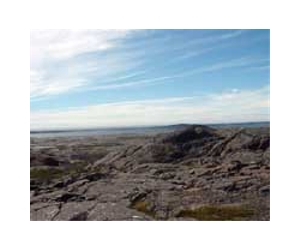
Canadian bedrock more than 4 billion years old may be the oldest known section of the Earth's early crust. Scientists at the Carnegie Institution of Washington and McGill University in Montreal used geochemical methods to obtain an age of 4.28 billion years for samples of the rock, making it 250 million years more ancient than any previously discovered rocks. The findings, which offer scientists clues to earliest stages of our planet's evolution, are published in this week's issue of the journal Science. "This research highlights the ways in which new instrumentation [a thermal ionization mass spectrometer, or TIMS] enables the collection of new data--data which lead to major scientific discoveries," says David Lambert, program director in the National Science Foundation (NSF)'s Division of Earth Sciences, which funded the research. The Nuvvuagittuq greenstone belt is an expanse of bedrock exposed on the eastern shore of Hudson Bay in northern Quebec and was first recognized in 2001 as a potential site of very old rocks. Samples of the Nuvvuagittuq rocks were analyzed by geologists Jonathan O'Neil of McGill University and Richard Carlson of the Carnegie Institution of Washington. By measuring minute variations in the isotopic composition of the rare earth elements neodymium and samarium in the rocks, O'Neil and Carlson determined that the rock samples range from 3.8 to 4.28 billion years old. The oldest dates came from rocks termed "faux amphibolite," which the researchers interpret to be ancient volcanic deposits. "There have been older dates from Western Australia for isolated resistant mineral grains called zircons," says Carlson, "but these are the oldest whole rock dates yet." The oldest zircon dates are 4.36 billion years. Before this study, the oldest dated rocks were from a body of rock known as the Acasta Gneiss in the Northwest Territories, which are 4.03 billion years old. Earth is 4.6 billion years old, and remnants of its early crust are extremely rare--most of it has been mashed and recycled into Earth's interior several times over by plate tectonics since the planet formed. The rocks are significant not only for their great age but also for their chemical composition, which resembles that of volcanic rocks in geologic settings where tectonic plates are crashing together. "This gives us an unprecedented glimpse of the processes that formed the early crust," says Carlson. "Our discovery not only opens the door to further unlock the secrets of the Earth's beginnings," adds O'Neil. "Geologists now have a new playground to explore how and when life began, what the atmosphere may have looked like, and when the first continent formed."
Related Links Explore The Early Earth at TerraDaily.com
|
|
|
| The content herein, unless otherwise known to be public domain, are Copyright 1995-2014 - Space Media Network. AFP, UPI and IANS news wire stories are copyright Agence France-Presse, United Press International and Indo-Asia News Service. ESA Portal Reports are copyright European Space Agency. All NASA sourced material is public domain. Additional copyrights may apply in whole or part to other bona fide parties. Advertising does not imply endorsement,agreement or approval of any opinions, statements or information provided by Space Media Network on any Web page published or hosted by Space Media Network. Privacy Statement |
 del.icio.us
 Digg
Digg Reddit
 Google