


|
|
|
|
|
|
|
|
|
|
|


| . |  |
. |
|
|
|
 by Yury Zaitsev Moscow (RIA Novosti) Nov 03, 2008
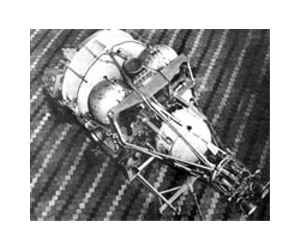
On November 1, 1963, the Polyot-1 spacecraft, the first satellite capable of maneuvering in orbit, was launched from the Tyura-Tam firing range, now called the Baikonur Space Center, in Kazakhstan. Polyot-1, which was also capable of changing its altitude and orbital inclination, was, in fact, a prototype anti-satellite weapon (ASAT) system called Istrebitel Sputnikov (interceptor of satellites). On November 1, 1968, a similar spacecraft intercepted an orbital target for the first time. On August 11-12, 1962, the Soviet Union launched the Vostok-3 and Vostok-4 spacecraft carrying Andriyan Nikolayev and Pavel Popovich. The two capsules came within 5 km (3 miles) of one another and ship-to-ship radio contact was established during the first dual space flight in history. The mission proved that high launch accuracy could allow even non-maneuvering spacecraft to approach each other, to inspect, and even destroy enemy satellites. Spacecraft maneuverability made it possible to enhance interception accuracy. The United States developed the first ASAT systems in the late 1950s, citing the alleged Soviet threat. Washington feared Moscow's Fractional Orbital Bombardment System (FOBS), a Soviet ICBM program in the 1960s. After launch, such missiles could go into a low earth orbit and could then de-orbit for an attack. They had no range limit, and the orbital flight path would not reveal the target location. This allowed them to streak toward North America over the South Pole, rather than the North Pole, which was closely watched by the North American Aerospace Defense Command's (NORAD's) early warning systems. The U.S.S.R. adopted its R-36-Orb (SS-9 Scarp Mod. 3) orbital ICBMs in 1968, or 10 years after the development of prototype U.S. ASAT systems intended to destroy reconnaissance, navigation, telecommunications and weather satellites in case of war. In effect, ASAT systems are used to destroy any spacecraft whenever necessary. Moscow even wanted to convert Soyuz manned spacecraft into satellite interceptors. The Soyuz-P modified version was, basically, an ASAT system. However, this difficult and dangerous project eventually had to be scrapped. It was also proposed to fire mini-rockets from manned and automatic satellite interceptors and to orbit booby-trapped satellites near spacecraft earmarked for destruction. After receiving orders from mission control centers, the explosive-laden satellites were to have approached them, exploding on impact. The cheapest and simplest ASAT option was eventually selected. A launch vehicle orbits a satellite interceptor with a 300kg warhead near the target. After firing its thrusters, the interceptor moves close to the target and explodes, sending numerous fragments in every direction and destroying everything within a 1,000m radius. Polyot-1 and Polyot-2, which lifted off in April 1964, were developed under the supervision of Vladimir Chelomei, a member of the Soviet Academy of Sciences. Although satellite interceptors were to have lifted on top of Chelomei's UR-200 rockets, production of these launch vehicles was delayed. Consequently, a two-stage version of the famous R-7 launch vehicle, developed under the supervision of Sergei Korolev, was used to orbit them. The Soviet government later decided to use R-36 ICBMs, developed by Mikhail Yangel, for orbiting satellite interceptors. The revamped R-36 was redesignated as Tsiklon (Cyclone), and the Korolev Design Bureau started implementing the entire ASAT program. The Polyot satellite design remained basically the same, but the spacecraft changed its name to Kosmos. In 1967-1970, Kosmos-185, Kosmos-217, Kosmos-248 and Kosmos-249 maneuvering satellites were launched. On November 1, 1968, Kosmos-252 successfully destroyed the first spacecraft in orbit. The government was set to adopt the system after subsequent launches. In 1972, the U.S.S.R. and the United States signed the Strategic Arms Limitation Treaty (SALT-I) and the Anti-Ballistic Missile (ABM) Treaty, which also covered ASAT systems. Depending on the pace of bilateral talks, the ASAT test program was either mothballed or resumed. The ASAT system was eventually adopted and subsequently upgraded. In 1976, Moscow began to launch second-generation satellite interceptors, featuring new target-acquisition and homing systems, first installed aboard Kosmos-814. Flying along a lower orbit, the latter quickly overtook the target satellite, accelerated and found itself less than 1,000 meters from the "victim." Enemy tracking stations cannot promptly detect such high-speed interceptors and protect the doomed spacecraft. If promptly notified by mission control, KH-9, codenamed HEXAGON, and popularly known as Big Bird, a series of photographic reconnaissance satellites launched by the United States between 1971 and 1986, could have switched on their rocket engines to escape destruction. Several dozen satellite interceptors were launched under the test program. The U.S.S.R. held its last ASAT test during a major troop exercise in July 1982. At that time, ground ICBMs and submarine-launched ballistic missiles (SLBMs) were fired. The Soviets also launched military satellites, including the Kosmos-1379 interceptor, which hit a simulated U.S. navigation satellite. Moreover, missile interceptors were launched against incoming ballistic-missile warheads. Washington called that exercise a seven-hour nuclear war that provided the Pentagon and U.S. politicians with a pretext for demanding the creation of new-generation ASAT and missile defense systems. In August 1982, President Ronald Reagan gave the go-ahead to the relevant program, and, on March 23, 1983, he announced the Strategic Defense Initiative, which focused on strategic defense rather than the prior strategic offense doctrine of mutual assured destruction (MAD). In August 1983, Yury Andropov, general secretary of the Soviet Communist Party's Central Committee, proposed banning space-defense system tests. However, Soviet ASAT systems remained in combat duty. In April 1991, their upgraded version, the IS-MU, was commissioned and mothballed by Russian leaders in August 1993. Moscow is now studying the possibility of upgrading the national space-defense system and satellite interceptors, since the United States continues to reject all Russian initiatives per an agreed-upon decision on preventing the militarization of outer space. Russia could manufacture lighter but more advanced ASAT weapons with space-to-space missiles and launch them into geostationary (36,000km) orbits. Moscow could also reactivate its ASAT facility at the Baikonur Space Center or redeploy that base to a firing range in Russia. They are also examining the possibility of launching ASAT rockets from the Russian Strategic Missile Force's missile silos. Yury Zaitsev is an academic adviser with the Russian Academy of Engineering Sciences. The opinions expressed in this article are the author's and do not necessarily represent those of RIA Novosti.
Source: RIA Novosti
Related Links North American Aerospace Defense Command (NORAD) Military Space News at SpaceWar.com
|
|
|
| The content herein, unless otherwise known to be public domain, are Copyright 1995-2014 - Space Media Network. AFP, UPI and IANS news wire stories are copyright Agence France-Presse, United Press International and Indo-Asia News Service. ESA Portal Reports are copyright European Space Agency. All NASA sourced material is public domain. Additional copyrights may apply in whole or part to other bona fide parties. Advertising does not imply endorsement,agreement or approval of any opinions, statements or information provided by Space Media Network on any Web page published or hosted by Space Media Network. Privacy Statement |
 del.icio.us
 Digg
Digg Reddit
 Google