


|
|
|
|
|
|
|
|
|
|
|


| . |  |
. |
|
|
|
 by Loren B. Thompson Arlington, Va. (UPI) Feb 13, 2009
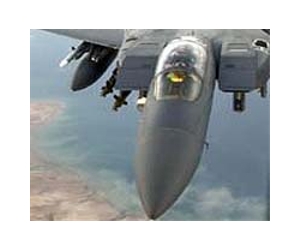
An Air Launched Hit-to-Kill ballistic missile defense system has been proposed that would enable U.S. Air Force Boeing-McDonnell Douglas F-15C Eagle fighters to carry the Patriot Advanced Capability Three missile for both boost-phase and terminal-phase interception missions. The Patriot PAC-3 has superior performance characteristics to the Network Centric Airborne Defense Element because it was designed from its inception to be used for intercepting ballistic missiles. However, it costs much more per round than NCADE. In addition, the configuration of the proposed system would make it dangerous to use in hostile airspace, since it would lack the low observable characteristics of the F-22 Raptor or the F-35 Lightning Joint Strike Fighters carrying interceptors internally. Thus, it probably would not be as well-suited to approaching the launch sites of enemy countries during periods of heightened tension, because it could be tracked much more easily. The Patriot PAC-3 also cannot accomplish interception outside the atmosphere, while the NCADE can. The operating concept for the Network Centric Airborne Defense Element envisions using the host aircraft to do much of the lifting required to position the interceptor for attack, which is why a relatively small missile can be adapted to the mission. Once aircraft sensors lock onto the target missile and sufficient proximity is achieved, the NCADE interceptor is released at high altitude. It maintains a digital link with the host aircraft en route to the target, which is then acquired by the interceptor itself using an infrared seeker in its nose adapted from the Sidewinder air-to-air missile. This all must unfold in a few minutes due to the compressed period of time before boosters burn out, but having the option of carrying the interceptor internally on a stealthy aircraft greatly enhances the likelihood of being in position for a successful engagement. The Network Centric Airborne Defense Element is potentially the most economic system available for accomplishing early interception of ballistic missiles. By mounting the modified air-to-air missile on a stealthy, highly survivable fighter such as the Lockheed Martin/Boeing F-22 Raptor fighter, the joint force could quickly and cheaply deploy a boost-phase interceptor capable of closely approaching enemy launch sites. Boost-Phase capabilities must be preserved. The United States is currently facing the worst economic downturn in three generations. In such times, it is natural for the U.S. government to rethink priorities. But there are some things that are worse than a weak economy, especially the possibility of a nuclear attack. (Part 13: The case for cost-effective NCADE ballistic missile defense against the growing threat of nuclear proliferation in a time of economic recession.) (Loren B. Thompson is chief executive officer of the Lexington Institute, an Arlington, Va.-based think tank that supports democracy and the free market.) (United Press International's "Outside View" commentaries are written by outside contributors who specialize in a variety of important issues. The views expressed do not necessarily reflect those of United Press International. In the interests of creating an open forum, original submissions are invited.)
Related Links Learn about missile defense at SpaceWar.com Learn about nuclear weapons doctrine and defense at SpaceWar.com All about missiles at SpaceWar.com Learn about the Superpowers of the 21st Century at SpaceWar.com
|
|
|
| The content herein, unless otherwise known to be public domain, are Copyright 1995-2014 - Space Media Network. AFP, UPI and IANS news wire stories are copyright Agence France-Presse, United Press International and Indo-Asia News Service. ESA Portal Reports are copyright European Space Agency. All NASA sourced material is public domain. Additional copyrights may apply in whole or part to other bona fide parties. Advertising does not imply endorsement,agreement or approval of any opinions, statements or information provided by Space Media Network on any Web page published or hosted by Space Media Network. Privacy Statement |
 del.icio.us
 Digg
Digg Reddit
 Google