



|
|
|
|
|
|
|
|
|
|
|


| . |  |
. |
|
|
|
 by Ariel Cohen | Lajos Szaszdi Washington (UPI) Nov 6, 2008
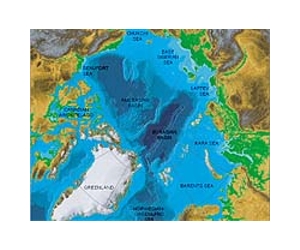
The arctic is quickly re-emerging as a strategic area where vital U.S. interests are at stake. The geopolitical and geo-economic importance of the arctic region is rising rapidly, and its mineral wealth will likely transform the region into a booming economic frontier in the 21st century. The arctic coasts and continental shelf are estimated to hold large deposits of oil, natural gas, methane hydrate clusters and large quantities of valuable minerals. Russia recognizes the multifaceted potential of the arctic and is moving rapidly to assert its national interests. Moscow has submitted a claim to the U.N. Convention on the Law of the Sea to an area of 460,000 square miles -- the size of Germany, France and Italy combined. The Kremlin is pursuing its interests by projecting military power into the region and by using diplomatic instruments such as the Law of the Sea Treaty. Russia made a show of planting its flag on the arctic seabed in August 2007 and has resumed strategic bomber flights over the arctic for the first time since the end of the Cold War. While paying lip service to international law, Russia's ambitious actions hark back to 19th-century statecraft rather than to 21st-century law-based policy and appear to indicate that the Kremlin believes credible displays of power will settle conflicting territorial claims. By comparison, the West's posture toward the arctic has been irresolute and inadequate. This needs to change. In August 2007, shortly after sending the scientific expedition to the arctic ridge, then-Russian President Vladimir Putin ordered the resumption of regular air patrols over the Arctic Ocean. Strategic bombers including the turboprop Tu-95 (Bear), supersonic Tu-160 (Blackjack) and Tu-22M3 (Backfire), and the long-range anti-submarine warfare patrol aircraft Tu-142 have flown patrols since then. According to the Russian air force, the Tu-95 bombers refueled in-flight to extend their operational patrol area. Patrolling Russian bombers penetrated the 12-mile air defense identification zone surrounding Alaska 18 times during 2007. Since August 2007 the Russian air force has flown more than 90 missions over the Arctic, Atlantic and Pacific oceans. The Russian navy is also expanding its presence in the arctic for the first time since the end of the Cold War. Lt. Gen. Vladimir Shamanov, head of the Defense Ministry's combat training department, said the Russian navy is increasing the operational radius of the Northern Fleet's submarines and that Russia's military strategy might be reoriented to meet threats to the country's interests in the arctic, particularly with regard to its continental shelf. Shamanov said, "We have a number of highly professional military units in the Leningrad, Siberian and Far Eastern military districts, which are specifically trained for combat in arctic regions." On July 14, 2008, the Russian navy announced that its fleet had "resumed a warship presence in the arctic." These arctic naval patrols include the area of the Spitsbergen archipelago that belongs to Norway, a NATO member. Russia refuses to recognize Norway's right to a 200-nautical-mile exclusive economic zone around Spitsbergen. Russia deployed an anti-submarine warfare destroyer followed by a guided-missile cruiser armed with 16 long-range anti-ship cruise missiles designed to destroy aircraft carriers. The United States, Canada, Denmark and Norway -- the leading arctic NATO members -- need to take Russian ambitions seriously and follow Russian activities. While a major military confrontation has a low probability today, the arctic is emerging as a new Cold War flashpoint, reminiscent of the 20th-century tensions in the region. (Ariel Cohen, Ph.D., is senior research fellow in Russian and Eurasian studies and international energy security, and Lajos F. Szaszdi, Ph.D., is a researcher in the Douglas and Sarah Allison Center for Foreign Policy Studies, a division of the Kathryn and Shelby Cullom Davis Institute for International Studies, at The Heritage Foundation.)
Related Links Learn about the Superpowers of the 21st Century at SpaceWar.com Learn about nuclear weapons doctrine and defense at SpaceWar.com
|
|
|
| The content herein, unless otherwise known to be public domain, are Copyright 1995-2014 - Space Media Network. AFP, UPI and IANS news wire stories are copyright Agence France-Presse, United Press International and Indo-Asia News Service. ESA Portal Reports are copyright European Space Agency. All NASA sourced material is public domain. Additional copyrights may apply in whole or part to other bona fide parties. Advertising does not imply endorsement,agreement or approval of any opinions, statements or information provided by Space Media Network on any Web page published or hosted by Space Media Network. Privacy Statement |
 del.icio.us
 Digg
Digg Reddit
 Google