


|
|
|
|
|
|
|
|
|
|
|


| . |  |
. |
|
|
|
 by Staff Writers Houghton MI (SPX) Aug 15, 2008
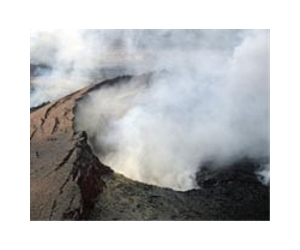
People do all kinds of crazy things in Hawaii, but flying balloons over a volcano usually isn't one of them. Unless you're Adam Durant, that is. Durant, an adjunct geological sciences faculty member at Michigan Technological University, and colleagues took meteorological balloons to the Kilauea volcano this summer to make the first on-location measurements of volcanic gases as they actually spew from the mouth of the volcano. The Kilauea volcano began erupting in March. Durant and Matt Watson, also an adjunct faculty member at Michigan Tech, are working with Paul Voss of Smith College to measure the temperature, composition and water content of the volcanic gases. Durant and Watson both are Michigan Tech alumni who are doing postdoctoral work at the University of Bristol in the United Kingdom. "The first flight was a success and made the first in situ measurements of gases in a volcanic plume using meteorological balloons," Durant reported in a talk at Michigan Tech. In addition to seeing volcanoes up close-Durant and his colleagues wear goggles and breathing masks at the infernal mouth of the volcano-he analyzes the plumes using controlled meteorological (CMET) balloons, which have altitude control and drift with winds. "The balloons are piloted remotely by satellite link," Durant explained, "with flight visualization using Google Earth. We were looking at tropospheric volcanic emissions of sulfur dioxide, carbon dioxide and water, which can be hazardous to human and animal health and degrade ecosystems." The scientists released two balloons in July that rode the winds in and out of the plumes emanating from Kilauea's Halema'uma'u crater. Using instruments hanging below the balloon, the researchers measured the gases as the plumes rose up and away from the active volcano, one of three on Hawaii. After the first balloon was released into strong winds left over from tropical storm Elida, it worked for a couple of hours, ascending to 2,500 meters around Mauna Loa mountain. The flight lasted for just under two hours before the balloon crashed into the mountain north of the launch site. Durant and Watson spent the next three hours scouring the jungle on steep mountain slopes before finally locating the balloon, mostly intact. The next day's launch was even more eventful. Voss worked through the night at home in Massachusetts, while Durant worked remotely in the field to fly the balloon using Google Earth. The balloon remained airborne so long that the researchers had to ask the Federal Aviation Administration to extend the flight beyond their approved window. After five hours, they finally had to terminate the flight themselves, to avoid exceeding the new FAA window or interfering with Hilo or Kona airports. This flight landed in a macadamia nut tree plantation. The Google Earth images were so clear "we could count the rows of trees to find the balloon," Durant said. They also managed to land the balloon close to a major highway. "It sure beat slugging it out through a jungle," he remarked. The preliminary data is already interesting, Durant says. "We are fairly confident of three findings. First, this work is feasible for measuring sulfur dioxide (SO2) and carbon dioxide (CO2) in volcanic emissions for several hours after eruptions. Second, there is a loss of SO2 after one hour of flight away from the source, which could reflect conversion to sulfate aerosol (which may lower the Earth's temperature by reflecting away solar radiation). And third, there is a clear stratification of SO2 above CO2 within the plumes." The stratification could represent separation of the gases through meteorological processes such as water droplet formation, Durant said This finding has implications for remote sensing studies that aim to measure volcanic gas emission rates. Their research could have immediate consequences for neighboring residents. "One of the largest subdivisions in America is Ocean View, and it is downwind from the volcano on the west side of the island," Durant noted. "We detected sulfur dioxide over the development, several hours after it was erupted into the atmosphere." Although they detected considerably less than the 500 parts per million at the source, the level is still high enough to warrant more monitoring, he said. Durant and colleagues would like to return to Hawaii to conduct another, larger study with more accurate (and expensive) instrumentation, to collect more data on the gases that Kilauea belches out. The devil is in the details, it seems, even in paradise.
Related Links Michigan Technological University Bringing Order To A World Of Disasters When the Earth Quakes A world of storm and tempest
|
|
|
| The content herein, unless otherwise known to be public domain, are Copyright 1995-2014 - Space Media Network. AFP, UPI and IANS news wire stories are copyright Agence France-Presse, United Press International and Indo-Asia News Service. ESA Portal Reports are copyright European Space Agency. All NASA sourced material is public domain. Additional copyrights may apply in whole or part to other bona fide parties. Advertising does not imply endorsement,agreement or approval of any opinions, statements or information provided by Space Media Network on any Web page published or hosted by Space Media Network. Privacy Statement |
 del.icio.us
 Digg
Digg Reddit
 Google