


|
|
|
|
|
|
|
|
|
|
|


| . |  |
. |
|
|
|
 by Staff Writers Tuscaloosa AL (SPX) Aug 11, 2008
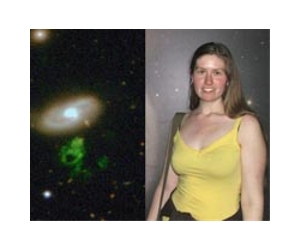
A Dutch schoolteacher has discovered a mysterious and unique astronomical object through the Galaxy Zoo project, which enables members of the public to take part in astronomy research online. Hanny van Arkel, a primary schoolteacher from the Netherlands, came across the image of a strange gaseous object with a hole in the center that has been described as a "cosmic ghost" while using the Galaxy Zoo Web site to classify images of galaxies. She posted about the image - which quickly became known as Hanny's 'Voorwerp' after the Dutch for 'object' - on the Galaxy Zoo forum and the astronomers who run the site began to investigate. They soon realized the potential significance of what they think is a new class of astronomical object and will now use the Hubble Space Telescope to get a closer look at 'Hanny's Voorwerp.' "At first we thought it was a distant galaxy," said Dr. Chris Lintott of Oxford University, a galaxyzoo.org team member, "but we realised there were no stars in it so that it must be a cloud of gas." What was particularly puzzling to astronomers was that the gas was so hot - more than 10,000 degrees Celsius - when there were no stars in the vicinity to heat it up. "We now think that what we're looking at is light from a quasar - the bright, stormy centre of a distant galaxy powered by a supermassive black hole," said Lintott. "The quasar itself is no longer visible to us, but its light continues to travel through space and the Voorwerp is a massive 'light echo' produced as this light strikes the gas." "This discovery really shows how citizen science has come of age in the Internet world," said Dr. William "Bill" Keel, professor of astronomy at The University of Alabama, and a galaxyzoo.org team member. "Hanny's attentiveness alerted us not only to a peculiar object, but to a window into the cosmic past which might have eluded us for a long time otherwise," Keel said. "Trying to understand the processes operating here has proven to be a fascinating challenge, involving a whole range of astrophysical techniques and instruments around the world and beyond. This has also been some of the most rewarding astronomy I've done in years!" Keel is the principal investigator on the Hubble approved project to look more closely at the object. The black hole at the center of the galaxy, IC 2497, is now 'turned off' - which is why the quasar has gone dim - but around 100,000 years ago the quasar was bright enough to have been visible from the Earth through a small, inexpensive telescope. "From the point of view of the Voorwerp the galaxy looks as bright as it would have done before the black hole turned off - it's this light echo that has been 'frozen in time' for us to observe," Lintott said. "It's rather like examining the scene of a crime where, although we can't see them, we know the culprit must be lurking somewhere nearby in the shadows." "IC 2497 is so close that if the quasar was still shining today, on a good night you could probably see it with a small telescope," said galaxyzoo.org team member Kevin Schawinski of Yale University. "The nearest active quasar, called 3C 273, is 1.7 billion light years further away." Smaller light echoes have been noted around supernovae before but never anything of the scale and shape of the Voorwerp. As yet nobody has a sensible explanation for the hole that runs through its center. "It's amazing to think that this object has been sitting in the archives for decades and that amateur volunteers can help by spotting things like this online," said Hanny van Arkel. "It was a fantastic present to find out on my 25th birthday that we will get observational time on the Hubble Space Telescope to follow-up this discovery." Dr. Dan Smith of Liverpool John Moores University and Peter Herbert of the University of Hertfordshire were observing using the Isaac Newton Group of telescopes in La Palma, Spain, when word of the discovery filtered through. "When we got the news about Hanny's Voorwerp we were intrigued to find out what it was, and, fortunately, we were able to slew the telescopes round and get some great images and spectra to study it," said Smith. "It was only later that we heard the story about how it had been discovered; it's inspirational that Hanny picked out this object from Galaxy Zoo in her spare time and nobody had ever seen anything like it before." During the last year, 50 million classifications of galaxies have been submitted on one million objects at www.galaxyzoo.org by more than 150,000 armchair astronomers from all over the world. The next stage of Galaxy Zoo will ask volunteers for more detailed classifications, making it easier to identify more unusual objects such as Hanny's Voorwerp.
Related Links Galaxy Zoo project Sloan Digital Sky Survey University of Alabama Astronomy News from Skynightly.com
|
|
|
| The content herein, unless otherwise known to be public domain, are Copyright 1995-2014 - Space Media Network. AFP, UPI and IANS news wire stories are copyright Agence France-Presse, United Press International and Indo-Asia News Service. ESA Portal Reports are copyright European Space Agency. All NASA sourced material is public domain. Additional copyrights may apply in whole or part to other bona fide parties. Advertising does not imply endorsement,agreement or approval of any opinions, statements or information provided by Space Media Network on any Web page published or hosted by Space Media Network. Privacy Statement |
 del.icio.us
 Digg
Digg Reddit
 Google