


|
|
|
|
|
|
|
|
|
|
|


| . |  |
. |
|
|
|
 by Staff Writers Durham NC (SPX) Jun 22, 2010
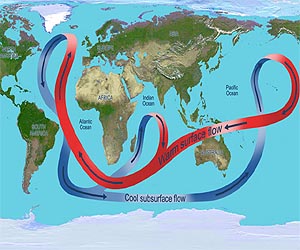
For decades, oceanographers have embraced the idea that Earth's ocean currents operate like a giant conveyor belt, overturning to continuously transport deep, cold polar waters toward the equator and warm equatorial surface waters back toward the poles along narrow boundary currents. The model held that the conveyor belt was driven by changes in the temperature and salinity of the surface waters at high latitudes. In a paper in Science, a Duke University oceanographer reviews the growing body of evidence that suggests it's time to rethink the conveyor belt model. "The old model is no longer valid for the ocean's overturning, not because it's a gross simplification, but because it ignores crucial elements such as eddies and the wind field. The concept of a conveyor belt for the overturning was developed decades ago, before oceanographers had measured the eddy field of the ocean and before they understood how energy from the wind impacts the overturning," says Susan Lozier, professor of physical oceanography and chair of the Division of Earth and Ocean Sciences at Duke University's Nicholas School of the Environment. "It is important to understand that there is clear and convincing evidence that the ocean waters overturn and that this overturning impact's the Earth's climate," she says. "Recent studies, however, have cast doubt on our ability to describe this overturning as a conveyor belt. From these studies we now understand that the overturning waters are not restricted to narrow boundary currents, that the overturning may vary from one ocean basin to the next and that the winds may create variability in the amount of water that overturns and in the pathways for the upper and lower limbs of the overturning." The Science article also reviews what remains unknown about the ocean's overturning. As surface waters warm and/or freshen due to climate change, how might the overturning change? Though modeling studies have addressed this question, there has been no observational study. A new international research program in the planning stages, led by Lozier, aims to address the question of climate effects. The initiative will bring together researchers from the United States, Germany, Canada, France and the United Kingdom to study overturning in the northern North Atlantic over a five-to-10-year period. In her Science article, Lozier reviews the emerging view of the overturning circulation within a historical framework that chronicles significant scientific developments in the field, from the first reported measurement of ocean overturning in 1751 through the present. "Basically, our ability to refine our understanding of the ocean's overturning stems in large part from our ever increasing ability to measure the ocean at finer and finer scales and at depths previously unmeasured," she says. "Because the ocean waters are corrosive, at high pressure and generally inaccessible, the ocean has historically been a sparsely observed system. Recent technological advances are rapidly expanding the ocean's observational database and with it, our understanding of ocean circulation."
Related Links Duke University Water News - Science, Technology and Politics
|
|
|
| The content herein, unless otherwise known to be public domain, are Copyright 1995-2014 - Space Media Network. AFP, UPI and IANS news wire stories are copyright Agence France-Presse, United Press International and Indo-Asia News Service. ESA Portal Reports are copyright European Space Agency. All NASA sourced material is public domain. Additional copyrights may apply in whole or part to other bona fide parties. Advertising does not imply endorsement,agreement or approval of any opinions, statements or information provided by Space Media Network on any Web page published or hosted by Space Media Network. Privacy Statement |
 del.icio.us
 Digg
Digg Reddit
 Google