



|
|
|
|
|
|
|
|
|
|
|


| . |  |
. |
|
|
|
 by Staff Writers Canberra, Australia (UPI) Oct 15, 2009
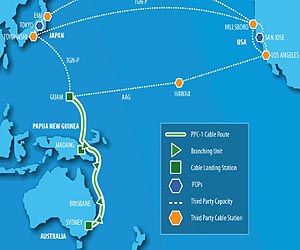
Another major undersea telecommunications cable has gone live between Australia and the United States, but more capacity is needed, analysts have said. PIPE International, a wholly owned subsidiary of PIPE Networks Limited, and Tyco Telecommunications, a business unit of Tyco Electronics, recently completed the PPC-1 cable system which was activated last week. The 4,300-mile cable links Sydney to San Jose via Guam and has a capacity of 2.56 terabits per second over two fiber pairs and is 40 Gbs/sec capable. It will provide diversity to the few existing routes in the region, in addition to onward connectivity to Asia and the United States, a written statement from PIPE said. This should help lower capacity costs by generating increased competition in the Australian undersea cable market. "The on-schedule completion of PPC-1 marks a huge technological advancement for Australia," said PIPE Networks CEO Bevan Slattery. "We are confident this system will provide Australia with the bandwidth and competition needed to enhance both personal communications and international business efforts." Internode is the first Internet service provider to use the new fibre-optic cable but traffic growth will soon demand more cable capacity. Australia should begin investing now, according to two analysts quoted in the Australia- based Computer World magazine. Paul Brooks, a consultant with Communications Alliance NBN and founder of Layer 10, said PPC-1 would "provide an extra player in the market to keep all the players honest in their pricing points." However, he said the most important aspect of PPC-1 is not any competitive pricing spinoff but increased security of communication links. "It can affect the price but having the extra physical option for reliability and redundancy purposes and protection against failure, to me is one of the major benefits that it brings." He said recent cable breaks and interruptions have shown the security priority for Australia to have more submarine cables that are not operating to capacity. "The more cables we have and the more that each carrier spreads their capacity across multiple cables then the safer and more reliable the international connections will be," he told Computer World. In early August a cut in the Asia-Pacific Cable Network 2 (APCN2) undersea cable "crippled connection speeds" for users in the Asia-Pacific region, particularly in Singapore and the Philippines, according to a report on technology Web site ZDNet Asia. Malaysian telecommunications provider TM Net said the cable fault was traced to the segment between Shantou, China and Tanshui, Taiwan. TM Net traced the outage to Typhoon Morakot, which hit the region. The increasing civilian and military importance of undersea cables was highlighted by a 2005 amendment to telecommunication laws allowing the setting up of protective areas within the country's territorial waters. The Australian Communications and Media Authority (ACMA) was given the authority to declare the submarine cable protection zones which are noted on hydro graphic charts. It is now an offense to damage a submarine cable or engage in any prohibited activity. Fines can be up to $60,000 and/or 10 years in jail for an individual and a corporation faces a fine of up to nearly $300,000. Military exercises have also come under scrutiny by the ACMA and last December a memorandum of understanding was signed with the Ministry of Defense. The memorandum sets out what operations the MoD can conduct within a zone, including the use of explosives, and confirms the obligation on cable operators to consult with the MoD prior to accessing the practice areas. The MoU includes the direction for firing ammunition, the use of inert practice rounds and the use of targets by the MoD. Submarines are not allowed to bottom within protection zones. Other countries in the Asia-Pacific region are exploring the sharing of submarine cables in the event of cuts or breakdowns. Bangladesh and Myanmar are said to have started talks on cooperation, according to a report in the Myanmar government newspaper New Age in June. The Myanmar proposal was sent to the Bangladesh Submarine Cable Co. Ltd. in the first week of June, an official told the newspaper. Bangladesh was connected to the global submarine cable system May 2006 for around cost of $35 million, the report said.
Related Links Satellite-based Internet technologies
|
|
|
| The content herein, unless otherwise known to be public domain, are Copyright 1995-2014 - Space Media Network. AFP, UPI and IANS news wire stories are copyright Agence France-Presse, United Press International and Indo-Asia News Service. ESA Portal Reports are copyright European Space Agency. All NASA sourced material is public domain. Additional copyrights may apply in whole or part to other bona fide parties. Advertising does not imply endorsement,agreement or approval of any opinions, statements or information provided by Space Media Network on any Web page published or hosted by Space Media Network. Privacy Statement |
 del.icio.us
 Digg
Digg Reddit
 Google