


|
|
|
|
|
|
|
|
|
|
|


| . |  |
. |
|
|
|
 by Andrei Fedyashin Moscow (UPI) Sep 24, 2008
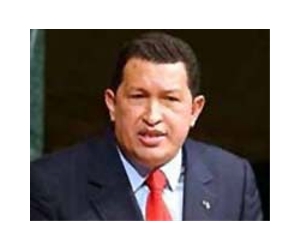
When asked why he did not go to the current U.N. General Assembly session this week in New York, Venezuelan President Hugo Chavez told journalists at Beijing airport Tuesday it was far more important to be in the Chinese capital. "The United States is on the decline, while China and Russia continue to develop," said the Venezuelan leader, who will pay a brief visit to Moscow Sept. 26 after a three-day stay in China. While a Russian naval squadron is still sailing to Venezuela for joint naval exercises, Chavez has embarked on a major seven-day Eurasian tour. Chavez, who visited Cuba on Sept. 21, also will stop in Belarus, France and Portugal through Sept. 27. Chavez's Beijing visit will have some far-reaching consequences. The Venezuelan leader discussed oil exports to China with President Hu Jintao, hoping this will cement mutual friendship. No matter what people think of Chavez, and no matter how they mock him, the president of Venezuela is redrawing the geopolitical map and changing his country's orientation rather skillfully. This is particularly true of his economic policies. China, a key to Chavez's Asian gambit, will help Caracas overcome its dependence on the U.S. oil market, and also will make it possible to export Venezuelan oil to rapidly developing Asian markets. Analysts have repeatedly told Chavez that his threats to stop exporting Venezuelan oil to the United States, if Washington starts playing tough against Caracas' friends and neighbors, were pointless and even reckless in present-day conditions. Although Venezuela dislikes Washington, it sells 60 percent of its oil to the United States. Chavez's possible decision to stop exporting oil to the U.S. market would cripple the entire Venezuelan economy. Consequently, Chavez has decided to visit China, an emerging industrial powerhouse. This April, China received 250,000 barrels of Venezuelan oil per day. By 2010 Venezuela will supply 500,000 barrels of oil to China per day, with daily oil exports to Beijing reaching 1 million barrels by 2012. The state-owned Petroleos de Venezuela SA and Beijing have agreed to build three refineries in China. Moreover, Chinese and Venezuelan companies will set up their joint refinery in Venezuela's famous Oil Belt in the Orinoco River basin. That refinery will export oil to China and other countries. China has pledged to build three large-tonnage tankers for Venezuela. Beijing and Caracas also will contribute $4 billion and $2 billion, respectively, to a huge socioeconomic development fund. On Nov. 1 China will orbit the first Venezuelan telecommunications satellite. Caracas will spend Chinese petrodollars on 24 Chinese-Pakistani K-8 Karakorum light attack fighters. Although the K-8s are no match for the U.S. Air Force, Chavez can use them to intimidate neighbors and wipe out guerrilla bases in mountain areas. "In the past, we had to go and beg for money in Washington. Now we are negotiating with China, which is telling the whole world that a great power does not necessarily have to bully anyone. The Chinese are soldiers of peace. And Venezuela is no longer a U.S. back yard," Chavez said. On Sept. 26 Chavez will discuss lucrative gas deals in the Russian capital. Two weeks ago Russian Deputy Prime Minister Igor Sechin visited Venezuela, with Chavez agreeing to involve energy giant Gazprom in local gas projects. Gazprom and Petroleos de Venezuela SA have signed a memorandum on developing the shelf deposit Blanquilla Este y Tortuga and an agreement on building a liquefied-gas plant. Venezuela ranks second after the United States in the Western Hemisphere in terms of proven gas deposits, containing 4.1 trillion cubic meters. Gazprom is ready to invest $850 million in the next seven years and to annually receive $420 million worth of gas-sale proceeds. Moreover, Gazprom will gain access to the extremely promising Latin American hydrocarbon market. It is high time Russia, which owes its status as an energy superpower to oil and gas, started diversifying its export routes. Some political leaders, including Libya's Col. Moammar Gadhafi, are still in office after staging coups and committing other extravagant acts. However, the unprecedented Venezuelan political and economic activity and even extravagance may do Chavez a disservice. The president of Venezuela faces political opposition and discontent among some segments of society. Moreover, the country is not accustomed to Libyan-style political homogeneity. Only naive people believe the United States will allow Chavez to do what he wants in its back yard and to change the situation in nearby regions with the help of his new far-away friends, including Moscow, Beijing and Minsk, and that Washington will not order its secret services to do something about the Venezuelan leader. But it would be pointless to exclude Latin America from the process of building a new multipolar world. (Andrei Fedyashin is a political commentator for RIA Novosti. The opinions expressed in this article are the author's and do not necessarily represent those of RIA Novosti.) (United Press International's "Outside View" commentaries are written by outside contributors who specialize in a variety of important issues. The views expressed do not necessarily reflect those of United Press International. In the interests of creating an open forum, original submissions are invited.)
Related Links Powering The World in the 21st Century at Energy-Daily.com
|
|
|
| The content herein, unless otherwise known to be public domain, are Copyright 1995-2014 - Space Media Network. AFP, UPI and IANS news wire stories are copyright Agence France-Presse, United Press International and Indo-Asia News Service. ESA Portal Reports are copyright European Space Agency. All NASA sourced material is public domain. Additional copyrights may apply in whole or part to other bona fide parties. Advertising does not imply endorsement,agreement or approval of any opinions, statements or information provided by Space Media Network on any Web page published or hosted by Space Media Network. Privacy Statement |
 del.icio.us
 Digg
Digg Reddit
 Google