


|
|
|
|
|
|
|
|
|
|
|


| . |  |
. |
|
|
|
 by Staff Writers Stockholm, Sweden (SPX) Feb 04, 2011
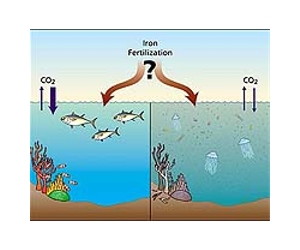
Failure to tackle rising greenhouse gas emissions effectively has led to intensifying debate on geoengineering - deliberate large-scale schemes to slow the rate at which Earth is heating up. The public debate often mixes opinion with fact so scientists have now released the first summary for policymakers on ocean fertilization, one of the earliest geoengineering proposals. The authors report that the chances of success of using ocean fertilization to deal with climate change is low. Ocean fertilization involves adding iron or other nutrients to the surface of the ocean to trigger growth of microscopic marine plants. These plants use dissolved carbon dioxide to grow, which led to the idea that deliberate fertilization of the ocean on a large scale would remove carbon dioxide from the atmosphere. Lead author of the report Professor Doug Wallace from the Leibniz-Institut fur Meereswissenschaften (IFM-GEOMAR) says: "The published findings suggest that even very large-scale fertilization would remove only modest amounts of carbon dioxide from the atmosphere over 100 years". For two decades, marine scientists have been carrying out a series of small-scale fertilization experiments to understand how ocean ecosystems respond to environmental change. However the experiments were not designed to address issues relating to geoengineering. Proposals to scale up this approach to slow climate warming or be included within emissions trading schemes to generate carbon credits have stimulated intense debate and criticism amongst scientists and the public. The new summary, involving independent scientists from seven countries, explains the complexity of the underlying science and brings the detailed findings together in an accessible form for policymakers. The summary notes that there are still major knowledge gaps. For example, it is unclear whether findings from small-scale experiments apply fully to larger scales. And a major concern is the possibility of large-scale fertilization having unintended consequences for ecosystems. The summary points out the extreme difficulty of assessing long-term effectiveness or unintended side effects. "It's vastly more complex than assessing carbon storage in a forest" says Wallace "the carbon, and many of the potential impacts, are largely invisible and likely to be spread over vast distances". Publication of the summary coincides with a symposium in California (La Jolla) on the ecosystem impacts of proposed geoengineering schemes and organized by the International Geosphere-Biosphere Programme. The one-day symposium, streamed live online, will bring together the world's leading experts in this area of research.
Related Links International Geosphere-Biosphere Programme Water News - Science, Technology and Politics
|
|
|
| The content herein, unless otherwise known to be public domain, are Copyright 1995-2014 - Space Media Network. AFP, UPI and IANS news wire stories are copyright Agence France-Presse, United Press International and Indo-Asia News Service. ESA Portal Reports are copyright European Space Agency. All NASA sourced material is public domain. Additional copyrights may apply in whole or part to other bona fide parties. Advertising does not imply endorsement,agreement or approval of any opinions, statements or information provided by Space Media Network on any Web page published or hosted by Space Media Network. Privacy Statement |
 del.icio.us
 Digg
Digg Reddit
 Google