|
|
|
|
|
|
|
|
|
|
|


| . |  |
. |
|
|
|
 by Staff Writers Washington DC (SPX) Apr 30, 2008
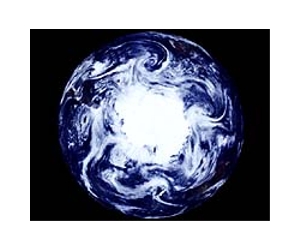
Scientists have detected crisscrossing patterns of currents running throughout the world's oceans. Besides uncovering a surprising and little- understood ocean feature, the findings could significantly improve high-resolution models that help researchers understand trends in climate and in marine ecosystems, the scientists say. In parts of the Southern Ocean, the striations -- also known as ocean fronts -- produce alternating eastward and westward accelerations of circulation. Portions of the pattern nearly circumnavigate Antarctica. In the Atlantic Ocean, the flows bear a strong association to the Azores Current along which water flowing south from the North Atlantic circulation is being subducted. The linkage between the striations and the larger scale patterns of currents could improve predictions of sea temperatures and hurricane paths, the scientists say. The striations also delineate ocean regions where uptake of carbon dioxide is greatest, they add. A report on the striations by Nikolai Maximenko of the University of Hawaii, Peter Niiler of the Scripps Institution of Oceanography in San Diego, and their colleagues was published today in Geophysical Research Letters, a journal of the American Geophysical Union (AGU). In the new analysis, the researchers have produced the clearest representation to date of striated patterns in the eastern Pacific Ocean and show that these complex patterns of currents extend from the surface to depths of 700 meters (2,300 feet). The patterns are so extraordinary "that our first proposal submitted to the National Science Foundation failed miserably because most reviewers said 'You cannot study what does not exist,'" Maximenko recalls. Since the 1960s, a number of researchers have theorized the existence of striations in the ocean, says Niiler, who led the new study. He came up with the first theory in 1965. Niiler attributes the ultimate detection of these current patterns to the long-term and comprehensive ocean current measurements made over more than 20 years by the Global Drifter Program, now a network of more than 1,300 drifting buoys. The drifters were designed by Niiler and are administered by the National Oceanic and Atmospheric Administration (NOAA). In the new study, Maximenko undertook a combined satellite and drifter analysis of ocean velocity that helped clarify the dimensions of striated currents at the surface and of ocean temperature that helped confirm their presence at depth. "The striations are like ghosts," he says. Clear resolution of these subtle features would not have been possible without the use of data from both the drifters and satellites, he adds. The new work shows striations associated with some important ecosystems, such as the California and Peru-Chile current systems. Off California, the striations are linked to the steady east-west displacements, or meanders, of the California Current, a major flow that runs from the border of Washington and Oregon to the southern tip of Baja California. The striations run nearly perpendicular to the California Current and continue southwestward to the Hawaiian Islands. Niiler theorizes that the striations in the eastern North Pacific are caused by the angular momentum of the swirling eddies within the California Current System. Niiler notes that many computer models that can simulate equatorial currents fail to accurately simulate the meandering flow of the California Current and the striations that exude from it. The new striated maps of ocean circulation may serve as a yardstick for judging the accuracy of the circulation patterns portrayed by climate and ocean ecosystem models, he says, eventually leading to substantially more reliable forecasting tools for climate and ecosystem management. "This research presents the next challenge in ocean modeling," says Niiler. "I'm looking forward to the day when we can correctly portray most ocean circulation systems with all climate and ecosystem models." Maximenko, Niiler, and their colleagues are also investigating ties between the crisscross patterns and currents such as the Kuroshio, which flows in western Pacific Ocean waters near Japan. NOAA, the National Science Foundation, the NASA Ocean Surface Topography Team, and the Japan Agency for Marine Earth Science and Technology supported the research.
Related Links Water News - Science, Technology and Politics
|
|
|
| The content herein, unless otherwise known to be public domain, are Copyright 1995-2014 - Space Media Network. AFP, UPI and IANS news wire stories are copyright Agence France-Presse, United Press International and Indo-Asia News Service. ESA Portal Reports are copyright European Space Agency. All NASA sourced material is public domain. Additional copyrights may apply in whole or part to other bona fide parties. Advertising does not imply endorsement,agreement or approval of any opinions, statements or information provided by Space Media Network on any Web page published or hosted by Space Media Network. Privacy Statement |
 del.icio.us
 Digg
Digg Reddit
 Google