


|
|
|
|
|
|
|
|
|
|
|


| . |  |
. |
|
|
|
 by Staff Writers Paris (AFP) Sept 26, 2010
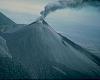
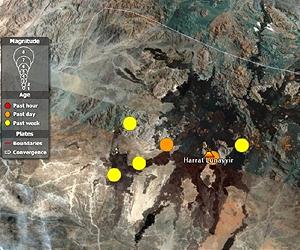
A swarm of small earthquakes that struck western Saudi Arabia last year was the rumbling of a volcano, geologists reported on Sunday. More than 30,000 minor quakes occurred between April and June 2009 within an ancient solidified lava field called Harrat Lunayyir, damaging some buildings in the nearby town of Al Ays and prompting the authorities to evacuate 40,000 people from the region. Most of the quakes were tiny, measuring less than two on the scale of magnitude, but several were hefty, delivering a jolt of up to 5.4. US and Saudi geologists probing the incident conclude that ground deformation, detected by satellite radar, and the shockwaves' seismic signature and depth all point to a cause that is volcanic. The ground ruptured dramatically along eight kilometres (five miles), they found. It ripped open to a width of 45 centimetres (one and a half feet) as a tentacle of magma probed forward just beneath the surface. Because magma has now come so close to the surface, the chance of an eruption has increased, the experts say. But the hazard is low, given the remoteness of the site and the expected type of eruption, a slow-moving lava flow. Saudi Arabia's geology is best known for the oil-drenched sedimentary rocks of the east that are the source of its bounty in hydrocarbons. Less familiar to the general public is the peninsula's western side, which is home to around 180,000 square kilometres (69,500 square miles) of lava fields, known in Arabic as harrat, that were formed over the past 30 million years. The source is basalt magma derived from the Earth's mantle and spewed from submarine volcanoes that form a line along the central axis of the Red Sea, which is gradually being pulled open by continental rifting as Africa separates from Arabia. On a human scale, volcanic eruptions in Saudi Arabia are rare, occurring with frequencies of hundreds of years. The best known event was a 52-day eruption in 1256 that sent flows of lava "like a red-blue boiling river" into the holy city of Medina, according to contemporary accounts. After the governor and citizens prayed for the safety of the city, and women and children wept and begged for mercy around the tomb of the Prophet, the lava changed course. On a geological scale, which measures time in hundreds to millions of years, volcanism in Saudi Arabia is contemporary, said lead resarcher John Pallister of the Volcano Disaster Assistance Programme at the US Geological Survey (USGS). "Several of the lava fields have 'young-looking' features (to a geologist) and even have deposits that overlie Neolithic [Stone Age] sites," Pallister said in an email exchange with AFP. Last year's event in Harrat Lunayyir occurred some 200 kilometres (120 miles) from the main area of geological spreading which is happening beneath the Red Sea. Despite this distance, the intrusion of magma points to an "increased chance" of eruptions "in the next several decades," said Pallister. But he cautioned against fear. "An eruption, at Lunayyir, if it were to occur, would pose little hazard due to the type of volcanism expected at the site and the remoteness of the vent areas," he said. "There (is) a low probability of large damaging earthquakes related to this type of activity. "However, urban development is encroaching on other areas in Saudi Arabia where an eruption would be more serious." He praised the Saudi Geological Survey for its rapid response. "They quickly recognized the hazard and deployed a first-class seismic monitoring network and advised their government and citizens of the status of the unrest and the potential hazards," said Pallister. "The Saudi Survey now has a very good network for seismic monitoring of Lunayyir. Consequently, I expect that they should be able to make a robust forecast in the case of renewed unrest." The study is published online by the specialist journal Nature Geoscience.
Related Links Bringing Order To A World Of Disasters When the Earth Quakes A world of storm and tempest
|
|
|
| The content herein, unless otherwise known to be public domain, are Copyright 1995-2014 - Space Media Network. AFP, UPI and IANS news wire stories are copyright Agence France-Presse, United Press International and Indo-Asia News Service. ESA Portal Reports are copyright European Space Agency. All NASA sourced material is public domain. Additional copyrights may apply in whole or part to other bona fide parties. Advertising does not imply endorsement,agreement or approval of any opinions, statements or information provided by Space Media Network on any Web page published or hosted by Space Media Network. Privacy Statement |
 del.icio.us
 Digg
Digg Reddit
 Google