


|
|
|
|
|
|
|
|
|
|
|


| . |  |
. |
|
|
|
 by Staff Writers Washington DC (SPX) Dec 14, 2010
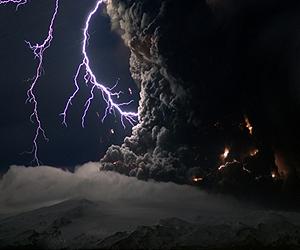
The eruption of the Icelandic volcano Eyjafjallajokull in April this year resulted in a giant ash cloud, which - at one point covering most of Europe - brought international aviation to a temporary standstill, resulting in travel chaos for tens of thousands. New research to be published in IOP Publishing's Environmental Research Letters, shows that lightning could be used as part of an integrated approach to estimate volcanic plume properties. The scientists found that during many of the periods of significant volcanic activity, the ash plume was sufficiently electrified to generate lightning, which was measured by the UK Met Office's long range lightning location network (ATDnet), operating in the Very Low Frequency radio spectrum. The measurements suggest a general correlation between lightning frequency and plume height and the method has the advantage of being detectable many thousands of kilometres away, in both day and night as well as in all weather conditions. As the researchers write, "When a plume becomes sufficiently electrified to produce lightning, the rate of lightning generation provides a method of remotely monitoring the plume height, offering clear benefits to the volcanic monitoring community."
Related Links Institute of Physics Bringing Order To A World Of Disasters When the Earth Quakes A world of storm and tempest
|
|
|
| The content herein, unless otherwise known to be public domain, are Copyright 1995-2014 - Space Media Network. AFP, UPI and IANS news wire stories are copyright Agence France-Presse, United Press International and Indo-Asia News Service. ESA Portal Reports are copyright European Space Agency. All NASA sourced material is public domain. Additional copyrights may apply in whole or part to other bona fide parties. Advertising does not imply endorsement,agreement or approval of any opinions, statements or information provided by Space Media Network on any Web page published or hosted by Space Media Network. Privacy Statement |
 del.icio.us
 Digg
Digg Reddit
 Google