



|
|
|
|
|
|
|
|
|
|
|


| . |  |
. |
|
|
|
 by Staff Writers San Diego CA (SPX) May 01, 2009
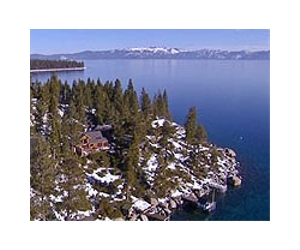
For more than a decade, scientists at Scripps Institution of Oceanography at UC San Diego have been unraveling the history of fault ruptures below the cobalt blue waters of Lake Tahoe one earthquake at a time. Two new studies by the Scripps research team offer a more comprehensive analysis of earthquake activity in the Lake Tahoe region, which suggest a magnitude-7 earthquake occurs every 2,000 to 3,000 years in the basin, and that the largest fault in the basin, West Tahoe, appears to have last ruptured between 4,100 and 4,500 years ago. These studies, led by a team of Scripps researchers including Graham Kent, Neal Driscoll, Jeff Babcock and Alistair Harding, collected new data on earthquake history along three active faults in the region. These new data suggest that the most recent ruptures along the West Tahoe and Incline Village faults each produced nearly 4-meter-high offsets. The most recent event along the Incline Village Fault occurred about 575 years ago. "These studies taken together show that the West Tahoe Fault is capable of a magnitude-7 earthquake - similar to large earthquakes that have occurred on the nearby Genoa Fault - but with the added danger of nearly 500 m of overlying water, which is capable of spawning a large tsunami wave," said Kent, a research geophysicist at Scripps. Jeff Dingler, lead author on a paper in the April online issue of Geological Society of America Bulletin (GSA Bulletin) and former Scripps Oceanography graduate student, used a high-resolution seismic imaging technique, known as CHIRP, to supply a comprehensive view of faulting beneath the lake. Scripps' Neal Driscoll developed the new digital CHIRP profiler for this study, which provided an unprecedented picture of deformation within the sedimentary layers that blanket the floor of Lake Tahoe, laying the groundwork for more detailed fault studies that continue today. In a complementary paper, published in the April issue of the Bulletin of the Seismological Society of America (BSSA), Scripps graduate student Danny Brothers investigated the rupture history of the West Tahoe Fault in greater detail. Using comprehensive CHIRP and coring surveys of Fallen Leaf Lake, where the West Tahoe Fault crosses the southern end of the lake, the study confirmed the suspected fault length of over 50 km (31 miles). When combined with the rupture offset size observed across the fault from CHIRP imagery, the analysis suggests an upper limit of a magnitude-7.3 earthquake for the basin's most dangerous fault. This new analysis, coupled with a slip-rate approaching 0.8 mm/year and the rupture timeline taking place between 4,100 and 4,500 years ago, places the West Tahoe Fault near the end of its characteristic earthquake cycle. Researchers caution that some degree of variability is to be expected. Such an earthquake could produce tsunami waves some three to 10 meters (10 to 33 feet) high, colleagues at the University of Nevada, Reno, have shown. Lake Tahoe, which straddles the California and Nevada border in the Sierra Nevada region, is one of the world's deepest freshwater lakes. At more than 501 meters (1,645 feet) deep, the lake covers 191 square miles in a basin prone to earthquakes and catastrophic landslides. The West Tahoe Fault runs along the west shore of the lake and comes onshore at Baldwin Beach, then passes through the southern third of Fallen Leaf Lake, where it descends into Christmas Valley near Echo Summit. Researchers from University of California, Davis, San Diego State University, University of Nevada, Reno are co-author on the GSA Bulletin paper titled "A high-resolution seismic CHIRP investigation of active normal faulting across the Lake Tahoe Basin, California-Nevada" and researchers from University of Nevada, Reno, and San Diego State University are co-authors on the BSSA paper titled "New Constraints on Deformation, Slip-Rate, and Timing of the Most Recent Earthquake on the West Tahoe-Dollar Point Fault, Lake Tahoe Basin."
Related Links Scripps Institution of Oceanography Bringing Order To A World Of Disasters When the Earth Quakes A world of storm and tempest
|
|
|
| The content herein, unless otherwise known to be public domain, are Copyright 1995-2014 - Space Media Network. AFP, UPI and IANS news wire stories are copyright Agence France-Presse, United Press International and Indo-Asia News Service. ESA Portal Reports are copyright European Space Agency. All NASA sourced material is public domain. Additional copyrights may apply in whole or part to other bona fide parties. Advertising does not imply endorsement,agreement or approval of any opinions, statements or information provided by Space Media Network on any Web page published or hosted by Space Media Network. Privacy Statement |
 del.icio.us
 Digg
Digg Reddit
 Google