


|
|
|
|
|
|
|
|
|
|
|


| . |  |
. |
|
|
|
 by Staff Writers Gaithersburg MD (SPX) Jun 17, 2008
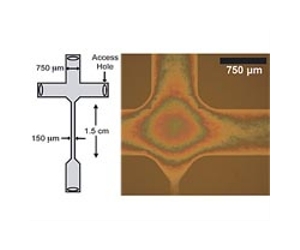
While the results may not rival the artistry of glassblowers in Europe and Latin America, researchers at the National Institute of Standards and Technology (NIST) and Cornell University have found beauty in a new fabrication technique called 'nanoglassblowing" that creates nanoscale (billionth of a meter) fluidic devices used to isolate and study single molecules in solution-including individual DNA strands. The novel method is described in a paper posted online next week in the journal Nanotechnology. Traditionally, glass micro- and nanofluidic devices are fabricated by etching tiny channels into a glass wafer with the same lithographic procedures used to manufacture circuit patterns on semiconductor computer chips. The planar (flat-edged) rectangular canals are topped with a glass cover that is annealed (heated until it bonds permanently) into place. About a year ago, the authors of the Nanotechnology paper observed that in some cases, the heat of the annealing furnace caused air trapped in the channel to expand the glass cover into a curved shape, much like glassblowers use heated air to add roundness to their work. The researchers looked for ways to exploit this phenomenon and learned that they could easily control the amount of 'blowing out" that occurred over several orders of magnitude. As a result, the researchers were able to create devices with 'funnels" many micrometers wide and about a micrometer deep that tapered down to nanochannels with depths as shallow as 7 nanometers-approximately 1,000 times smaller in diameter than a red blood cell. The nanoglassblown chambers soon showed distinct advantages over their planar predecessors. 'In the past, for example, it was difficult to get single strands of DNA into a nanofluidic device for study because DNA in solution balls up and tends to bounce off the sharp edges of planar channels with depths smaller than the ball," says Cornell's Elizabeth Strychalski. 'The gradually dwindling size of the funnel-shaped entrance to our channel stretches the DNA out as it flows in with less resistance, making it easier to assess the properties of the DNA," adds NIST's Samuel Stavis. Future nanoglassblown devices, the researchers say, could be fabricated to help sort DNA strands of different sizes or as part of a device to identify the base-pair components of single strands. Other potential applications of the technique include the manufacture of optofluidic elements-lenses or waveguides that could change how light is moved around a microchip-and rounded chambers in which single cells could be confined and held for culturing. This work was supported in part by Cornell's Nanobiotechnology Center, part of the National Science Foundation's Science and Technology Center Program. It was performed while Samuel Stavis held a National Research Council Research Associateship Award at NIST.
Related Links National Institute of Standards and Technology Nano Technology News From SpaceMart.com Computer Chip Architecture, Technology and Manufacture
|
|
|
| The content herein, unless otherwise known to be public domain, are Copyright 1995-2014 - Space Media Network. AFP, UPI and IANS news wire stories are copyright Agence France-Presse, United Press International and Indo-Asia News Service. ESA Portal Reports are copyright European Space Agency. All NASA sourced material is public domain. Additional copyrights may apply in whole or part to other bona fide parties. Advertising does not imply endorsement,agreement or approval of any opinions, statements or information provided by Space Media Network on any Web page published or hosted by Space Media Network. Privacy Statement |
 del.icio.us
 Digg
Digg Reddit
 Google