



|
|
|
|
|
|
|
|
|
|
|


| . |  |
. |
|
|
|
 by Staff Writers Tallahassee FL (SPX) Nov 27, 2008
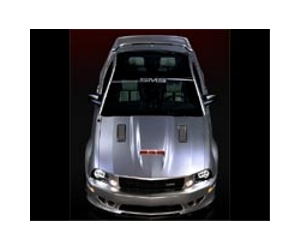
No one needs to tell Disney, which brought the likes of Herbie the Love Bug and Lightning McQueen to the big screen, that cars have personality. Now a study co-authored by a Florida State University researcher has confirmed through a complex statistical analysis that many people see human facial features in the front end of automobiles and ascribe various personality traits to cars - a modern experience driven by our prehistoric psyches. Researchers, product designers and, of course, filmmakers have long toyed with the idea that cars have faces, but this study is the first to investigate the phenomenon systematically. The study will be published in the December issue of the journal Human Nature. "The study confirmed with some rigor what many people have already felt - that cars seem to have consistent personality traits associated with them, and that this is similar to the way people perceive facial expressions," said Dennis Slice, an associate professor in Florida State's Department of Scientific Computing. "The most unique aspect of the study was that we were able to quantitatively link the perception of cars to aspects of their physical structure in a way that allows us to generate a car that would project, say, aggression, anger or masculinity or the opposite traits." As a guest professor at the University of Vienna, Slice collaborated with doctoral student Sonja Windhager, the study's lead author, and several colleagues to explore the link between perception and the geometry of a car front and its parts. The researchers asked 40 people to view high-resolution, 3-D computer reconstructions and printed images of 38 actual 2004-06 car models, representing 26 manufacturers from Ford to Mercedes. One-third (32.5 percent) of those participating in the experiment associated a human or an animal face with at least 90 percent of the cars. Generally, the headlights were marked as eyes; the nose tended to be the grill or emblem; the additional air intake slots, the mouth. Each participant in the experiment also was asked to rate each model on 19 traits, including dominance, maturity, gender and friendliness, and if they liked the car. "In our study, people generally agreed in their ratings,'' Slice said, noting that 96 percent agreed on whether a car was dominant or submissive. "Thus, there must be some kind of consistent message that is being perceived in car fronts." For example, cars scoring high in the so-called power traits had horizontally elongated hoods, pronounced lower car bodies relative to the windshields and more angular headlights that seemed to suggest a frown. Conversely, cars on the other end of the power scale - that is, those perceived as childlike, submissive, female and friendly - had headlights with their upper edge relatively close to the midline and had an upward shift of the car's lateral-most points. ("In this way, the car gives us a big smile," Slice said.) In a finding that suggests perhaps there is a hidden road warrior in all of us, study participants liked power vehicles best - the most mature, masculine, arrogant and angry-looking ones. Although people do not necessarily buy the kind of car they say they like, Slice said the finding spurs some interesting questions for future studies about pedestrian and driver behavior. For example, do people extend the perception of the car to the person behind the wheel? And does that affect how drivers interact with other cars on the road? In addition, the study provides a check into the rearview mirror of our prehistoric psyches, Slice said. The researchers theorized that, through biological evolution, our brains have been designed to infer a great deal of information about another person - age, sex, attitudes, personality traits and emotions - from just a glance at their face. The ability to "read" faces in order to identify people, detect possible kin relationships and assess potential danger has been so important to human development that people have adapted a hypersensitivity to detecting facial features even if they are presented in rather abstract ways. As a result, we are tempted to see faces everywhere, even in clouds, stones and, yes, cars. "The fact that we can so easily see faces in inanimate objects may tell us something about the evolutionary environment in which this capacity arose," Slice said. "Seeing too many faces, even in mountains or toast, has little or no penalty, but missing or misinterpreting the face of a predator or attacker could be fatal."
Related Links Florida State University Car Technology at SpaceMart.com
|
|
|
| The content herein, unless otherwise known to be public domain, are Copyright 1995-2014 - Space Media Network. AFP, UPI and IANS news wire stories are copyright Agence France-Presse, United Press International and Indo-Asia News Service. ESA Portal Reports are copyright European Space Agency. All NASA sourced material is public domain. Additional copyrights may apply in whole or part to other bona fide parties. Advertising does not imply endorsement,agreement or approval of any opinions, statements or information provided by Space Media Network on any Web page published or hosted by Space Media Network. Privacy Statement |
 del.icio.us
 Digg
Digg Reddit
 Google