


|
|
|
|
|
|
|
|
|
|
|


| . |  |
. |
|
|
|
 by Staff Writers Delft, Netherlands (SPX) Feb 01, 2011
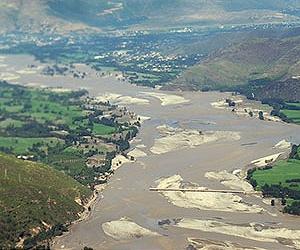
Many different aspects are involved in predicting high water and floods, such as the type of precipitation, wind, buildings and vegetation. The greater the number of variables included in predictive models, the better the prediction will be. However, the models will inevitably become increasingly more complex. PhD student from Delft Steven Weijs uses basic insight from the information theory (Shannon's Information Theory) to demonstrate the cohesion between this added complexity, the information from observational data and the uncertainty of predictions. He will continue his research at the Ecole Polytechnique Federale de Lausanne in Switzerland thanks to funding from the prestigious AXA Research Fund Postdoctoral Fellowship.
Surprise The level of surprisal depends on how likely the recipient considered the event to be: rain in the Netherlands, for example, is hardly a surprise, but seeing rain in the desert is highly unlikely and surprising and therefore provides more information.
Flow In fact not only the flow of water, but also the flow of information from measurements, via models and predictions, to the final decision should be optimised. This would be achievable by assessing the models according to the amount of information comprised in their predictions.
Lausanne TU Delft Works closely with the EPFL in the area of innovative measuring technology. The EPFL is currently focusing on collecting vast amounts of information about the weather and hydrology in the Val Ferret area. This is a pilot district where a lot of high-tech measuring equipment and sensor networks have been set up. The researchers hope that the information can be used to make more accurate predictions about flooding and enable better management of reservoirs to cope with high water levels.
Follow-up The detailed measurements obtained from Val Ferret can also be used to design cheaper, less intensive sensor networks, which can be deployed on a larger scale in similar, larger areas and ultimately be used to make more accurate predictions of flooding in the Netherlands.
Related Links TU Delft Bringing Order To A World Of Disasters When the Earth Quakes A world of storm and tempest
|
|
|
| The content herein, unless otherwise known to be public domain, are Copyright 1995-2014 - Space Media Network. AFP, UPI and IANS news wire stories are copyright Agence France-Presse, United Press International and Indo-Asia News Service. ESA Portal Reports are copyright European Space Agency. All NASA sourced material is public domain. Additional copyrights may apply in whole or part to other bona fide parties. Advertising does not imply endorsement,agreement or approval of any opinions, statements or information provided by Space Media Network on any Web page published or hosted by Space Media Network. Privacy Statement |
 del.icio.us
 Digg
Digg Reddit
 Google