


Subscribe free to our newsletters via your
. 24/7 Space News .


TECTONICS
Indonesia quake zone a disaster waiting to happen: scientists
by Staff Writers
Jakarta (AFP) Oct 1, 2009


New Sumatra quake takes seismologists by surprise
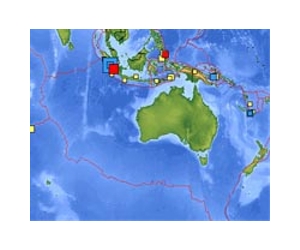
The huge earthquake that hit Sumatra occurred at a deep, unexpected location, illustrating the dangerously complex geological mosaic in this area, a seismologist told AFP on Thursday. The 7.6 magnitude quake struck on Wednesday 80 kilometers (50 miles) beneath the sea, 45 kilometers northwest of the city of Padang, according to US Geological Survey (USGS) data. The fault line where this happened runs parallel to Sumatra and is called the Sunda Trench. It marks a "subduction" zone, where one plate of Earth's crust rides on top of the other. To the west is the Australia plate, which is moving northeast at about five centimetres (two inches) a year). The Australia plate is being forced under, or subducted, by the Sunda plate, which lies to the east. Scientists had long feared a major earthquake would occur on the part of the trench near Padang.

They considered it vulnerable to a so-called quake "cascade" that began with the notorious 9.1 quake of December 26, 2004 that unleashed the Indian Ocean tsunami. "Cascade" events can occur in long, badly-stressed faults. The stress of a large earthquake causes the next section of a fault to weaken and then rupture, in a domino-like effect. But Sandy Steacy, a professor at the Environmental Sciences Research Institute at the University of Ulster in Northern Ireland, said Wednesday's quake was not part of this chain reaction. "The event yesterday was kind of strange, it wasn't what we would have expected," she said. "It appears if the most recent earthquake didn't occur on the interface of the subduction zone. It occurred within the plate that is being subducted, the part that's going down beneath the interface." Steacy said that seismologists were working hard to calculate what had happened, but her bet was that the quake had occurred deep below the seabed on the tongue of the Australian plate, contorting as it was forced under the Sunda plate.

"Clearly you are going to get faults in that kind of situation, because you're taking a slab, you're bending it, you're pushing it down, so you're going to get material breakage there," she said. "I think once calculations are done, they will show that the stress had increased along that structure," she said. "I suspect that structure, nobody even knew it was there. We don't have any way of mapping the faults in the subducting slab because it's so deep. It's only by having earthquakes on it that gives you an indication." French expert Robin Lacassin, of the Institute of the Physics of the Globe in Paris, agreed that an "as-yet unknown mechanism" had unleashed Wednesday's quake. "It happened at some depth, around 80 kilometres. It appears to have occurred in the subducted plate, beneath the face where the two plates meet," he said.

Scientists have warned for years that the Indonesian city of Padang is a disaster waiting to happen because of strain on a nearby fault-line. After this week's quake they say worse is still to come.

The city on Sumatra island is located between two lines of high seismic activity -- the Great Sumatran fault on the mainland to the east, and the Sumatra trench, also called the Sunda trench, under the ocean to the west.

Scientists have long anticipated a major quake there, as parts of the Indo-Australian plate and the Eurasian tectonic plates bump and ride over each other as part of the jostling mosaic of the Earth's crust.

Predictions have been issued "since early 2004, before the great 2004 tsunami and earthquake," California Institute of Technology (Caltech) geologist Kerry Sieh told AFP, referring to the Indian Ocean disaster that killed more than 220,000.

The 7.6-magnitude quake that struck the West Sumatra capital on Wednesday killed more than 700 people and left thousands buried under rubble in the city of nearly a million people.

But pressure in the area caused by the meeting of the two plates means a vastly larger 8.8-magnitude quake, coupled with an ensuing five-metre-high wall of water, is a virtual certainty in the coming decades, Sieh said.

"This earthquake today is a flea compared to this tiger of a quake that is coming," he said.

"It's 100 percent likely. The question is when is the date. The strain has been building off Padang for this 8.8 for 175 years."

The fears for Padang have been generated by a domino-like series of events on the Sunda trench since 2004.

When one section ruptures, intense stress applies to the next part of the fault, making it more vulnerable to a bust.

A series of big shakes -- including a magnitude 8.2 that struck Bengkulu province in September 2007, and one off Aceh that triggered the 2004 tsunami -- showed that all the segments had released their energy, except that of Padang.

A pair of European seismologists confirmed on Thursday that the quake was not the big release of strain on the fault-line that had been predicted.

Wednesday's quake, they said, came from a unexpected site. It was pinpointed some 80 kilometres (50 miles) below the seabed, apparently where the Australian plate is "subducted" -- forced into a tortuous slide beneath the Sunda plate.

"The event yesterday was kind of strange, it wasn't what we would have expected," said Sandy Steacy, a professor at the Environmental Sciences Research Institute at the University of Ulster in Northern Ireland.

"I suspect that structure, nobody even knew it was there. We don't have any way of mapping the faults in the subducting slab because it's so deep. It's only by having earthquakes on it that gives you an indication."

Experts have called on the government to invest in quake-resistant buildings and widen Padang's roads -- predicting an exodus of about 500,000 people in the event of a major quake. But little has been done.

Geological Disaster Mitigation and Volcanology Centre head Surono said there is a "perception that building such expensive infrastructure is not economically viable" because of the uncertainty of earthquake prediction.

"West Sumatra is like a supermarket for geological disasters. There are active volcanoes, landslides, land quakes caused by faults," he told AFP.

"Being close to the faults means Padang is always prone to earthquakes. Every day, there is a tectonic quake there, but they may be too small for any effect to be felt."

The Indonesian Red Crescent society said the government had enough funds to make significant improvements to Padang's infrastructure, but money had been lost through corruption.

"There's so much corruption in Indonesia and many corrupt government officials, those in all levels of government," Indonesian Red Crescent secretary-general Djazuli Ambari told AFP.

"Money is available and it shouldn't be a problem building houses with strong foundations, but unfortunately, funds are misused," he said.

The government's Disaster Management Agency, however, said that money was not the only issue.

"It's difficult to build with materials strong enough to withstand quakes and not just bamboo and wood," agency spokesman Priyadi Kardono said. "We need time to do this."

burs/adp/pst

.


Related Links
Tectonic Science and News


Comment on this article via your Facebook, Yahoo, AOL, Hotmail login.

Share this article via these popular social media networks
del.icio.usdel.icio.us DiggDigg RedditReddit GoogleGoogle


TECTONICS
Asia trembles as 'Ring of Fire' sees new deadly quakes
Hong Kong (AFP) Oct 1, 2009
Asia trembled this week as earthquakes hit in Indonesia and the South Pacific along the "Ring of Fire," a stretch of seismic fury responsible for most of the world's tremors and volcanoes. But experts said that although one earthquake can sometimes can set off another, that was not the case in this week's disasters which struck Indonesia's Sumatra and the once-idyllic Samoan islands. ... read more


TECTONICS
China says completes 3D moon map

SMART-1 Mapped Crash Scene Of Upcoming LCROSS Impact

Key Process For Space Outpost Proved On 'Vomit Comet' Ride

NASA Goddard Shoots The Moon To Track LRO

TECTONICS
Opportunity Passes 11 Mile Mark

Spirit Makes Progress On Antenna Actuator

Iceberg Chasing And Laser Lights

Radar Map Of Buried Mars Layers Matches Climate Cycles

TECTONICS
Clown takes giant leap into space

Russia Sends Circus Man Into Space

Russia's Last Analogue Space Freighter Buried In Pacific

Cirque du Soleil founder reaches for the stars

TECTONICS
China to build, launch satellite for Laos

China says will push space programme to catch up West

China Begins New Space Center Construction

China breaks ground on new space launch centre: state media

TECTONICS
Russia To Launch Orbital Lab "Oka-T" In 2015

Light-Duty Day For Crew, Expedition 21 Prepares For Launch

ESA Calls For Ideas For Climate Change Studies From ISS

Progress M-67 Undocks From ISS

TECTONICS
Arianespace Maintains Record Launch Rate

Space Systems/Loral Delivers SES World Skies Satellite To Launch Base

NSS-12 Satellite Arrives At Kourou

Delta II NASA Launch For MDA Successful

TECTONICS
Simulation Suggests Rocky Exoplanet Has Bizarre Atmosphere

NASA's Spitzer Spots Clump Of Swirling Planetary Material

Spitzer Spots Clump Of Swirling Planetary Material

Mass And Density Of Smallest Exoplanet Finally Measured

TECTONICS
ORMatE Returns To NRL After Nearly Two Years In Earth Orbit

Space Debris Gets Some Respect

IKONOS Satellite Marks 10 Years In Operations

NASA works on space age coating


The content herein, unless otherwise known to be public domain, are Copyright 1995-2014 - Space Media Network. AFP, UPI and IANS news wire stories are copyright Agence France-Presse, United Press International and Indo-Asia News Service. ESA Portal Reports are copyright European Space Agency. All NASA sourced material is public domain. Additional copyrights may apply in whole or part to other bona fide parties. Advertising does not imply endorsement,agreement or approval of any opinions, statements or information provided by Space Media Network on any Web page published or hosted by Space Media Network. Privacy Statement