



|
|
|
|
|
|
|
|
|
|
|


| . |  |
. |
|
|
|
 by Staff Writers Munich, Germany (SPX) Apr 07, 2009
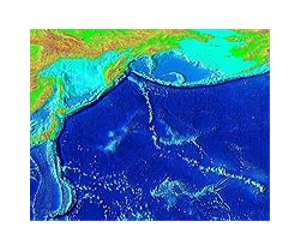
More than 80 undersea volcanoes and a multitude of islands are dotted along the Hawaii-Emperor seamount chain like pearls on a necklace. A sharp bend in the middle is the only blemish. The long-standing explanation for this distinctive feature was a change in direction of the Pacific oceanic plate in its migration over a stationary hotspot - an apparently unmoving volcano deep within the earth. According to the results of an international research group, of which LMU Munich geophysicist Professor Hans-Peter Bunge was a member, however, the hotspot responsible for the Hawaii-Emperor seamount chain was not fixed. Rather it had been drifting quite distinctly southward. Nearly 50 million years ago, it finally came to rest while the Pacific plate steadily pushed on, the combination of which resulted in the prominent bend. The movements of hotspots are determined by circulations in the earth's mantel. "These processes are not of mere academic interest," Bunge emphasizes. "Mantel circulation models help us understand the forces that act on tectonic plates. This in turn is essential for estimating the magnitude and evolution of stresses on the largest tectonic fault lines, that is the sources of many major earthquakes." The characteristic bend in the trail of the 5000 kilometer long Hawaii-Emperor seamount chain is one of the most striking topographical features of the earth, and is an identifying feature in representations of the Pacific Ocean floor. For a long time, textbooks have explained the creation of the Hawaii-Emperor chain as an 80 million year-long migration of the Pacific oceanic plate over a stationary hotspot. Hotspots are volcanoes rooted deep within the bowels of the earth, from which hot material is constantly pushing its way up to the surface. According to this now obsolete scenario, the bend would have come about as the Pacific plate abruptly changed direction. In the past 30 years, geophysicists had also depended on the apparently unchanging locations of hotspots in the earth's mantel in their definition of a global reference for plate tectonics. More recent investigations, however, suggest that hotspots are less stationary than so far assumed. An international research group, of which Professor Hans-Peter Bunge of the LMU Munich Department of Earth and Environmental Sciences was a member, took a closer look at certain evidence pointing towards substantial inherent motion of the underground volcanoes, and has now confirmed this evidence. "Paleomagnetic observations suggest that the bend in the Hawaii-Emperor chain is not the result of a change in the relative motion of the Pacific plate," Bunge states. "On the contrary, it seems the hotspot had been drifting rapidly in a southward direction between 80 and 40 million years ago before it came to a complete halt." If the trail of the Hawaiian hotspot is corrected to include this drift, the result implies a largely constant movement of the Pacific plate over the last 80 million years. The bend ultimately came about as the hotspot started to slow down. The driving force behind the migration of the hotspot is the circulation of material under the surface of our planet. "The earth's interior is in constant motion," reports Bunge. "Over geological timescales, this motion compares to the weather patterns in our atmosphere. These patterns can easily lead to a change in position of hotspots. Numerical simulations of this global circulation in the earth's mantel allow us to retrace these motions in unprecedented detail." The new data will now be entered into the mantel circulation models presently used. These calculations help explain the driving and resisting forces acting on tectonic plates. "And we need to understand these forces because they are essential for estimating the magnitude and evolution of stresses on the major tectonic fault lines - that is, the sources of many major earthquakes on our planet," says Bunge. The findings to come from these models will allow scientists to improve their computer models by checking their calculations against observations.
Related Links LMU Munich Bringing Order To A World Of Disasters When the Earth Quakes A world of storm and tempest
|
|
|
| The content herein, unless otherwise known to be public domain, are Copyright 1995-2014 - Space Media Network. AFP, UPI and IANS news wire stories are copyright Agence France-Presse, United Press International and Indo-Asia News Service. ESA Portal Reports are copyright European Space Agency. All NASA sourced material is public domain. Additional copyrights may apply in whole or part to other bona fide parties. Advertising does not imply endorsement,agreement or approval of any opinions, statements or information provided by Space Media Network on any Web page published or hosted by Space Media Network. Privacy Statement |
 del.icio.us
 Digg
Digg Reddit
 Google