


|
|
|
|
|
|
|
|
|
|
|


| . |  |
. |
|
|
|
 by Staff Writers Woods Hole MA (SPX) Jun 30, 2008
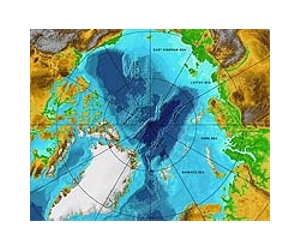
A research team led by the Woods Hole Oceanographic Institution (WHOI) has uncovered evidence of explosive volcanic eruptions deep beneath the ice-covered surface of the Arctic Ocean. Such violent eruptions of splintered, fragmented rock-known as pyroclastic deposits-were not thought possible at great ocean depths because of the intense weight and pressure of water and because of the composition of seafloor magma and rock. Researchers found jagged, glassy rock fragments spread out over a 10 square kilometer (4 square mile) area around a series of small volcanic craters about 4,000 meters (2.5 miles) below the sea surface. The volcanoes lie along the Gakkel Ridge, a remote and mostly unexplored section of the mid-ocean ridge system that runs through the Arctic Ocean. "These are the first pyroclastic deposits we've ever found in such deep water, at oppressive pressures that inhibit the formation of steam, and many people thought this was not possible," said WHOI geophysicist Rob Reves-Sohn, lead author and chief scientist for the Arctic Gakkel Vents Expedition (AGAVE) of July 2007. "This means that a tremendous blast of CO2 was released into the water column during the explosive eruption." The paper, which was co-authored by 22 investigators from nine institutions in four countries, was published in the June 26 issue of the journal Nature. Seafloor volcanoes usually emit lobes and sheets of lava during an eruption, rather than explosive plumes of gas, steam, and rock that are ejected from land-based volcanoes. Because of the hydrostatic pressure of seawater, ocean eruptions are more likely to resemble those of Kilauea than Mount Saint Helens or Mount Pinatubo. Making just the third expedition ever launched to the Gakkel Ridge-and the first to visually examine the seafloor--researchers used a combination of survey instruments, cameras, and a seafloor sampling platform to collect samples of rock and sediment, as well as dozens of hours of high-definition video. They saw rough shards and bits of basalt blanketing the seafloor and spread out in all directions from the volcanic craters they discovered and named Loke, Oden, and Thor. They also found deposits on top of relatively new lavas and high-standing features-such as Duque's Hill and Jessica's Hill--indications that the rock debris had fallen or precipitated out of the water, rather than being moved as part of a lava flow that erupted from the volcanoes. Closer analysis has shown that the some of the tiny fragments are angular bits of quenched glass known to volcanologists as limu o Pele, or "Pele's seaweed." These fragments are formed when lava is stretched thin around expanding gas bubbles during an explosion. Reves-Sohn and colleagues also found larger blocks of rock-known as talus-that could have been ejected by explosive blasts from the seafloor. Much of Earth's surface is made up of oceanic crust formed by volcanism along seafloor mid-ocean ridges. These volcanic processes are tied to the rising of magma from Earth's mantle and the spreading of Earth's tectonic plates. Submerged under several kilometers of cold water, the volcanism of mid-ocean ridges tends to be relatively subdued compared to land-based eruptions. To date, there have been scattered signs of pyroclastic volcanism in the sea, mostly in shallower water depths. Samples of sediment and rock collected on other expeditions have hinted at the possibilities at depths down to 3,000 meters, but the likelihood of explosive eruptions at greater depths seemed slim. One reason is the tremendous pressure exerted by the weight of seawater, known as hydrostatic pressure. More importantly, it is very difficult to build up the amount of steam and carbon dioxide gas in the magma that would be required to explode a mass of rock up into the water column. (Far less energy is needed to do so in air.) In fact, the buildup of CO2 in magma in the sea crust would have to be ten times higher than anyone has ever observed in seafloor samples. The findings from the Gakkel Ridge expedition appear to show that deep-sea pyroclastic eruptions can and do happen. "The circulation and plumbing of the Gakkel Ridge might be different," said Reves-Sohn. "There must be a lot more volatiles in the system than we thought." The research team hypothesizes that excess gas may be building up like foam or froth near the ceiling of the magma chambers beneath the crust, waiting to pop like champagne beneath a cork. "Are pyroclastic eruptions more common than we thought, or is there something special about the conditions along the Gakkel Ridge?" said Reves-Sohn. "That is our next question." Support for the Arctic Gakkel Vents Expedition and for vehicle development was provided by the National Science Foundation's Office of Polar Programs; the NSF Division of Ocean Sciences; the Gordon Center for Subsurface Sensing and Imaging Systems, an NSF Engineering Research Center; the NASA Astrobiology Program; and the WHOI Deep Ocean Exploration Institute.
Related Links Woods Hole Oceanographic Institution Bringing Order To A World Of Disasters When the Earth Quakes A world of storm and tempest
|
|
|
| The content herein, unless otherwise known to be public domain, are Copyright 1995-2014 - Space Media Network. AFP, UPI and IANS news wire stories are copyright Agence France-Presse, United Press International and Indo-Asia News Service. ESA Portal Reports are copyright European Space Agency. All NASA sourced material is public domain. Additional copyrights may apply in whole or part to other bona fide parties. Advertising does not imply endorsement,agreement or approval of any opinions, statements or information provided by Space Media Network on any Web page published or hosted by Space Media Network. Privacy Statement |
 del.icio.us
 Digg
Digg Reddit
 Google