


|
|
|
|
|
|
|
|
|
|
|


| . |  |
. |
|
|
|
 by Staff Writers Durham NC (SPX) Apr 20, 2009
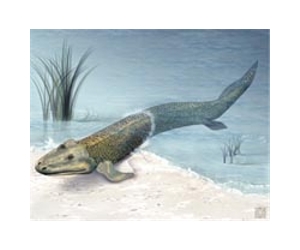
New evidence gleaned from CT scans of fossils locked inside rocks may flip the order in which two kinds of four-limbed animals with backbones were known to have moved from fish to landlubber. Both extinct species, known as Ichthyostega and Acanthostega, lived an estimated 360-370 million years ago in what is now Greenland. Acanthostega was thought to have been the most primitive tetrapod, that is, the first vertebrate animal to possess limbs with digits rather than fish fins. But the latest evidence from a Duke graduate student's research indicates that Ichthyostega may have been closer to the first tetrapod. In fact, Acanthostega may have had a terrestrial ancestor and then returned full time to the water, said Viviane Callier, who is the first author of a report on the findings to be published in the journal Science. "If there is one take-home message, it is that the evolutionary relationship between these early tetrapods is not well resolved," Callier said. Co-author Jennifer Clack of the University Museum of Zoology in Cambridge, England - where she supervised Callier's work for a master's degree - found the fossils embedded in rocks collected from East Greenland. Rather than trying to remove them - an action that would have destroyed much of the evidence - the researchers studied the fossils inside the stone with computed tomography (CT) scanning. Callier "reconstructed" the animals using imaging software (Amira and Mimics) to analyze the CT scans, focusing on the shapes of the two species' upper arm bones, or humeri. The CT slices revealed that Clack had found the first juvenile forms of Ichthyostega. Previously known fossils of Ichthyostega had come from adults. Anatomies can morph as animals move towards adulthood, Callier said. And such shifts can help scientists deduce when in development the animal acquired the terrestrial habit. The fossils suggest that Ichthyostega juveniles were aquatically adapted, and that the terrestrial habit was acquired relatively late in development. The fossils bore evidence that the muscle arrangement in adults was better suited to weight-bearing, terrestrial locomotion than the juvenile morphology. It is possible that Ichthyostega came out of the water only as a fully mature adult. In contrast, in Acanthostega "there is less change from the juvenile to the adult. Although Acanthostega appears to be aquatically adapted throughout the recorded developmental span, its humerus exhibits subtle traits that make it more similar to the later, fully terrestrial tetrapods," Callier said Because the shapes of its adult limbs seemed the most fin-like, scientists had previously concluded that Acanthostega was "more primitive," Callier said. "But now, if we look at the details of the humeri, Ichthyostega's are actually more similar to earlier fishes." Ironically, the shape of Acanthostegas limb's, in both adult and the newly-discovered juvenile forms, is more "paddle-like" than Ichthyostega's, Callier said. "They would have been really good swimmers. So, although Acanthostega had limbs with digits, we don't think it was really terrestrial. We think even the adults were aquatic." "If Ichthyostega is actually more primitive than Acanthostega, then maybe animals evolved towards a terrestrial existence a lot earlier than originally believed," she said. "Maybe Acanthostega was actually derived from a terrestrial ancestor, and then, went back to an aquatic lifestyle." Per Ahlberg, a Swedish paleontologist who was previously Clack's graduate student, also joined Clack in a comparative analysis of other more fish-like species living at about the same time as Ichthyostega and Acanthostega. Those include Tiktaalik, another animal that has made the news because of scientists' deductions that it was in transition from water to land. "It seems like there were different species evolving the same or similar traits independently - evidence of parallel evolution," Callier said. "The terrestrial environment posed new challenges like feeding and moving on land and breathing air, to which the first tetrapods had to evolve solutions. Sometimes different lineages stumbled upon similar solutions." Ahlberg, now professor at the University of Uppsala in Sweden, is corresponding author of the new Science report. The research was funded by the Winston Churchill Foundation and the Swedish Research Council.
Related Links Duke University Explore The Early Earth at TerraDaily.com
|
|
|
| The content herein, unless otherwise known to be public domain, are Copyright 1995-2014 - Space Media Network. AFP, UPI and IANS news wire stories are copyright Agence France-Presse, United Press International and Indo-Asia News Service. ESA Portal Reports are copyright European Space Agency. All NASA sourced material is public domain. Additional copyrights may apply in whole or part to other bona fide parties. Advertising does not imply endorsement,agreement or approval of any opinions, statements or information provided by Space Media Network on any Web page published or hosted by Space Media Network. Privacy Statement |
 del.icio.us
 Digg
Digg Reddit
 Google