


|
|
|
|
|
|
|
|
|
|
|


| . |  |
. |
|
|
|
 by Staff Writers Washington (AFP) Jan 20, 2011
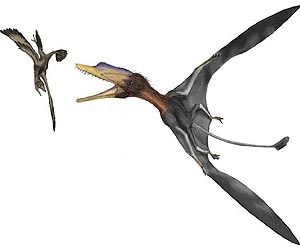
Her life came to a crashing end, but the fossil left by a flying reptile nicknamed Mrs T has shed light on what female pterosaurs looked like when they soared above Earth millions of years ago. The 160-million-year-old fossil, showing an almost complete skeleton of a heavy-hipped Darwinopterus and her egg, was found in the Jurassic sedimentary rocks of China's northeastern Liaoning Province. Pterosaurs were warm-blooded, winged creatures that flew alongside the dinosaurs between 65 million and 220 million years ago, and they resembled a mix between a stork and a bat. A team of British and Chinese researchers said in the journal Science that the hawk-sized Mrs T (short for pterosaur) displays wider hips than males, and likely lacked the same distinct head crest that could be seen in the opposite sex. David Unwin, a paleobiologist in the Department of Museum Studies at the University of Leicester, said the discovery of a mother and egg together was "incredibly rare," and a first for pterosaurs. "Certainly if somebody had said to me a few years ago, 'What do you think about the chance of finding a pterosaur preserved together with an egg?' I just would have said 'You're crazy,'" Unwin said. The find will also help researchers better identify previously found fossils as either male or female, particularly since in Darwinopterus they were about the same size. "She has relatively large hips, to accommodate the passage of eggs, but no head crest," Unwin said. "Males, on the other hand, have relatively small hips and a well developed head crest. Presumably they used this crest to intimidate rivals, or to attract mates such as Mrs T." Many of her other traits match those of 10 similar creatures found in the same rock formation -- an elongated neck and tail, a protruding beak-like mouth lined with slender teeth, and an extended fifth toe. A team of scientists from the Universities of Leicester, Lincoln and the Geological Institute, Beijing studied the fossil, which was first identified in 2009, and gleaned clues of a violent end to the young creature's life. Judging by the visible bone break near her wing, some kind of sudden accident like a volcanic eruption or a storm must have fractured the mother-to-be's forearm, making it impossible for her to fly, they said. She plunged into a body of water and drowned. As her body grew waterlogged, it sank to the bottom. The egg, which looked like it was days from being laid, was pushed out of her decaying body. "The association of the egg with the skeleton, at least in pterosaurs, is unique. We have no other similar sort of specimen," said Christopher Bennett, an expert at Fort Hays State University in Kansas who reviewed the research. Bennett said she might have had some sort of head markings, though it was likely not the same flashy display grown by males to attract sex partners. "I am not entirely convinced that this individual didn't have any crest. It is possible that it was a young adult and a bony crest had not yet grown," he said. Nevertheless, the fossil is a "nice specimen" and shows that "females had a pelvis that was deeper and had a larger opening," Bennett said. Unwin said Mrs T's egg was small and likely had a soft shell, much like the eggs of reptiles, and probably would have been buried before hatching. "A small egg would require less investment in terms of materials and energy -- a distinct evolutionary advantage for active energetic fliers such as pterosaurs," said Unwin.
Related Links Explore The Early Earth at TerraDaily.com
|
|
|
| The content herein, unless otherwise known to be public domain, are Copyright 1995-2014 - Space Media Network. AFP, UPI and IANS news wire stories are copyright Agence France-Presse, United Press International and Indo-Asia News Service. ESA Portal Reports are copyright European Space Agency. All NASA sourced material is public domain. Additional copyrights may apply in whole or part to other bona fide parties. Advertising does not imply endorsement,agreement or approval of any opinions, statements or information provided by Space Media Network on any Web page published or hosted by Space Media Network. Privacy Statement |
 del.icio.us
 Digg
Digg Reddit
 Google