


Subscribe free to our newsletters via your
. 24/7 Space News .


ENERGY TECH
First Russian gas tanker forges Arctic passage to China
by Staff Writers
Moscow (AFP) Aug 25, 2010


Russia to build China link by 2018
Moscow (UPI) Aug 25, 2010 - Russian energy giant Gazprom may build a natural gas pipeline from Russia to China before it completes South Stream. The 1,700-mile Altai pipeline to China is to be built between 2015 and 2018, while the launch of South Stream isn't planned until 2015-24, Russian business daily Vedomosti reports. The newspaper cites from the latest draft of a gas sector development plan drafted by the Russian Energy Ministry, which will submit the paper to the government by the end of this month, Vedomosti quoted a ministry official as saying.

South Stream is intended to move 2.2 trillion cubic feet of gas per year from Russia under the Black Sea to Bulgaria and then to Western Europe. Several European governments and companies, including Italian utility Eni, back South Stream. Plans for a pipeline to China date back almost a decade but the realization has been delayed by the difficult nature of the price negotiations between Moscow and Beijing. Well aware of the European plan to diversify its gas imports to become less dependent on Russia, Moscow would like to sell its gas to China for Western prices. Naturally, China refuses that. The row is set to continue and could delay the Altai pipeline further, observers say.

Some of them have questioned the pipeline's merit altogether at a time when China seems to be turning to Central Asia for its energy supplies. Beijing has courted Turkmenistan and Kazakhstan for major gas and oil projects and in several instances managed to grab stakes in key fields. Due to its seemingly unlimited cash reserves, China was able to complete within three years a 1,100-mile pipeline from Turkmenistan to China. Gas deliveries started this year. The Altai pipeline has also come under fire from environmental organizations because it runs through the Ukok Plateau, a natural habitat of the snow leopard and other endangered species.

South Stream as well as Nord Stream under the Baltic Sea were jump-started in a bid to bypass transit countries such as Ukraine and deliver Russian gas unilaterally to Europe, and at the same time secure Russia's prominent position as Europe's main gas supplier. Russia pushed South Stream even stringer when Europe launched Nabucco, a competitor pipeline. The proposed 2,500-mile pipeline would stretch from Azerbaijan to Austria via Turkey and is aimed at breaking the Russian domination of gas import routes to Europe. Nabucco would be designed to carry 1.1 trillion cubic feet of natural gas per year to Europe.

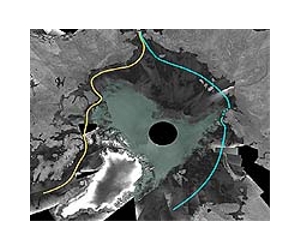
A Russian gas tanker is this month making a historic voyage across the famed Northeast passage as receding ice opens up an elusive trade route from Asia to the West sought for centuries by explorers.

The 114,564-tonne tanker Baltica, escorted by the world's two most powerful nuclear ice breakers, sailed from Russia's northernmost port of Murmansk on August 14.

The largest vessel to ever navigate once-impassable route, the Baltica is due to deliver its cargo of gas condensate to China in the first weeks of September.

Russian television has shown the tanker making cautious progress through chunky sheets of ice in the wake of the steel-rimmed ice breakers, as a polar bear loped across ice floes within shouting distance of the ships.

"Never before has a ship of this size passed via the Northeast sea passage," said Captain Alexander Nikiforov in an interview with Russian channel NTV.

The trailblazing voyage by Russian state-owned shipping giant Sovcomflot is the latest Kremlin bid to mark out its stake over the energy-rich Arctic, where retreating ice cover amid global warming is opening new strategic trade routes.

Russia hopes to make the Arctic route a competitor to the Suez Canal and increase cargo traffic along its Siberian coast from two million tonne a year now to 30 million tonnes -- profiting off taxes and the lease of its unique fleet of nuclear ice breakers.

The Northeast passage is tens of thousands of kilometres shorter than existing routes, stretching 13,000 kilometres along Russian shores to Asia compared to the 22,000-kilometres passage via the Suez Canal, Sovcomflot said.

"The aim of the voyage is to determine the feasibility of delivering energy on a regular, economically viable and safe basis along the Northern Sea Route from the Barents and Kara Seas to the markets of Southeast Asia," Sovcomflot said in statement.

But mariners admit many obstacles remain before Russia's shipping route might steal business from established southern thoroughfares -- not least because of a summer that lasts just a few weeks.

Sovcomflot said it must find new deep-water routes to steer heavy tankers through the perilous coastal waters and contend with free-floating icebergs that make the route hard to time and unreliable.

"The summer in Arctic waters lasts 2-2.5 months. It's winter the rest of the time," chief engineer Boris Abakhov told NTV, bundled in a parka and wool hat aboard the mighty ice-breaker Rossiya.

As the tanker neared the most precarious stretch of its journey -- via the Vilkitsky Strait, leading around Siberia's northernmost tip -- mariners floated a wreath in memory of sailors who died in the icy waters, television showed.

The shallow, ice-choked strait, named after Russian explorer Boris Vilkitsky who mapped it in 1913, separates the Kara Sea from the Laptev Sea about halfway along the Siberian coastline.

In 1553, the British adventurer Sir Hugh Willoughby perished with his crew in the Arctic waters on an expedition to discover a northern route to China.

While Russia has long shipped small cargo along its sprawling Arctic shores, two German cargo ships made the first commercial trip last summer from South Korea to the Netherlands even as UN secretary General Ban Ki-moon warned the Arctic may be ice-less as soon as 2037.

Since a Russian expedition planted a flag at the North Pole in 2007, the five Arctic nations -- Russia, the United States, Norway, Denmark and Canada -- have grown more vocal in their competing claims over swaths of the energy-rich territory.

.


Related Links
Powering The World in the 21st Century at Energy-Daily.com


Comment on this article via your Facebook, Yahoo, AOL, Hotmail login.

Share this article via these popular social media networks
del.icio.usdel.icio.us DiggDigg RedditReddit GoogleGoogle


ENERGY TECH
Cairn discovers gas in offshore Greenland amid protests
London (AFP) Aug 24, 2010
Scottish exploration group Cairn Energy said Tuesday it has discovered gas in offshore Greenland, amid environmental protests by Greenpeace to stop its operations near the nation's fragile coast. Cairn revealed the discovery alongside news of a return to profit in the first half of 2010 while uncertainty over its recent deal to sell a majority stake in its Indian unit, Cairn India, to mining ... read more


ENERGY TECH
Caterpillar Joins Sponsors Of First Expedition

LRO Reveals Incredible Shrinking Moon

A Hop, Skip And A Jump On The Moon - And Beyond

China's Lunar Twins

ENERGY TECH
The Mutating Mars Hoax

NASA's Marks 35th Anniversary Of Mars Viking Mission

Martian 'mud' volcanoes eyed for life

Opportunity Keeps On Driving To Endeavour Crater

ENERGY TECH
DLR Develops Custom Flight Control System For SHEFEX II

SpaceX's Dragon Spacecraft Completes High Altitude Drop Test

Astronauts Stay Strong With Help From SolidWorks

Researchers Explore Physiological Effects Of Space Travel

ENERGY TECH
China Finishes Construction Of First Unmanned Space Module

China Contributes To Space-Based Information Access A Lot

China Sends Research Satellite Into Space

China eyes Argentina for space antenna

ENERGY TECH
ISS orbit corrected

ISS Reboosted And Cooling System Fully Operational

ISS Could Last Another Decade - Roscosmos

Astronauts make third space foray to fix ISS cooling pump

ENERGY TECH
Arianespace Announces Launch Contracts For Intelsat-20 And GSAT 10 Satellites

Arianespace Launches Two Satellites

New Rocket Launch Period In And Around Tanegashima

Kourou Spaceport Welcomes New Liquid Oxygen And Liquid Nitrogen Production Facility

ENERGY TECH
Richest Planetary System Discovered

Planets In Unusually Intimate Dance Around Dying Star

Detector Technology Could Help NASA Find Earth-Like Exoplanets

NASA Finds Super-Hot Planet With Unique Comet-Like Tail

ENERGY TECH
Toshiba to sell launch first 3D TV without glasses: report

US grants licenses for radar equipment sales to Taiwan

Amazon says new Kindle a best seller

Nokia and Intel launch joint research lab


The content herein, unless otherwise known to be public domain, are Copyright 1995-2014 - Space Media Network. AFP, UPI and IANS news wire stories are copyright Agence France-Presse, United Press International and Indo-Asia News Service. ESA Portal Reports are copyright European Space Agency. All NASA sourced material is public domain. Additional copyrights may apply in whole or part to other bona fide parties. Advertising does not imply endorsement,agreement or approval of any opinions, statements or information provided by Space Media Network on any Web page published or hosted by Space Media Network. Privacy Statement