


|
|
|
|
|
|
|
|
|
|
|


| . |  |
. |
|
|
|
 by Tony Fitzpatrick St Louis MO (SPX) Apr 29, 2008
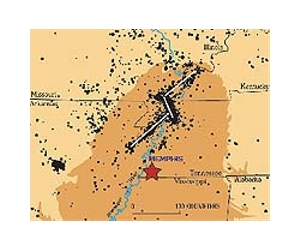
To the surprise of many, the earthquake on April 18, 2008, about 120 miles east of St. Louis, originated in the Wabash Valley Fault and not the better-known and more-dreaded New Madrid Fault in Missouri's bootheel. The concern of Douglas Wiens, Ph.D., and Michael Wysession, Ph.D., seismologists at Washington University in St. Louis, is that the New Madrid Fault may have seen its day and the Wabash Fault is the new kid on the block. The earthquake registered 5.2 on the Richter scale and hit at 4:40 a.m. with a strong aftershock occurring at approximately 10:15 a.m. that morning, followed by lesser ones in subsequent days. The initial earthquake was felt in parts of 16 states. "I think everyone's interested in the Wabash Valley Fault because a lot of the attention has been on the New Madrid Fault, but the Wabash Valley Fault could be the more dangerous one, at least for St. Louis and Illinois," said Wiens, professor of earth and planetary sciences in Arts and Sciences. "The strongest earthquakes in the last few years have come from the Wabash Valley Fault, which needs more investigation." Wiens said that seismologist Robert Hermann of Saint Louis University, Gary Pavils of Indiana University, and several geologists including Steven Obermeir of the U.S. Geological Survey (USGS), have made studies of the Wabash Valley Fault. Pavils also has run a dense local array of stations and recorded many very small earthquakes at the Wabash Valley Fault. Hermann has studied the 1968 magnitude 5.5 earthquake, the largest ever recorded there. Obermeir and others have found disturbed sediments from previous earthquakes along the fault with estimated magnitudes of about 7 on the Richter scale over the past several thousand years. According to Wysession, there are 200,000 earthquakes recorded every year, with a magnitude 6 earthquake happening every three days somewhere in the world. "There hasn't been a magnitude 6 earthquake on the New Madrid zone in more than 100 years, yet in 20 years there have been three magnitude 5 or better earthquakes on the Wabash Valley Fault," said Wyssession, associate professor of earth and planetary sciences. "There is evidence that sometime in the past the Wabash Valley Fault has produced as strong as magnitude 7 earthquakes. On the other hand, the New Madrid Fault has been very quiet for a long time now. Clearly, the Wabash Valley Fault has gotten our deserved attention." Wysession said a recent re-analysis of data by USGS shows that the New Madrid fault risk is much less than was thought three decades ago. The three notable earthquakes that occurred at the end of 1811 and the beginning of 1812 were not magnitude 8s, rather magnitude 7s. A magnitude 8 is 30 times more energetic than a magnitude 7. "The damage to the region by those earthquakes has been exaggerated," Wysession said. "St. Louis was here at the time, and all that happened was some chimneys fell in East St. Louis. The little village of St. Genevieve, closer to the fault zone, had no damage at all. But, let's face it, St. Louis is the biggest city in the region of both faults, and the Wabash Valley Fault is closer to us. If the big one does occur, it's looking more like it will come out of Illinois." Wysession said that the North American Earth's crust is filled with cracks and faults, and that an earthquake can occur anywhere on the continent. Many of the faults are undetected. "As the continents bang into each other, sometimes they pull apart, and the crust cracks and ruptures, causing earthquakes," he explained. "This whole region of New Madrid and the Wabash Valley seismic zone became a rift zone about 750 million years ago when the continent almost broke apart. There was a lot of volcanic activity, a lot of seismic activity. The crust got stretched and thinned. By looking at seismometers, we can actually see many of these faults in the thinning of crusts underground." Wysession said that an earthquake in the Midwest will be felt ten times farther away than one occurring in the western United States because the crust beneath the Midwest is very old, stiff and cold. The rock is about 1.7 billion years old and the seismic waves can travel very long distances through this type of crust. It can be felt hundreds of miles away, even if it was a smaller earthquake. In the western United States, the rock is hotter, and thus it dampens the shock waves and they are not felt as far away. Despite the fact that most seismologists, including Wysession and Wiens, don't think it likely that earthquakes ever will be predicted - which inevitably dredges up memories of the 1990 Midwest earthquake scare sparked by Iben Browning - Wysession says that there are some precursory phenomena that have been observed right before some earthquakes. Radon or helium gas may leak out of the ground as the ground cracks. Sometimes water well pressure changes, or there's a change in the magnetic field. Electrical resistivity changes have been noted, too. "These are changes we can measure with instruments, but we can't sense them as humans," he said. "Many people think that animals sense atmospheric changes. You always get stories about Rover going bananas right before an earthquake. But until Rover learns to tell us what he's barking about, we won't be able to employ animals in any predictive way. "
Related Links Washington University in St. Louis Bringing Order To A World Of Disasters When the Earth Quakes A world of storm and tempest
|
|
|
| The content herein, unless otherwise known to be public domain, are Copyright 1995-2014 - Space Media Network. AFP, UPI and IANS news wire stories are copyright Agence France-Presse, United Press International and Indo-Asia News Service. ESA Portal Reports are copyright European Space Agency. All NASA sourced material is public domain. Additional copyrights may apply in whole or part to other bona fide parties. Advertising does not imply endorsement,agreement or approval of any opinions, statements or information provided by Space Media Network on any Web page published or hosted by Space Media Network. Privacy Statement |
 del.icio.us
 Digg
Digg Reddit
 Google