


Subscribe free to our newsletters via your
. 24/7 Space News .


WATER WORLD
ESA Has Sharp Eyes On Coastal Waters
by Staff Writers
Paris, France (ESA) Feb 11, 2011


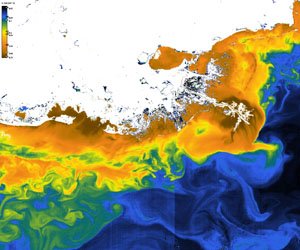
Backscatter coefficient of suspended matter - Gulf Of Mexico, Sept 30 2008 - orbit: 34434. More at ESA's CoastColour project.

Drilling may kill Mediterranean ecosystem: WWF
Rome (AFP) Feb 9, 2011 - A rush to drill in the gas-rich Mediterranean may do permanent damage to the sea's wildlife as it takes at least a millennium for an ecosystem to grow, the World Wildlife Fund warned Wednesday. Drilling in the Mediterranean's eastern region shared by Turkey, Israel and Egypt, "could cause irreversible damage" to its biodiversity, said Sergi Tudela, head of WWF's Mediterranean Fisheries Programme. The area hosts rare and millennia-old species such as deep-sea sponges, worms, mollusks and cold water corals, and therefore are "particularly fragile and vulnerable to external interference," he added in a statement. Once a deep-sea floor has been drilled, "it can take a millennium or more before the unique micro-ecosystem grows again, so the most fragile and valuable species and under-sea areas must be left untouched by gas development."

The recently discovered Leviathan gas field, 135 kilometres off the Israeli coast, is the world's biggest deep-water gas discovery in a decade, with an estimated volume of 16 trillion cubic feet of gas. Earlier this year the West Nile Delta gas field was discovered, lying in Egyptian waters 80 kilometres off Alexandria. The green group called on a handful of Mediterranean countries and the European Union to ban industrial development and drilling in deep-sea areas where the biodiversity is rich.

Our growing reliance on coastal waters for food, trade and tourism means that these delicate ecosystems need to be more closely monitored to guarantee their future sustainability.

ESA's CoastColour project is helping scientists develop techniques to take full advantage of the unique capabilities of the Medium Resolution Imaging Spectrometer (MERIS) sensor on its Envisat satellite.

With a resolution of 300 m, MERIS provides the sharpest view of coastal waters to date, and includes spectral bands specially designed to characterise the complex mixing of pollutants, suspended sediments and phytoplankton typically found in coastal zones.

Stressing the need for information to help manage these ecosystems, more than 40 user organisations have already signed up to the CoastColour project, which is now processing MERIS data with state-of-the-art techniques over 27 high-priority coastal regions selected by users worldwide.

Coral reef monitoring
Arnold Dekker from Australia's Commonwealth Scientific and Industrial Research Organisation is working with CoastColour to develop techniques to monitor the health of Australia's Great Barrier Reef.

During the wet season large plumes of sediment-laden river water flows into the reef lagoon. Sediments can smother corals and deprive them of the sunlight they need to survive, while river-borne nutrients may influence the frequency of naturally occurring algal blooms.

"ESA is to be commended for supporting the use of Earth observation to help solve the management issues of these truly complex coastal aquatic ecosystems," Dr Dekker said.

Algal bloom monitoring
MERIS data are being used to monitor harmful algal booms along the west coast of South Africa in the Southern Benguela upwelling system. Red tides and algal blooms with extremely high phytoplankton concentrations frequently occur in the region's bays, threatening fisheries and tourism.

Dr Stewart Bernard of the Council for Scientific and Industrial Research is developing systems aiming to integrate the satellite data with hydrodynamic models to monitor and predict harmful algal blooms operationally.

Coastal resource managers and the aquaculture industry in the region greatly need these predictions to minimise risks to public safety and financial losses, according to Dr Bernard.

"The involvement of local scientists in CoastColour has already increased South Africa's technical ocean-colour capability, and is expected to significantly aid the implementation of the ocean-colour components of developing African operational oceanography systems."

Port maintenance monitoring
In the Baltic Sea, the sustainable development of seaports requires shipping channels to be dredged every two years. Dredging mixes large amounts of suspended sediments into the water, affecting coastal water quality which is regulated by internationally agreed standards.

Dr Liis Sipelgas of the Tallinn University of Technology is working with the Port of Tallinn, which runs four harbours on the Estonian coast, to understand the environmental impact of their dredging operations by mapping sediment plumes.

"The new site-specific CoastColour water quality products improve significantly the operational environmental monitoring of harbour dredging activities," Dr Sipelgas said.

"The products also enable us to estimate and quantify the long-term water quality changes in the harbour area."

.


Related Links
Coast Colour at ESA
CLW at CSIRO
Afro Sea
Tallinn University of Technology
Water News - Science, Technology and Politics


Comment on this article via your Facebook, Yahoo, AOL, Hotmail login.

Share this article via these popular social media networks
del.icio.usdel.icio.us DiggDigg RedditReddit GoogleGoogle


WATER WORLD
NOAA releases aquaculture draft policy
Washington (UPI) Feb 9, 2011
The National Oceanic and Atmospheric Administration has released a draft policy on aquaculture in U.S. waters, saying it balances economics and the environment. After crude oil and natural gas, seafood is the third-largest contributor to the U.S. trade deficit as the country imports about $9 billion worth each year, AAAS ScienceMag.org reported Wednesday. Hoping to foster the gro ... read more


WATER WORLD
Astrobotic Technology Annouces Lunar Mission On SpaceX Falcon 9

LRO Could Have Given Apollo 14 Crew Another Majestic View

NASA's New Lander Prototype Skates Through Integration And Testing

Draper Commits One Million Dollars To Next Giant Leap's Moon Lander

WATER WORLD
Mars 500: Landing On The Simulated Red Planet

Experiment volunteers 'to land on Mars'

Tool Makes Search For Martian Life Easier

Mars Express Puts Craters On A Pedestal

WATER WORLD
Lockheed Martin Ships Out First Orion Spacecraft

LightSail-1 On NASA Short List For Upcoming Launch

Astronaut's space tales aim to inspire

Rockets, doughnuts could face ax in US budget cuts

WATER WORLD
U.S. wary of China space weapons

Slow progress in U.S.-China space efforts

China Builds Theme Park In Spaceport

Tiangong Space Station Plans Progessing

WATER WORLD
Cosmonauts To Perform 28th Russian Space Station Spacewalk

Azorean Station To Track Ariane Launch

International Partners Discuss ISS Operations

Russian Cosmonauts To Conduct Spacewalk Feb 16

WATER WORLD
Vandenberg Launches Minotaur One

Activities At Esrange Space Center 2011

Russia Plans To Build Carrier Rocket For Mars Missions

First Delta IV Heavy Launches From Vandenberg

WATER WORLD
NASA Finds Earth-Size Planet Candidates In Habitable Zone

Las Cumbres Scientists Play Key Role In New Planetry System Discovery

A Six-Planet System

Earth-Size Planet Candidates Found In Habitable Zone

WATER WORLD
Yap.TV a virtual living room for show lovers

Nokia needs to make Windows phones hip

Cartoon news is the future: Hong Kong media mogul

Web makes 15 mins fame a lifetime of shame


The content herein, unless otherwise known to be public domain, are Copyright 1995-2014 - Space Media Network. AFP, UPI and IANS news wire stories are copyright Agence France-Presse, United Press International and Indo-Asia News Service. ESA Portal Reports are copyright European Space Agency. All NASA sourced material is public domain. Additional copyrights may apply in whole or part to other bona fide parties. Advertising does not imply endorsement,agreement or approval of any opinions, statements or information provided by Space Media Network on any Web page published or hosted by Space Media Network. Privacy Statement