



|
|
|
|
|
|
|
|
|
|
|


| . |  |
. |
|
|
|
 by Staff Writers Nova Scotia, Canada (SPX) Aug 02, 2010
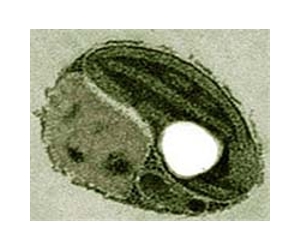
A new article published in the 29 July issue of the international journal Nature reveals for the first time that microscopic marine algae known as "phytoplankton" have been declining globally over the 20th century. Phytoplankton forms the basis of the marine food chain and sustains diverse assemblages of species ranging from tiny zooplankton to large marine mammals, seabirds, and fish. Says lead author Daniel Boyce, "Phytoplankton is the fuel on which marine ecosystems run. A decline of phytoplankton affects everything up the food chain, including humans." Using an unprecedented collection of historical and recent oceanographic data, a team from Canada's Dalhousie University documented phytoplankton declines of about 1% of the global average per year. This trend is particularly well documented in the Northern Hemisphere and after 1950, and would translate into a decline of approximately 40% since 1950. The scientists found that long-term phytoplankton declines were negatively correlated with rising sea surface temperatures and changing oceanographic conditions. The goal of the three-year analysis was to resolve one of the most pressing issues in oceanography, namely to answer the seemingly simple question of whether the ocean is becoming more (or less) �green' with algae. Previous analyses had been limited to more recent satellite data (consistently available since 1997) and have yielded variable results. To extend the record into the past, the authors analysed a unique compilation of historical measurements of ocean transparency going back to the very beginning of quantitative oceanography in the late 1800s, and combined these with additional samples of phytoplankton pigment (�chlorophyll') from ocean-going research vessels. The end result was a database of just under half a million observations which enabled the scientists to estimate phytoplankton trends over the entire globe going back to the year 1899. The scientists report that most phytoplankton declines occurred in polar and tropical regions and in the open oceans where most phytoplankton production occurs. Rising sea surface temperatures were negatively correlated with phytoplankton growth over most of the globe, especially close to the equator. Phytoplankton need both sunlight and nutrients to grow; warm oceans are strongly stratified, which limits the amount of nutrients that are delivered from deeper waters to the surface ocean. Rising temperatures may contribute to making the tropical oceans even more stratified, leading to increasing nutrient limitation and phytoplankton declines. The scientists also found that large-scale climate fluctuations, such as the El-Nino Southern Oscillation (ENSO), affect phytoplankton on a year-to-year basis, by changing short-term oceanographic conditions. The findings contribute to a growing body of scientific evidence indicating that global warming is altering the fundamentals of marine ecosystems. Says co-author Marlon Lewis, "Climate-driven phytoplankton declines are another important dimension of global change in the oceans, which are already stressed by the effects of fishing and pollution. Better observational tools and scientific understanding are needed to enable accurate forecasts of the future health of the ocean." Explains co-author Boris Worm, "Phytoplankton are a critical part of our planetary life support system. They produce half of the oxygen we breathe, draw down surface CO2, and ultimately support all of our fisheries. An ocean with less phytoplankton will function differently, and this has to be accounted for in our management efforts."
Related Links Dalhousie University Water News - Science, Technology and Politics
|
|
|
| The content herein, unless otherwise known to be public domain, are Copyright 1995-2014 - Space Media Network. AFP, UPI and IANS news wire stories are copyright Agence France-Presse, United Press International and Indo-Asia News Service. ESA Portal Reports are copyright European Space Agency. All NASA sourced material is public domain. Additional copyrights may apply in whole or part to other bona fide parties. Advertising does not imply endorsement,agreement or approval of any opinions, statements or information provided by Space Media Network on any Web page published or hosted by Space Media Network. Privacy Statement |
 del.icio.us
 Digg
Digg Reddit
 Google