



|
|
|
|
|
|
|
|
|
|
|


| . |  |
. |
|
|
|
 by Staff Writers Berlin, Germany (SPX) Nov 03, 2010
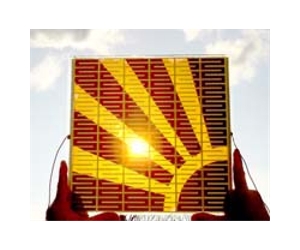
Scientists have been working on organic solar cells for about a decade. Their manufacture is environmentally friendly and they can be applied to all kinds of materials, such as plastic film, for instance. The trouble is, they only yield a fifth of the electrical energy that silicon solar cells do, with most of the electrical current trickling away into the material instead. Scientists at Helmholtz-Zentrum Berlin (HZB) have developed a method that uses the magnetic fingerprint of the charge-carrying particles to reveal exactly how electricity is being lost. They did so by cleverly manipulating the magnetic properties of these particles. Together with Scottish researchers, they have published their findings in Physical Review Letters. Being made from carbon compounds, in other words plastics, organic solar cells are also known as plastic solar cells. The heart of the cell is a layer only a hundred millionth of a millimetre thick, made of two components, polymers and soccer ball-shaped fullerenes, mixed together. When light strikes a layer of this mixture, the polymer component is set into an excited state, dubbed an exciton. When an exciton bumps into a fullerene, an electron jumps over to the soccer ball molecule and a "hole" remains behind in the polymer. So that current can flow, the electrons and holes must travel to their respectively opposite contacts. The electrons travel via the fullerenes while the holes travel via the polymer chain. The holes, which scientists call polarons, can obstruct one another along their path and thus reduce the efficiency of the solar cell. This sets the limit on how much electrical energy can be yielded from a given amount of solar energy. Using electrically detected magnetic resonance (EDMR), the scientists demonstrated that the polarons always get in one another's way when their magnetic moment (spin) is identical. "For the first time, we have uncovered and thus proven the long-assumed formation of these so-called bipolarons," says Jan Behrends, who performed the measurements during his doctorate at the HZB Institute for Silicon Photovoltaics. The researchers' EDMR method involved manipulating the spin of the polarons using an external magnetic field and a microwave pulse. Using a resonance effect, the randomly distributed spin could be turned and aimed like a compass needle. Measurements revealed that current flows freely when the tiny magnets are oppositely aligned, but is blocked when they are aligned in the same direction. The researchers demonstrated these current losses in plastic solar cells at room temperature, having redesigned an experimental method originally developed for silicon. "With this important finding, we should soon see advancements in organic solar cell technology as new plastics are introduced that develop no spin blockades", says project leader Dr. Klaus Lips.
Related Links Helmholtz Association of German Research Centres Powering The World in the 21st Century at Energy-Daily.com
|
|
|
| The content herein, unless otherwise known to be public domain, are Copyright 1995-2014 - Space Media Network. AFP, UPI and IANS news wire stories are copyright Agence France-Presse, United Press International and Indo-Asia News Service. ESA Portal Reports are copyright European Space Agency. All NASA sourced material is public domain. Additional copyrights may apply in whole or part to other bona fide parties. Advertising does not imply endorsement,agreement or approval of any opinions, statements or information provided by Space Media Network on any Web page published or hosted by Space Media Network. Privacy Statement |
 del.icio.us
 Digg
Digg Reddit
 Google