








|
|
|
|
|
|
|
|
|
|
|


| . |  |
. |
|
|
|
 by Staff Writers London, UK (SPX) Oct 22, 2008
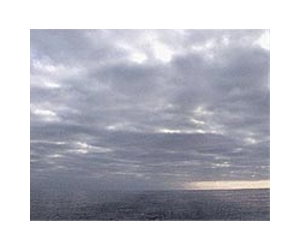
The clouds being investigated in this study are known as marine stratocumulus clouds. They tend to form adjacent to continents where deep, cold, upwelling water reaches the sea-surface. This cools the surface air, condensation occurs and clouds form. These clouds are capped by warm air that descends into this region. The Southeast Pacific region supports one of the largest marine stratocumulus cloud decks in the world - the area of the cloud-decks is massive, often exceeding that of the United States! The clouds are low-level (under 2km in altitude) and are present nearly all the year round in this region. Because these clouds reflect a significant amount of sunlight back to space, they have a profound influence on the planet's overall energy budget and, hence, climate. Further, there is good evidence that the clouds, along with ocean upwelling, affect the amount of heat that is transferred into the tropical Pacific region. The tropical Pacific is a major climate system (eg El Nino and La Nina) that can influence climate and weather around the globe. A large part of the uncertainty in climate models today comes from these marine stratocumulus clouds and the south east Pacific region being poorly represented in the models. Unfortunately, the global climate models that are used to predict climate change do not represent these stratocumulus clouds accurately, because scientists have a relatively limited understanding of how these clouds form. This is a major source of uncertainty in predictions of future climate. This field campaign is taking place in October/November when coverage of these clouds is at it its greatest for this region. This is because the south-east Trade Winds are at their strongest at this time of year and the coastal upwelling is at its greatest
Upwelling in the Southeast Pacific This is because the Andes Mountains act to divert the south east Trade Winds parallel to the coasts of Chile and Peru and these winds push the warmer surface waters off the coast to the open ocean. They are replaced by cold, deeper waters which are brought up to the sea-surface during a process known as upwelling. The clouds that form as a consequence reflect sunlight away from the ocean and so perpetuate these cold sea-surface temperatures and cloud formation. The cold, upwelled waters are also rich in nutrients and hence this area supports one of the most productive fisheries in the world. Ocean eddies (which are like naturally occurring whirlpools) cause upwelling and mixing in this region, also bringing cold water to the surface.
The Effect of Aerosols and Pollution Atmospheric aerosols are tiny particles eg dust that are suspended in air and they can act as nuclei for water droplets to condense onto, forming clouds and subsequently rain. The number of cloud droplets present in a cloud can therefore affect how reflective the clouds are and also how much rain falls from them. In highly polluted areas there may be a high level of aerosols in the atmosphere, eg from industrial emissions, and this may result in a higher number of cloud droplets which are smaller. This can lead to reduced rainfall (as the water in the clouds is effectively spread across a greater number of rain droplets) and brighter clouds. However, the story is more complex - these aerosols within the clouds can actually change the the rate of drizzle and the amount of water the clouds hold, which affects the lifetime of the clouds. This complex cycle of events is the type of information that the cloud scientists hope to pin down and quantify during this study. The southeastern Pacific region provides an ideal laboratory in which to explore such effects as there are both natural and man-made aerosols present. Copper smelters, associated with extensive mining activities along the Peruvian and Chilean coast, inject large emissions of aerosol (containing sulphur) into the atmosphere - in fact the combined sulphur emissions are comparable to the entire sulphur emissions from industrialised nations such as Mexico and Germany. These aerosols form a gradient away from the coast in which the scientists can fly their aircraft and make their measurements. This will allow them to compare differences between clouds formed in a polluted atmosphere and those formed in a clean atmosphere. Such extensive and detailed measurements have never been taken in this region before.
The Field Campaign and Climate Modelling The UK participation in the field campaign will involve two research aircraft, a BAe-146 aircraft, known as "the flying lab" and a Dornier 228 research aircraft. The former is owned by the Natural Environment Research Council and the Met Office and the latter by the Natural Environment Research Council. The aircraft will make measurements of the clouds and aerosol, flying west for as far as possible along 20 degrees south across the pollution gradient and also flying close to the coast in the pollution plumes. Scientists will also be aboard the US research ship the NOAA RV Ron Brown collecting information on ocean mixing and temperatures and making remotely-sensed measurements of the clouds from the ship. There is one other Chilean research ship and three other research aircraft (US) involved in this campaign. In addition there is a buoy moored in the region which collects regional meteorology data. This massive, co-ordinated field campaign will provide observations for cloud physicists climate modellers to use to improve quantitative understanding of clouds and to examine how well state-of-the-art climate models capture the complex climate of the southteastern Pacific and its impact on the wider tropical Pacific, determining where the uncertainities lie and where improvements can be made. UK climate experts will use very high resolution climate models to investigate the complex interactions between the ocean, atmosphere and the Andes, and how these influence the climate of the South East Pacific and its effects on climate around the world.
Related Links National Centre for Atmospheric Science Climate Science News - Modeling, Mitigation Adaptation
|
|
|
| The content herein, unless otherwise known to be public domain, are Copyright 1995-2014 - Space Media Network. AFP, UPI and IANS news wire stories are copyright Agence France-Presse, United Press International and Indo-Asia News Service. ESA Portal Reports are copyright European Space Agency. All NASA sourced material is public domain. Additional copyrights may apply in whole or part to other bona fide parties. Advertising does not imply endorsement,agreement or approval of any opinions, statements or information provided by Space Media Network on any Web page published or hosted by Space Media Network. Privacy Statement |
 del.icio.us
 Digg
Digg Reddit
 Google







