



|
|
|
|
|
|
|
|
|
|
|


| . |  |
. |
|
|
|
 by Staff Writers Cincinnati OH (SPX) Nov 03, 2010
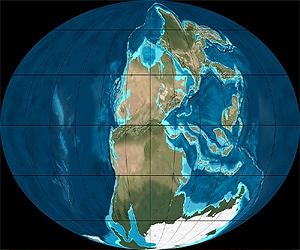
More than 251 million years ago, at the end of the Permian period, Earth almost became a lifeless planet. Around 90 percent of all living species disappeared then, in what scientists have called "The Great Dying." Thomas J. Algeo, has spent much of the past decade investigating the chemical evidence buried in rocks formed during this major extinction. The University of Cincinnati professor of geology has worked with a team of scientific colleagues to understand the ancient catastrophe. Algeo will present his latest findings at the annual meeting of the Geological Society of America, Oct. 31 to Nov. 3, in Denver. The world revealed by Algeo's research sounds horrific and alien - a devastated landscape, barren of vegetation, scarred by erosion from showers of acid rain, huge "dead zones" in the oceans and runaway greenhouse gases leading to sizzling temperatures. This was Earth, 251 million years ago. The more famous "K-T" extinction between the Cretaceous and Tertiary periods - in which the dinosaurs went extinct - was triggered by a large meteoroid or bolide striking the Earth. The Great Dying, between the Permian and Triassic periods, has another culprit. "The Permian-Triassic extinction event is still not fully understood," Algeo said. "It took some time, but it finally dawned on the geologic community that this was not caused by a bolide." Algeo and his colleagues from around the world are building a better understanding of the events that all but erased life from our planet. The work involves five principal investigators in addition to Algeo. The National Science Foundation has provided several substantial grants to support the research. The evidence Algeo and his colleagues are looking at points to massive volcanism in Siberia. A large portion of western Siberia reveals volcanic deposits five kilometers (three miles) thick, covering an area equivalent to the continental United States. "It was a massive outpouring of basaltic lava," Algeo said. And, the lava flowed where it could most endanger life, through a large coal deposit. Algeo noted that the dinosaur-killing bolide was lethal because it vaporized sulfur-rich sediments, resulting in extremely acidic rainfall. The effects of the Siberian lava eruption were likewise amplified by the coal deposit. "The eruption released lots of methane when it burned through the coal," he said. "Methane is 30 times more effective as a greenhouse gas than carbon dioxide. We're not sure how long the greenhouse effect lasted, but it seems to be thousands of years, maybe tens of thousands of years." A lot of the evidence ended up being washed into the ocean, and that is where Algeo and his colleagues look for it. Today, those oceanic deposits are found in Canada, China, Vietnam, Pakistan, India, Spitsbergen and Greenland. In Denver, Algeo, with Margaret Fraiser of the University of Wisconsin-Milwaukee, will chair a session on "New Developments in Permian-Triassic Paleoceanography" to review some of the newly analyzed evidence. For this session, Algeo contributed to two presentations that suggest the Siberian lava eruption may not have been the only agent of global death during the late Permian. An analysis of the carbon content of marine sediments at 33 locations around the world shows similar patterns, except for rocks now preserved in southern China. While most rocks deposited during the extinction show increased concentrations of total organic carbon and higher organic carbon accumulation rates, the Chinese samples show the opposite effect. "It's probable that we're seeing evidence of an explosive regional volcanic eruption," Algeo said. "The sediments there are just sterilized. It may be that the combined effects of this local volcanism and global climate change were especially lethal." Algeo will also present research on the conditions leading to oxygen depletion in the oceans during the late Permian. Warm global climates certainly played a part as uniformly hot conditions stifled turnover by ocean currents. However, Algeo believes that chemical weathering by acid rain and similar processes also contributed. When erosion seven times the normal rate sent large flows of nutrients into the ocean, it created conditions much like the over-fertilization we see today near the outlets of large rivers. As it does today, this condition led to a microbial feeding frenzy and the removal of oxygen - and life - from the late Permian ocean. "If there is a lesson to all this," Algeo said, "it is a reminder that things can get out of whack pretty quickly and pretty seriously. We are used to a stable world, but it may not always be so stable."
Related Links Geological Society of America University of Cincinnati Explore The Early Earth at TerraDaily.com
|
|
|
| The content herein, unless otherwise known to be public domain, are Copyright 1995-2014 - Space Media Network. AFP, UPI and IANS news wire stories are copyright Agence France-Presse, United Press International and Indo-Asia News Service. ESA Portal Reports are copyright European Space Agency. All NASA sourced material is public domain. Additional copyrights may apply in whole or part to other bona fide parties. Advertising does not imply endorsement,agreement or approval of any opinions, statements or information provided by Space Media Network on any Web page published or hosted by Space Media Network. Privacy Statement |
 del.icio.us
 Digg
Digg Reddit
 Google