



|
|
|
|
|
|
|
|
|
|
|


| . |  |
. |
|
|
|
 by Staff Writers Beirut, Lebanon (UPI) Aug 18, 2011
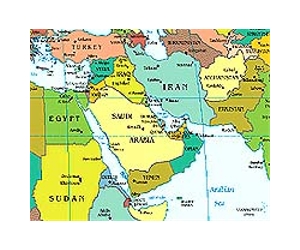
China's first aircraft carrier just completed sea trials, a pointer toward Beijing's growing naval power that's making waves in the Far East that are rippling through the Middle East. There have long been concerns there that China's naval buildup, designed to project the power of the Asian titan as far as Africa, the source of much of its raw materials, is also intended to protect its strategic oil routes in the Arabian Sea and Indian Ocean in a future conflict over shrinking resources. Some 85 percent of China's oil supplies pass through the Indian Ocean, which makes it a vital energy artery for Beijing. India, another major Asian consumer of Middle Eastern energy, is also building up its naval forces in the region and which one day may have to contest China's plans to secure energy routes. Apart from Taiwan, which China considers a breakaway province, Beijing claims the South China Sea and the vast reservoirs of oil and natural gas it is believed to hold. Naval power will be required to enforce those claims, contested by the Philippines, Malaysia, Vietnam, Taiwan and Brunei. The new Chinese carrier launched Aug. 10 is expected to be named the Shi Lang, after the Chinese admiral who conquered Taiwan in the 17th century. It's hardly a fearsome, state-of-the-art weapons platform that will instill fear in China's rivals. The U.S. Navy, for instance, deploys 11 carrier groups. It's a revamped ex-Soviet warship originally named the Varyag whose military clout is questionable and its actual operational deployment may be years away, longer still before the People's Liberation Army's navy will be capable of deploying U.S.-style carrier battle groups. But it's a symbol of China's aspirations to become a global maritime power and protecting its economic lifelines will be one of the new navy's main missions. The Indian Ocean, through which raw materials from Africa also pass en route to China, is fast becoming contested by Beijing and New Delhi as both contend with growing demands for energy. The Indians have been concerned about a series of ports and intelligence stations -- the so-called string of pearls -- the Chinese have built across islands in the vast ocean as well as along the coasts of Myanmar, Sri Lanka and Pakistan. These are expected to extend "along the coast of the Arabian Sea and the Persian Gulf," says military analyst Vivian Yang. "Beijing has been trying to find other sources of energy from around the world but it remains dependent on Middle Eastern oil." Small flotillas of Chinese warships, mainly destroyers and frigates, are fixtures in the Gulf of Aden with international anti-piracy task forces. But they're also learning how to conduct the kind of long-range deployments that would be required for naval operations in the Indian Ocean. A Chinese admiral's recent suggestion Beijing build a naval base in the Gulf of Aden has raised fears in the Middle East that a confrontation between China and India is looming along vital energy export routes. Beijing sought to play down that possibility but, like India, its main Asian economic rival, China will continue to be reliant on Middle Eastern oil in the future as supplies dwindle. Inevitably, Chinese naval operations will increasingly encroach on Middle Eastern and African waters as Beijing seeks to protect the economic arteries on which it is becoming increasingly dependent. The construction of a $1 billion container port at Hambantota, until recently a fishing hamlet on Sri Lanka's southeastern coast, illustrates how the Chinese thrust into the Indian Ocean is becoming more pronounced. The deep-water port will include a development zone and an oil refinery. Over the last few years, the Chinese have built a similar port at Gwadar on Pakistan's Arabian Sea coast, which will eventually be the terminal for a pipelines carrying Persian Gulf crude and natural gas to western China. Another is planned at Chittagong in Bangladesh. These could become bases for China's growing submarine fleet, a potential threat to the shipping lanes running east from the Persian Gulf. Beijing says it has no interest in establishing major foreign bases. But it will inevitably need them to project its growing power, which includes at least two more aircraft carriers.
Related Links Powering The World in the 21st Century at Energy-Daily.com
|
|
|
| The content herein, unless otherwise known to be public domain, are Copyright 1995-2014 - Space Media Network. AFP, UPI and IANS news wire stories are copyright Agence France-Presse, United Press International and Indo-Asia News Service. ESA Portal Reports are copyright European Space Agency. All NASA sourced material is public domain. Additional copyrights may apply in whole or part to other bona fide parties. Advertising does not imply endorsement,agreement or approval of any opinions, statements or information provided by Space Media Network on any Web page published or hosted by Space Media Network. Privacy Statement |
 del.icio.us
 Digg
Digg Reddit
 Google