


|
|
|
|
|
|
|
|
|
|
|


| . |  |
. |
|
|
|
 by Staff Writers Pasadena CA (SPX) Oct 07, 2008
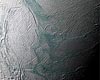
As major league baseball readies for the World Series, NASA's Cassini team will come to bat twice this month when the spacecraft flies by Saturn's geyser moon, Enceladus. The Oct. 9 flyby is an inside pitch -- the closest flyby yet of any moon of Saturn, at only 25 kilometers (16 miles) from the surface. The Oct. 31 flyby is farther out, at 196 kilometers (122 miles). Scientists are intrigued by the possibility that liquid water, perhaps even an ocean, may exist beneath the surface of Enceladus. Trace amounts of organics have also been detected, raising tantalizing possibilities about the moon's habitability. While Cassini's cameras and other optical instruments were the focus of an Aug. 11 flyby, during Cassini's Oct. 9 flyby, the spacecraft's fields and particles instruments will venture deeper into the plume than ever before, directly sampling the particles and gases. The emphasis here is on the composition of the plume rather than imaging the surface. "We know that Enceladus produces a few hundred kilograms per second of gas and dust and that this material is mainly water vapor and water ice," said Tamas Gambosi, Cassini scientist at the University of Michigan, Ann Arbor. "The water vapor and the evaporation from the ice grains contribute most of the mass found in Saturn's magnetosphere. "One of the overarching scientific puzzles we are trying to understand is what happens to the gas and dust released from Enceladus, including how some of the gas is transformed to ionized plasma and is disseminated throughout the magnetosphere," said Gambosi. On Oct. 31, the cameras and other optical remote sensing instruments will be front and center, imaging the fractures that slash across the moon's south polar region like stripes on a tiger. These two flybys might augment findings from the most recent Enceladus flyby, which hint at possible changes associated with the icy moon. Cassini's Aug. 11 encounter with Enceladus showed temperatures over one of the tiger-stripe fractures were lower than those measured in earlier flybys. The fracture, called Damascus Sulcus, was about 160 to 167 Kelvin (minus 171 to minus 159 degrees Fahrenheit), below the 180 Kelvin (minus 136 degrees Fahrenheit) reported from a flyby in March of this year. "We don't know yet if this is due to a real cooling of this tiger stripe, or to the fact that we were looking much closer, at a relatively small area, and might have missed the warmest spot," said John Spencer, Cassini scientist on the composite infrared spectrometer, at the Southwest Research Institute, Boulder, Colo. Results from Cassini's magnetometer instrument during the August flyby suggest a difference in the intensity of the plume compared to earlier encounters. Information from the next two flybys will help scientists understand these observations. Four more Enceladus flybys are planned in the next two years, bringing the total number to seven during Cassini's extended mission, called the Cassini Equinox Mission. The next Enceladus doubleheader will be November 2 and 21, 2009. The Enceladus geysers were discovered by Cassini in 2005. Since then, scientists have been intrigued about what powers them, because the moon is so tiny, roughly the width of Arizona at only 500 kilometers (310 miles) in diameter. "The October doubleheader gives Cassini two more opportunities to hit the ball out of the park," said Bob Pappalardo, Cassini project scientist at NASA's Jet Propulsion Laboratory, Pasadena, Calif. "With high scores in geology, surface heat, watery plumes and magnetospheric effects, Enceladus could win the 'world championship' title this year!" Scientists anticipate reporting results from the two flybys in November and early December.
related report "This encounter will potentially have far-reaching implications for understanding how the solar system was formed and how it evolved," said professor Tamas Gombosi, chair of the University of Michigan Department of Atmospheric, Oceanic and Space Sciences. Gombosi is the interdisciplinary scientist for magnetosphere and plasma science on the Cassini mission. His role is to coordinate studies that involve multiple plasma instruments on the spacecraft. Enceladus is Saturn's sixth-largest moon, orbiting within the planet's outermost ring. It is approximately 313 miles in diameter. In this flyby, Cassini will be close enough to Enceladus to identify individual molecules in the moon's space environment, including ions and isotopes. An ion is a charged particle, or a version of an element that has lost or gained negatively charged electrons. An isotope is a version of an element that has in its nucleus the typical protons for that element, but a different number of neutrons, thus exhibiting a different atomic weight. The atoms around Enceladus are expected to hold clues to the past because they come from interior regions that have changed little since the moon was formed. Geysers near the moon's south pole spew water and other molecules from the satellite's interior. Because of Enceladus' weak gravity and low atmospheric pressure, the water and gas molecules waft off to space. The encounter will contribute to scientists' understanding of how particles become charged and energized in Saturn's magnetosphere. Also, when Cassini identifies the different isotopes in the space around the moon, it will help scientists discern the temperatures at various stages in Enceladus' formation eons ago. Cassini discovered the geysers on Enceladus in 2005. Scientists believe that there could be a liquid ocean beneath the moon's surface. They also detected organic molecules at the moon in March. Organic molecules have carbon-hydrogen bonds, and are found in living organisms, and in comets. "The mission as a whole is expected to bring central pieces of the solar system evolution puzzle into place," Gombosi said. "This encounter is expected to provide some of those puzzle pieces." This will be Cassini's fifth encounter with Enceladus. A sixth encounter, during which it will approach within 122 miles of the moon, is scheduled for Oct. 31. Four more flybys are planned in the next two years of Cassini's extended mission, the Cassini Equinox Mission.
Related Links Cassini mission Explore The Ring World of Saturn and her moons Jupiter and its Moons The million outer planets of a star called Sol News Flash at Mercury
|
|
|
| The content herein, unless otherwise known to be public domain, are Copyright 1995-2014 - Space Media Network. AFP, UPI and IANS news wire stories are copyright Agence France-Presse, United Press International and Indo-Asia News Service. ESA Portal Reports are copyright European Space Agency. All NASA sourced material is public domain. Additional copyrights may apply in whole or part to other bona fide parties. Advertising does not imply endorsement,agreement or approval of any opinions, statements or information provided by Space Media Network on any Web page published or hosted by Space Media Network. Privacy Statement |
 del.icio.us
 Digg
Digg Reddit
 Google