



|
|
|
|
|
|
|
|
|
|
|


| . |  |
. |
|
|
|
 by Staff Writers Pasadena CA (SPX) Aug 13, 2008
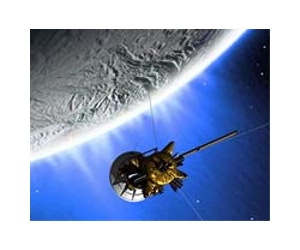
Shorty after 9:03 p.m. Pacific Time, the Cassini spacecraft began sending data to Earth following a close flyby of Saturn's moon Enceladus. During closest approach, Cassini successfully passed only 50 kilometers (30 miles) from the surface of the tiny moon. Cassini's signal was picked up by the Deep Space Network station in Canberra, Australia, and relayed to the Cassini mission control at NASA's Jet Propulsion Laboratory in Pasadena, Calif. "We are happy to report that Cassini's begun sending data home," said Julie Webster, Cassini team chief at JPL. "The downlink will continue through the night and into tomorrow morning." Closest approach occurred at approximately 3:21 p.m. PDT, while Cassini was traveling at a swift 17.7 kilometers per second (40,000 miles per hour) relative to Enceladus. During the flyby, Cassini focused its cameras and other remote sensing instruments on Enceladus with an emphasis on the moon's south pole where parallel stripes or fissures dubbed "tiger stripes" line the region. That area is of particular interest because geysers of water-ice and vapor jet out of the fissures and supply material to Saturn's E-ring. Scientists hope to learn more about the fissures and whether liquid water is indeed the engine powering the geysers. "There is a lot of anticipation and excitement about what the flyby might reveal" said Bob Pappalardo, Cassini project scientist, also of JPL. "Over the next few days and weeks, the Cassini teams will be analyzing the photos and other data to tease out new clues about this tiny, active world." Two more Enceladus flybys are planned for October. The first of those will cut Monday's flyby distance in half and bring the spacecraft to a remarkable 25 kilometers (16 miles) from the surface. Enceladus measures about 500 kilometers (310 miles) in diameter--just one-seventh the diameter of Earth's moon.
Related Links Cassini-Huygens mission Explore The Ring World of Saturn and her moons Jupiter and its Moons The million outer planets of a star called Sol News Flash at Mercury
|
|
|
| The content herein, unless otherwise known to be public domain, are Copyright 1995-2014 - Space Media Network. AFP, UPI and IANS news wire stories are copyright Agence France-Presse, United Press International and Indo-Asia News Service. ESA Portal Reports are copyright European Space Agency. All NASA sourced material is public domain. Additional copyrights may apply in whole or part to other bona fide parties. Advertising does not imply endorsement,agreement or approval of any opinions, statements or information provided by Space Media Network on any Web page published or hosted by Space Media Network. Privacy Statement |
 del.icio.us
 Digg
Digg Reddit
 Google