



|
|
|
|
|
|
|
|
|
|
|


| . |  |
. |
|
|
|
 by Staff Writers Pittsburgh PA (SPX) Jan 23, 2009
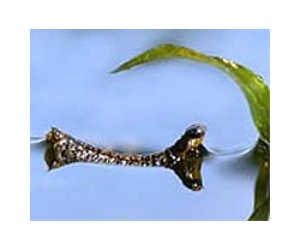
Inspired by the aquatic wriggling of beetle larvae, a University of Pittsburgh research team has designed a propulsion system that strips away paddles, sails, and motors and harnesses the energy within the water's surface. The technique destabilizes the surface tension surrounding the object with an electric pulse and causes the craft to move via the surface's natural pull. The researchers will present their findings Jan. 26 at the Institute of Electrical and Electronics Engineers' 2009 Micro Electro Mechanical Systems (MEMS) conference in Sorrento, Italy. This method of propulsion would be an efficient and low-maintenance mechanism for small robots and boats that monitor water quality in oceans, reservoirs, and other bodies of water, said Sung Kwon Cho, senior researcher and a professor of mechanical engineering and materials science in Pitt's Swanson School of Engineering. These devices are typically propeller-driven. The Pitt system has no moving parts and the low-energy electrode that emits the pulse could be powered by batteries, radio waves, or solar power, Cho added. Cho envisioned the system after reading about the way beetle larvae move on water, he said. Like any floating object, larva resting in the water causes the surface tension to pull equally on both sides. To move forward, the larva bends its back downward to change the tension direction behind it. The forward tension then pulls the larva through the water. Cho and his team-Pitt engineering doctoral students Sang Kug Chung and Kyungjoo Ryu-substituted the larva's back bending with an electric pulse. In their experiments, an electrode attached to a 2-centimeter-long "mini-boat" emitted a surge that changed the rear surface tension direction and propelled the boat at roughly 4 millimeters per second. A second electrode attached to the boat's front side served as the rudder.
Related Links University of Pittsburgh Powering The World in the 21st Century at Energy-Daily.com
|
|
|
| The content herein, unless otherwise known to be public domain, are Copyright 1995-2014 - Space Media Network. AFP, UPI and IANS news wire stories are copyright Agence France-Presse, United Press International and Indo-Asia News Service. ESA Portal Reports are copyright European Space Agency. All NASA sourced material is public domain. Additional copyrights may apply in whole or part to other bona fide parties. Advertising does not imply endorsement,agreement or approval of any opinions, statements or information provided by Space Media Network on any Web page published or hosted by Space Media Network. Privacy Statement |
 del.icio.us
 Digg
Digg Reddit
 Google