



|
|
|
|
|
|
|
|
|
|
|


| . |  |
. |
|
|
|
 by Staff Writers San Marcos TX (SPX) Jul 01, 2008
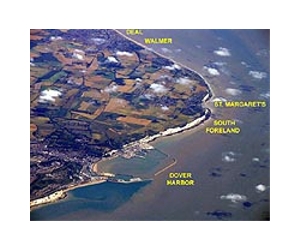
Researchers from Texas State University have revised the date when Julius Caesar invaded Britain in 55 BC, a transformational event in world history. Despite what most history books state, Caesar could not have landed on August 26-27. "The English Channel was flowing the wrong way," says team leader Donald W. Olson, a tide expert. He and fellow professor Russell Doescher, aided by astronomy honors students Kellie Beicker and Amanda Gregory, reached this conclusion during an expedition to England's southern coast last summer. Earlier, Olson had identified August 2007 as rare opportunity to settle the longstanding dispute among history scholars and scientists concerning Caesar's landing. During that month, complex tidal factors involving the Moon and Sun would unfold in a near-perfect replay of those in August of 55 BC. "We realized we could go out in a boat and observe the current for ourselves," Olson explains. "The year 1901 would have been just as good for this experiment, but no one noticed." According to Olson's team, Caesar's invasion fleet must have arrived four days earlier - August 22-23 in 55 BC - to have acquired a suitable northeastward current. The revised date reconciles an ancient record of a "falling tide" with Caesar's own description of the coastline topography as he moved his fleet along the white cliffs of Dover. The Texas researchers present their findings in the August 2008 Sky and Telescope magazine. Invasion Fleet Crosses the Channel When his 100 warships carrying two Roman legions (perhaps 10,000 men) approached the white cliffs, Caesar noticed a multitude of javelin-wielding Celtic warriors lined up along the ridge and decided to look for a better landing spot. He ordered his fleet to move along the coast, and after about seven miles they came to "an open and flat shore." But which way did Caesar turn - left or right - and when did he actually set foot on British soil? For centuries, these two questions have vexed not only historians, but the residents of coastal towns vying for the claim of "Caesar was here." Caesar mentioned unexpectedly strong tides, a full Moon, and an ocean current that changed direction in mid-afternoon. These clues even led famous astronomers Edmond Halley and George Airy to weigh in - but they disagreed with each other's conclusions. The debate about the date and place of Caesar's landing has raged ever since. The Texas team's revised date, August 22-23, gives Caesar the ocean current he needed to maneuver right, proceed seven miles, and land with a falling tide near present-day Deal. That's the beach preferred by most historians but rejected by tide experts in the past. What's more, a modified reading of Caesar's reference to the "night of a full Moon" also leads to the August 22-23 date. "The scientists were right about the tidal streams," Olson says, "and so were the historians about the landing site. With our new result and our new date, everything is reconciled." "I had a blast watching these guys in action," says Sky and Telescope Senior Editor Roger Sinnott, who joined the Texas State expedition last summer. "One day they were using GPS to measure their small boat's drift off Dover harbor, and on another they were tossing apples from the end of the long Deal pier to see which way the current went." Sinnott has been Olson's editor on two dozen past projects for Sky and Telescope since 1987. The Texas researchers have also studied paintings of night scenes by Van Gogh and Munch, dated photographs of the Moon by Ansel Adams, and interpreted cryptic lines in a Shakespearean play. Closely related to their work on Caesar is their earlier research on how the Moon and tides affected the World War II amphibious landings on the Pacific atoll of Tarawa and in Normandy on D-day. Caesar's historic landing in 55 BC was the Roman Empire's first excursion north of France, literally to the fringe of the then-known world. When he crossed the English Channel again the following summer with a 10-times-larger fleet, it was very much like a D-day in reverse. In their Sky and Telescope article, the Texas State researchers think they've resolved an age-old debate: When and where did Caesar first land in Britain?
Related Links Texas State University Astronomy News from Skynightly.com
|
|
|
| The content herein, unless otherwise known to be public domain, are Copyright 1995-2014 - Space Media Network. AFP, UPI and IANS news wire stories are copyright Agence France-Presse, United Press International and Indo-Asia News Service. ESA Portal Reports are copyright European Space Agency. All NASA sourced material is public domain. Additional copyrights may apply in whole or part to other bona fide parties. Advertising does not imply endorsement,agreement or approval of any opinions, statements or information provided by Space Media Network on any Web page published or hosted by Space Media Network. Privacy Statement |
 del.icio.us
 Digg
Digg Reddit
 Google