



|
|
|
|
|
|
|
|
|
|
|


| . |  |
. |
|
|
|
 by Staff Writers Cambridge MD (SPX) Mar 15, 2010
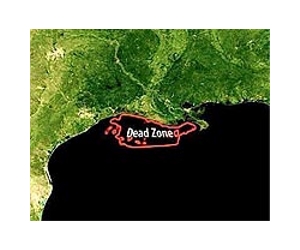
The increased frequency and intensity of oxygen-deprived "dead zones" along the world's coasts can negatively impact environmental conditions in far more than just local waters. In the March 12 edition of the journal Science, University of Maryland Center for Environmental Science oceanographer Dr. Lou Codispoti explains that the increased amount of nitrous oxide (N2O) produced in low-oxygen (hypoxic) waters can elevate concentrations in the atmosphere, further exacerbating the impacts of global warming and contributing to ozone "holes" that cause an increase in our exposure to harmful UV radiation. "As the volume of hypoxic waters move towards the sea surface and expands along our coasts, their ability to produce the greenhouse gas nitrous oxide increases," explains Dr. Codispoti of the UMCES Horn Point Laboratory. "With low-oxygen waters currently producing about half of the ocean's net nitrous oxide, we could see an additional significant atmospheric increase if these 'dead zones' continue to expand." Although present in minute concentrations in Earth's atmosphere, nitrous oxide is a highly potent greenhouse gas and is becoming a key factor in stratospheric ozone destruction. For the past 400,000 years, changes in atmospheric N2O appear to have roughly paralleled changes in carbon dioxide CO2 and have had modest impacts on climate, but this may change. Just as human activities may be causing an unprecedented rise in the terrestrial N2O sources, marine N2O production may also rise substantially as a result of nutrient pollution, warming waters and ocean acidification. Because the marine environment is a net producer of N2O, much of this production will be lost to the atmosphere, thus further intensifying its climatic impact. Increased N2O production occurs as dissolved oxygen levels decline. Under well-oxygenated conditions, microbes produce N2O at low rates. But at oxygen concentrations decrease to hypoxic levels, these waters can increase their production of N2O. N2O production rates are particularly high in shallow suboxic and hypoxic waters because respiration and biological turnover rates are higher near the sunlit waters where phytoplankton produce the fuel for respiration. When suboxic waters (oxygen essentially absent) occur at depths of less than 300 feet, the combination of high respiration rates, and the peculiarities of a process called denitrification can cause N2O production rates to be 10,000 times higher than the average for the open ocean. The future of marine N2O production depends critically on what will happen to the roughly ten percent of the ocean volume that is hypoxic and suboxic. "Nitrous oxide data from many coastal zones that contain low oxygen waters are sparse, including Chesapeake Bay," said Dr. Codispoti. "We should intensify our observations of the relationship between low oxygen concentrations and nitrous oxide in coastal waters." The article "Interesting Times for Nitrous Oxide" appears in the March 12, 2010 edition of the journal Science. The University of Maryland Center for Environmental Science is the University System of Maryland's environmental research institution. UMCES researchers are helping improve our scientific understanding of Maryland, the region and the world through its three laboratories - Chesapeake Biological Laboratory in Solomons, Appalachian Laboratory in Frostburg, and Horn Point Laboratory in Cambridge - and the Maryland Sea Grant College.
Related Links University of Maryland Center for Environmental Science Water News - Science, Technology and Politics
|
|
|
| The content herein, unless otherwise known to be public domain, are Copyright 1995-2014 - Space Media Network. AFP, UPI and IANS news wire stories are copyright Agence France-Presse, United Press International and Indo-Asia News Service. ESA Portal Reports are copyright European Space Agency. All NASA sourced material is public domain. Additional copyrights may apply in whole or part to other bona fide parties. Advertising does not imply endorsement,agreement or approval of any opinions, statements or information provided by Space Media Network on any Web page published or hosted by Space Media Network. Privacy Statement |
 del.icio.us
 Digg
Digg Reddit
 Google