



|
|
|
|
|
|
|
|
|
|
|


| . |  |
. |
|
|
|
 by Staff Writers Washington (AFP) Jan 27, 2011
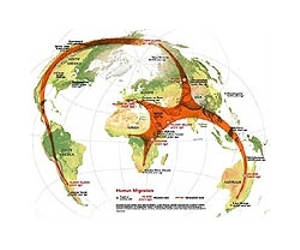
An ancient toolkit unearthed in the United Arab Emirates suggests modern humans may have left Africa over 100,000 years ago, much earlier than typically thought, researchers said Thursday. The findings by a team of British and German archeologists have sparked debate among scientists over whether they provide sufficient evidence that homo sapiens could have traveled directly from Africa to Arabia. The stone tools found in the archaeological site at Jebel Faya include basic hand axes, blades and scrapers, indicating that the user likely had a primitive level of skill, said the study published in the journal Science. That would "imply that technological innovation was not necessary for early humans to migrate onto the Arabian Peninsula," it said. The team also examined climate and sea-level records for the region dating back 130,000 years and found that low sea levels meant the Bab al-Mandab strait that separates the Horn of Africa from the Arabian Peninsula would have been narrower and easier to cross. Unlike the harsh desert conditions of today, the land would have been wetter and filled with more vegetation, lakes and rivers, making a journey by foot more feasible for early humans. Using a technique called luminescence dating to determine the age of the toolkit, scientists believe it is between 100,000 and 125,000 years old, according to lead author Simon Armitage from Royal Holloway college, University of London. Most other evidence has suggested modern humans left Africa around 60,000 years ago and made the trek along the Mediterranean Sea or the Arabian Coast, but some finds in recent years have suggested otherwise. The journal Science noted that some early homo sapien skulls and tools have also been found in Israel and scientists have been able to estimate their age at 100,000 to 130,000 years old. "At Jebel Faya, the ages reveal a fascinating picture in which modern humans migrated out of Africa much earlier than previously thought, helped by global fluctuations in sea-level and climate change in the Arabian Peninsula," said Armitage. The site, located about an hour's drive from the city of Sharjah, is marked by a rock shelter at the edge of a mountain. Previous artifacts uncovered in the area have been dated to the Iron, Bronze, and Neolithic periods as well as the Middle Paleolithic era, some 300,000 to 30,000 years ago. But not all experts are convinced that the toolkit is what the authors believe it is. "I'm totally unpersuaded," said archaeologist Paul Mellars of the University of Cambridge. "There's not a scrap of evidence here that these were made by modern humans, nor that they came from Africa," he said. "Everything hinges on whether that material is explicitly African and I don't see that." Study co-author Anthony Marks of Southern Methodist University in Dallas, Texas, said the tools were not the kind used by Neanderthals, who were not believed to have been in Arabia at the time. "That makes the African origin likely by process of elimination," he said. The tools do not resemble artifacts found in Israel or tools from the same era in North Africa, suggesting there may have been multiple waves of migration from Africa and that these could have been made by homo sapiens who left East Africa, Marks said. Archaeologist Mark Beech, a visiting fellow at the University of York, praised the paper but added: "One site does not confirm the out of Africa-via-Arabia hypothesis." The international team of researchers was headed by Hans-Peter Uerpmann from Eberhard Karls University in Tubingen, Germany. Uerpmann agreed that more evidence, such as fossil bones, would be necessary "before we can be absolutely sure" the tools were made by homo sapiens.
Related Links All About Human Beings and How We Got To Be Here
|
|
|
| The content herein, unless otherwise known to be public domain, are Copyright 1995-2014 - Space Media Network. AFP, UPI and IANS news wire stories are copyright Agence France-Presse, United Press International and Indo-Asia News Service. ESA Portal Reports are copyright European Space Agency. All NASA sourced material is public domain. Additional copyrights may apply in whole or part to other bona fide parties. Advertising does not imply endorsement,agreement or approval of any opinions, statements or information provided by Space Media Network on any Web page published or hosted by Space Media Network. Privacy Statement |
 del.icio.us
 Digg
Digg Reddit
 Google