


|
|
|
|
|
|
|
|
|
|
|


| . |  |
. |
|
|
|
 by John C.K. Daly Washington (UPI) Feb 25, 2009
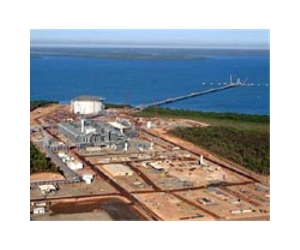
As the world lurches deeper into recession, the energy markets, especially oil, have been hit by falling prices. As the world retools for a more austere 21st century, one energy source that will continue to rise in prominence is natural gas. For the first time, Russia, currently the world's leading producer of natural gas, is now poised to enter the liquefied natural gas market, opening an LNG facility in Sakhalin. For Europeans worried about Russia's reliability as an exporter following its pricing dispute with Ukraine earlier this year, the good news is that its first project is directed at the Asian market. The primary shortcoming for consumers of natural gas is that the vast majority of it is currently shipped by pipelines. LNG, primarily methane, is produced by compressing and cooling it to minus 260 degrees Fahrenheit, converting it to liquid form, which takes up about 1/600th the volume of natural gas. The LNG is then loaded into special cryogenic tankers, which can transport it anywhere in the world. Upon arrival at an LNG port facility, it is re-gasified and distributed as pipeline natural gas. What has slowed the construction of LNG facilities worldwide are the immense start-up costs. An LNG plant costs at least $1.5 billion per 1 million metric tons annual capacity, while receiving terminals cost $1 billion per 30 million cubic meters daily throughput capacity, while LNG tankers run nearly triple the cost of conventional tankers built for carrying crude. According to the U.S. government's Energy Information Administration, almost three-quarters of the world's natural gas reserves are located in the Middle East and Eurasia, with Russia, Iran and Qatar together accounting for about 57 percent of the world's natural gas reserves and Russia alone accounting for 27.2 percent of the world total. The Soviet Union did not have LNG technology, and the Russian Federation, in order to develop its LNG potential, was forced to enter into consortiums with Western energy firms. In the case of Sakhalin-2, Gazprom relied on Shell's technical expertise to complete the $22 billion project. The consortium developing the Sakhalin-2 project and its attendant LNG facility currently includes Gazprom with 50 percent plus one share, Royal Dutch Shell as project operator with 27.5 percent, and Mitsui and Mitsubishi with 12.5 percent and 10 percent, respectively. The consortium will be busy for some time, as Sakhalin-2 gas reserves are estimated at up to 2 trillion cubic meters, along with crude oil reserves estimated at up to 150 million tons. The project represents one of the most massive energy infrastructures in Asia. On Feb. 18 Russia's first LNG plant was inaugurated at Prigorodnoe near the city of Yuzhno-Sakhalinsk on Sakhalin Island in the Sea of Okhotsk. Marking the high-profile visibility of the occasion, President Dmitry Medvedev was joined at the opening ceremonies by Britain's Prince Andrew, Netherlands Economic Affairs Minister Maria van der Hoeven, Japanese Prime Minister Taro Aso, Gazprom Chairman Alexei Miller, Royal Dutch Shell CEO Jeroen van der Veer, Mitsui President and CEO Shoei Utsuda and Mitsubishi President and CEO Yorihiko Kojima. The Sakhalin liquefaction facility will process gas from the Sakhalin-2 offshore fields in the Sea of Okhotsk. The Prigorodnoe facility, which has been under construction for six years, includes two 100,000-cubic-meter LNG processing trains, a loading pier, laboratory, control center and storage tanks, with the first LNG shipment scheduled for March. With the new facility, Russia is poised to enter the East Asian market, with Japan, China and South Korea receiving the majority of the plant's 9.6 million ton annual capacity. The facility represents a significant shift in Russian energy exports, as up to now, Russian oil and gas were sold mainly to Europe. Russia's exports to Asian energy markets are currently about 4 percent, a figure that Russian analysts believe could rise to 21 percent to 32 percent by 2030. The Sakhalin liquefaction plant, scheduled to operate at full capacity beginning next year, will have an immediate impact on the global energy market, as it is expected to produce 5 percent of the world's annual LNG supply. Japan currently imports almost 40 percent of the world's LNG, and the additional imports from Sakhalin will help diversify Japan's LNG sources, nearly all of which currently are in the Persian Gulf. It will take three to four days to ship LNG from Sakhalin to Japan, in contrast to the three weeks LNG shipments take to arrive from the Middle East. Japan will import about 5 million tons of LNG annually from Sakhalin-2, which will account for 7 percent of Japan's total LNG imports. Not that the consortium's path has been a smooth one. In yet another example of Kremlin energy politics that so unsettle Western investors, in late 2006 Gazprom wrested control of the huge oil and gas field from Shell after it was accused of breaking environmental laws, following which Gazprom became the majority owner. In a sign of displeasure, the European Bank for Reconstruction and Development subsequently withdrew its support for the Sakhalin-2 project, stating it no longer could consider the project because of the "new shareholder structure and because the majority shareholder has changed." Buoyed by the success of the LNG project, Gazprom Deputy Chief Executive Alexander Medvedev stated some of the consortium partners were interested in further cooperation on Russian LNG projects, telling journalists, "Gazprom is performing a pre-feasibility study for the Yamal LNG (liquefied natural gas) project, and we have taken the interests of all those present, including Shell, Mitsui and Mitsubishi, in participating in this project into account." For those wondering what the political subtext of Russia's entering the Japanese energy market might be, observers noted that Aso and Medvedev held meetings on the sideline of the dedication ceremonies to discuss diplomatic efforts needed to resolve the longstanding territorial dispute between Japan and Russia over four islands off Hokkaido, known in Tokyo as the Northern Territories and in Moscow as the Kuril Islands. Medvedev called for "a new, innovative and non-conventional approach" to tackling the issue, but lingering and intense Japanese feelings over the seized islands have precluded Japan and Russia from signing a peace treaty ending World War II. One can only wonder, then, what Aso thought as he listened to his Russian counterpart, as Japan from 1905 to 1945 controlled southern Sakhalin and is now forced to buy natural gas from an island it once controlled. Not perhaps the best environment for discussing "new" approaches to territorial disputes.
Related Links Powering The World in the 21st Century at Energy-Daily.com
|
|
|
| The content herein, unless otherwise known to be public domain, are Copyright 1995-2014 - Space Media Network. AFP, UPI and IANS news wire stories are copyright Agence France-Presse, United Press International and Indo-Asia News Service. ESA Portal Reports are copyright European Space Agency. All NASA sourced material is public domain. Additional copyrights may apply in whole or part to other bona fide parties. Advertising does not imply endorsement,agreement or approval of any opinions, statements or information provided by Space Media Network on any Web page published or hosted by Space Media Network. Privacy Statement |
 del.icio.us
 Digg
Digg Reddit
 Google