



|
|
|
|
|
|
|
|
|
|
|


| . |  |
. |
|
|
|
 by Rosalie Westenskow Chicago (UPI) May 2, 2008
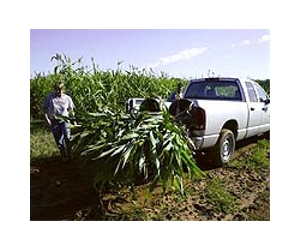
As oil prices rise and food-based ethanol appears increasingly unsustainable, companies are scrambling to find new energy crops for the next generation of biofuels. The development of feedstocks to replace corn is crucial for wide-scale biofuels production, said Steve Koonin, chief scientist for BP, a global petroleum company. "If you used all the corn in the world and converted it with 100 percent efficiency to biofuels �� you might be able to (replace) 15 percent of transport fuels," Koonin said at the World Congress on Industrial Biotechnology and Bioprocessing, held this week in Chicago. "(But) if you want carbon beyond petroleum, you're either going to dig it out of the ground as coal or get it from biomass, and that, I think, is a powerful argument for biofuels." So how can these two conflicting needs -- fuel and food -- be reconciled? With crops specifically designed for fuel production, according to Koonin and others. These "dedicated energy" crops are just emerging on the marketplace, with many still in development stages. This week the chief executive officer of California-based energy company Ceres Inc. announced the release of the first line of commercially available energy crops under the trade name Blade. "Blade will be the first multi-crop seed brand supplying the new market for non-food, low-carbon biofuels feedstocks," Richard Hamilton, Ceres CEO, said Tuesday at the Biotechnology World Congress. Energy crops hold potential as feedstock alternatives because of their ability to increase yields, both in tons of biomass per acre and gallons of fuel per ton of biomass. "From both an economic and environmental perspective, if we are going to turn plant matter into fuel, we should use feedstocks that give us the maximum fuel yield per acre," Hamilton said. Crops like the Blade varieties are engineered specifically for biofuels purposes through genomics-based breeding, wherein scientists manipulate the organisms by selecting and breeding for desirable traits. The same techniques have already been used to dramatically raise yields in food crops by increasing drought and pest resistance, among other things. Many varieties are offered through the Blade brand, mostly sorghum and switchgrass plants. The crops purportedly use less water and can be grown on marginal land. Ceres expects to sell the new varieties to farmers, many of whom hope growing the crops will attract a biofuels plant to their area, thus guaranteeing a steady buyer for their goods. Biorefineries themselves represent the other potential customer, as a number of companies are currently building pilot plants, with the help of grants from the Department of Energy, to produce fuel from non-food sources, called cellulosic ethanol. In order for these new biorefineries, expected to be fully operating by 2012, to produce cellulosic ethanol, they need a steady supply of feedstock. That means dedicated energy crops need to go into the ground soon, said Gary Koppenjan, Ceres corporate communications manager. "One of the things about perennial crops is that you need one to two years to get them established before you can use them for feedstocks," Koppenjan told United Press International. "So if you want to have a biorefinery established in 2011, you need to get crops planted as soon as possible." Other companies are also working to release energy crops in the next couple years, including Targeted Growth Inc., a Seattle-based company. Company scientists have discovered a method of increasing the biomass, and, as a result, fuel potential, of crops by blocking the gene in plants that stops cell divisions, said CEO Thomas Todaro. "There's clear evidence �� that just by inhibiting that gene, we're able to get dramatic yield increases," Todaro said. The company has a number of products in the early stages, including a corn variety that grows 8 or 9 feet tall, with much higher yields per acre. "The idea is that we can bring a high-sugar crop to the Midwest and solve the food versus fuel debate by putting three to four times as many ethanol-producing crops on each acre," Todaro said. But the ultimate goal should be to transition away from traditional agricultural lands, said Gerald Bange, chairman of the U.S. Department of Agriculture's World Agricultural Outlook Board. "There's a lot of things one would have to consider on this, but the hope is that cellulosic ethanol will come from land not currently being used for crops," Bange told UPI. Other Targeted Growth products, such as a plant called camelina, could be used for marginal lands, such as dry areas of Texas or California. U.S. companies aren't the only ones looking at cultivating crops on non-agricultural lands. The Indian government has begun an initiative to grow jatropha, a hardy plant that has high potential as a feedstock for cellulosic ethanol, said Ashok Dhawan of CCS Haryana Agricultural University in Hisar, India. "We have 100 million hectares (247 million acres) of wastelands in India," Dhawan said. "The mission of the government of India is to convert our wastelands into oilfields through jatropha."
Related Links Farming Today - Suppliers and Technology
|
|
|
| The content herein, unless otherwise known to be public domain, are Copyright 1995-2014 - Space Media Network. AFP, UPI and IANS news wire stories are copyright Agence France-Presse, United Press International and Indo-Asia News Service. ESA Portal Reports are copyright European Space Agency. All NASA sourced material is public domain. Additional copyrights may apply in whole or part to other bona fide parties. Advertising does not imply endorsement,agreement or approval of any opinions, statements or information provided by Space Media Network on any Web page published or hosted by Space Media Network. Privacy Statement |
 del.icio.us
 Digg
Digg Reddit
 Google