


|
|
|
|
|
|
|
|
|
|
|


| . |  |
. |
|
|
|
 by John C.K. Daly Washington, April 10, 2008
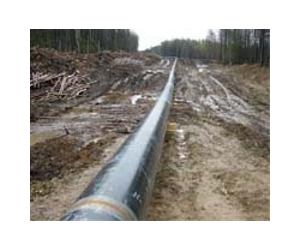
The Russian Federation's vast geography has made the issue of supplying the lucrative eastern Asian markets problematic, but that is about to change as Russia has undertaken a massive pipeline project to supply crude to Asian markets. Russia's Soviet-era pipeline network was designed to bring western Siberian crude westward to the Soviet Union's industrial heartland. Since independence, Russia primarily exported via its Baltic and Black Sea ports, a Eurasian landmass away from Japan and China. But Russia, along with developing its Arctic ports, is now looking at Asian markets. Pipelines in Russia remain a government monopoly under Transenft and politics surrounding potential pipelines to China are touchy, as former Yukos Chairman Mikhail Khodorkovsky found out in 2003 when he proposed building a private pipeline to China. Khodorkovsky was arrested in October 2003 and given a nine-year prison sentence in Siberia. Now, however, Moscow has seen the value of Khodorkovsky's vision, and the Eastern Siberia-Pacific (VSTO) oil pipeline is under way. Once complete, it is projected to have an annual capacity of 80 million tons by 2014-15. The 2,958-mile pipeline, from Taishet to the Pacific Ocean, will be the world's largest. The project's benefits extend far beyond fiscal value. VSTO "has a tremendous geostrategic significance for Russia," says Sergei Sergeyev, VSTO project director. "Firstly, it's the country's access to one of the largest markets of the Asian-Pacific region. Forecasts show that by the year 2010, Asia-Pacific region countries will be importing more than 1 billion tons of oil a year, and by 2030, 2 billion tons. "Secondly, the commissioning of the oil pipeline will give an opportunity to Russian oil companies to diversity oil supplies, shipping oil both to Europe and Asia. "Thirdly, which is particularly important, the pipeline's running through eastern Siberia and the Far Eat will give a powerful impulse to the socio-economic development of these regions and the development of new hydrocarbon fields." The commissioning of VSTO's first phase has been delayed, and is now scheduled for late next year. The initial phase will provide transport for 30 million tons of oil annually to Skovorodino from eastern Siberia and Yakutia for rail shipment to Priomrye until the second phase, the VSTO-2 Skovorodino-Kosmino pipeline segment, has been built. Sergeyev said Transneft has welded 1,097 miles of pipes and laid 891 miles in VSTO's first phase. VSTO will include significant environmental challenges: In Khabarovsk territory alone, the pipeline will cross nine major rivers, including the Amur. These sections will be made of reinforced three-layer pipes. In an echo not lost on Russian and foreign companies that Khodorkovsky's vision was too "Western," the state-owned Sberbank has been forced over the last 18 months to allocate to Transneft more than $6 billion in loans for construction of the VSTO pipeline, leaving the monopoly with a debt of approximately $5 billion, totaling almost 60 percent of its annual earnings. Nor is the maritime infrastructure being ignored. According to the press service of Nakhodka's administration, 355 acres have been acquired to build an oil port in Kozmino for the VSTO. Construction equipment is expected to be delivered to Nakhodka later this month for work on the $1.7 billion facility. In Moscow, the project's massive costs with the potential for inflation have already produced some friction. At an April 3 government meeting, Prime Minister Viktor Zubkov criticized Ministry of Industry and Energy, blaming its head, Viktor Khristenko, for several shortcomings. Khristenko defended himself by promising to avoid substantial cost overruns though he acknowledged the commissioning deadline for its first phase will be delayed by a year. At a post-meeting news conference, Khristenko attempted to make his case in public: "The size of the country has to be paid for. For such large-scale operations as the East Siberia-Pacific pipeline, we will have to bear in mind that the longer is the oil shipment itinerary the lower should be specific charges of its carriage." Although Russia is keeping a tight control over its energy assets, it looks as if it is no longer invulnerable to the beast of capitalism, inflation. If Khristenko cannot get a handle on cost overruns for VSTO, he might find himself sharing a cell with Khodorkovsky in Siberia. And as Russian Siberian exiles used to say, "The Tsar is in Moscow, and he is far away."
Related Links Powering The World in the 21st Century at Energy-Daily.com
|
|
|
| The content herein, unless otherwise known to be public domain, are Copyright 1995-2014 - Space Media Network. AFP, UPI and IANS news wire stories are copyright Agence France-Presse, United Press International and Indo-Asia News Service. ESA Portal Reports are copyright European Space Agency. All NASA sourced material is public domain. Additional copyrights may apply in whole or part to other bona fide parties. Advertising does not imply endorsement,agreement or approval of any opinions, statements or information provided by Space Media Network on any Web page published or hosted by Space Media Network. Privacy Statement |
 del.icio.us
 Digg
Digg Reddit
 Google