


|
|
|
|
|
|
|
|
|
|
|


| . |  |
. |
|
|
|
 by Rosalie Westenskow Washington DC (UPI) Jul 02, 2008
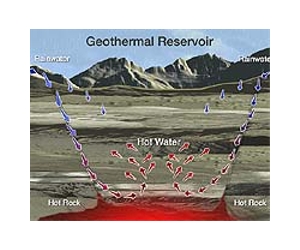
Burdened by a host of energy woes, U.S. government agencies are passing out incentives for a number of renewable energy technologies. Department of Energy officials said Monday the department will provide $30.5 billion in loan guarantees for clean technology, a quick follow-up to an announcement at the end of June that the department will invest $90 million in geothermal technologies. The U.S. Department of Agriculture also recently awarded $1.5 million for energy efficiency projects. The Energy Department's loan-guarantee program is designed to encourage advanced energy projects that avoid, reduce or sequester greenhouse gasses and other air pollutants. Renewable energy or energy efficiency projects, nuclear power plants and nuclear fuel production facilities are all eligible for the program. The loan guarantees will make it possible for a number of companies to finance new nuclear plants that would otherwise be too expensive, said Adrian Heymer, senior director for new plant deployment at the Nuclear Energy Institute, a policy organization that promotes pro-nuclear legislation. "It lowers the overall cost of the project, eases the financing, reduces your risk and enables projects to go forward," Heymer told United Press International. The program doesn't actually supply loans but will make it easier for companies to secure them from others by assuring Wall Street the amount will be repaid. If a company were to default on a loan, the federal government would be liable and repay it. Nuclear plants are expensive, running around $7 billion or $8 billion, and most companies are too small to take on such a big project, Heymer said. However, with a loan underwritten by the federal government, the company has a lower initial cost and can get a more favorable debt/equity structure, all of which leads to lower electricity prices in the end, Heymer said. The possibility of a loan guarantee has piqued the interest of a growing number of companies, but the $18.5 billion allotted to nuclear power plants may not be sufficient. "It's not going to cover all the loan guarantees needed for plants that are waiting for approval," Heymer said. The nuclear industry isn't the only one receiving a boost from the Energy Department. Geothermal will also receive a chunk of cash, department officials announced in June, amounting to $90 million over the next four years. The money will go to fund research, development and demonstration of enhanced geothermal systems technology. Recent research in geothermal has raised high hopes for the technology. A study by the Massachusetts Institute of Technology found EGS technologies could produce 100,000 megawatts of power in the United States by 2050 -- 20 percent of current U.S. generating capacity. An advanced form of conventional geothermal power generation, EGS consists of drilling deeps wells into hot rocks, fracturing the rocks and cycling water through the fractures to heat it. The hot water is then used to generate power. Funding for these technologies will help push them beyond an idea and into reality, said David Blackwell, professor of geophysics at Southern Methodist University. "We're at the stage where we need actual tests," he told UPI. "Learning how to run the systems is what's really important right now." As EGS operations come online, costs will come down, said Blackwell, who worked on the MIT study. Right now, EGS-generated electricity would be expensive, Blackwell said, running about 10 to 15 cents per kilowatt-hour. With experience, though, Blackwell said he projects it will fall to 6 or 8 cents per kwh, a price that's more comparable with that of coal-generated electricity. These technologies are already being proven in Europe and Australia, where a number of demonstration projects are under way, said Ron DiPippo, professor emeritus of mechanical engineering at the University of Massachusetts Dartmouth. "Within the next year we're probably going to see power produced from these types of systems," DiPippo told UPI. The funding program will help jumpstart EGS in the United States by offsetting the cost of drilling deep wells, DiPippo said. "The cost of drilling for EGS is high, probably $5 to $10 million per well," he said. "But EGS is really the breakthrough technology that will expand geothermal to be a key player." Some farmers and small rural businesses also received a piece of the fiscal pie recently, as the USDA's Rural Development Agency handed out $1.5 million in small loans and grants for energy-efficiency projects. The award amounts range from $17,000 to $284,000, and in each case the recipients received half of the award as a loan and half as a grant. The funds will help ease the burden of high energy prices on farmers and rural businesses, said Weldon Freeman, USDA Rural Development spokesperson. "It will help strengthen the bottom line for farmers in rural America," Freemen told UPI. The awards are being used for a variety of projects. James Walter of DeKalb County, Ill., for example, is using his $98,000 award to buy a more efficient grain dryer. The new model will reduce his energy costs by 44 percent.
Related Links Powering The World in the 21st Century at Energy-Daily.com
|
|
|
| The content herein, unless otherwise known to be public domain, are Copyright 1995-2014 - Space Media Network. AFP, UPI and IANS news wire stories are copyright Agence France-Presse, United Press International and Indo-Asia News Service. ESA Portal Reports are copyright European Space Agency. All NASA sourced material is public domain. Additional copyrights may apply in whole or part to other bona fide parties. Advertising does not imply endorsement,agreement or approval of any opinions, statements or information provided by Space Media Network on any Web page published or hosted by Space Media Network. Privacy Statement |
 del.icio.us
 Digg
Digg Reddit
 Google