



|
|
|
|
|
|
|
|
|
|
|


| . |  |
. |
|
|
|
 by Stefan Nicola Berlin (UPI) Oct 27, 2008
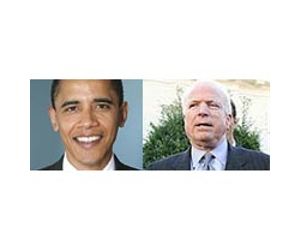
The next U.S. president should turn to Germany as a key ally for solving security issues around the world, according to a group of experts. As the race for the White House draws to a close, analysts are already preparing for the time ahead. No matter who wins the presidency -- Barack Obama or John McCain -- the successor of George W. Bush will have to tackle a number of tough security challenges, ranging from a resurgent Russia, security concerns in Afghanistan and the lingering peace process in the Middle East to global climate change and -- most pressingly -- the financial crisis. On all these issues, Washington should turn to Germany as a potential source of help, a group of experts from the American Institute for Contemporary German Studies at Johns Hopkins University write in a memo addressed to the next U.S. president. "Under your leadership, the American-German partnership must transcend the fraying thread of gratitude and rather re-establish itself as a strategy to address the challenges of the world with clear standards of success," the memo, called "A new map for American-German relations," reads. "Engaging pivotal allies such as Germany on the challenges at hand will be the key to your successful foreign policy." The memo outlines the above-mentioned security challenges and notes how Germany can be of help; it also outlines potential pitfalls the United States might encounter in engaging with Germany, should the two nations' policies be less congruent. How troubled relations can hamper diplomatic progress was demonstrated shortly after the launch of the Iraq war, when Bush and German Chancellor Gerhard Schroeder were hardly able to talk to each other. Both Obama and McCain have announced they will revive the trans-Atlantic partnership; Obama even traveled to Berlin to give a campaign speech there, with some 200,000 Germans flocking to the Victory Column to see and hear the Democratic presidential candidate. Already, trans-Atlantic relations have improved since Schroeder's successor, Chancellor Angela Merkel, took office in late 2005. Yet the next U.S. administration will open up entirely new ways for diplomacy, experts say. "For the first time in 50 years or so, there is a real opportunity for global governance," Richard Burt, ambassador to Germany from 1985 to 1987, said at the memo's presentation Monday in Berlin. He added that Berlin now needs to become much more active to help Washington tackle a series of crises. "There is a new requirement for European activism," he said. "The Germans -- whether they like it or not -- will probably have to lead the way." Burt is one of the 12 experts who compiled the memo after more than a year of meetings and workshops. The result is an unusually concrete piece of advice that highlights where and how Germany could and should be of help to the next U.S. president. Because of its political and economic weight in Europe, and because it plays a "critically important role in many highly volatile areas of interest to the United States," Germany is an ideal ally, the experts write. In regard to Washington's volatile relations with Russia, for example, the memo advises Washington to: -- Form a high-level working group with Germany and other key European allies to consolidate the West's Russia policy. -- Come up with a coordinated strategy on Russia to avoid a trans-Atlantic rift that may be exploited by Russia to the detriment of the West. -- Support European efforts to consolidate its energy policy with an emphasis on renewable energy and alternative energy sources to decrease European dependence on Russia in the long run. -- Encourage Germany to use its special relationship with Russia in a moderating role. -- Engage Russia, together with Germany, more creatively on issues such as arms control, global health and global warming. Germany also could help in the Israeli-Palestinian conflict because it is perceived as an honest broker in the region; it could, with its long experience in environmental policies, advise Washington on climate protection and renewable energy legislation; and finally, Germany could use its clout as the largest economy in Europe by helping Washington shape a new economic world order to combat the financial crisis, the toughest financial challenge to a U.S. president "in 70 years," said Jackson Janes, head of the American Institute for Contemporary German Studies. In any case, the current diplomatic framework has so radically changed that no U.S. president can go it alone, said John Kornblum, the ambassador to Germany from 1997 to 2001. "The diplomatic blueprints have to be redone," he said. "The old answers and methods won't work anymore."
Related Links Learn about the Superpowers of the 21st Century at SpaceWar.com Learn about nuclear weapons doctrine and defense at SpaceWar.com
|
|
|
| The content herein, unless otherwise known to be public domain, are Copyright 1995-2014 - Space Media Network. AFP, UPI and IANS news wire stories are copyright Agence France-Presse, United Press International and Indo-Asia News Service. ESA Portal Reports are copyright European Space Agency. All NASA sourced material is public domain. Additional copyrights may apply in whole or part to other bona fide parties. Advertising does not imply endorsement,agreement or approval of any opinions, statements or information provided by Space Media Network on any Web page published or hosted by Space Media Network. Privacy Statement |
 del.icio.us
 Digg
Digg Reddit
 Google