



|
|
|
|
|
|
|
|
|
|
|


| . |  |
. |
|
|
|
 by John C.K. Daly Washington (UPI) May 16, 2008
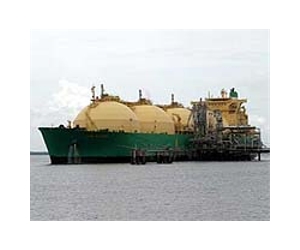
At a time of record-high oil prices, America is increasingly turning to alternative energy sources. One of the most attractive is liquefied natural gas. Of the fossil fuels, it is considered the most environmentally friendly, as it has the lowest CO2 emissions per unit of energy. LNG has two modes of transport -- pipeline or specially designed cryogenic LNG tankers. And therein lies the bad news -- a fully loaded LNG tanker contains latent kinetic energy equivalent to a small nuclear weapon. Coastal communities are reluctant to house LNG facilities, concerned about the safety implications. The most protracted struggle is occurring in Fall River, Mass., where for the last five years the Coalition for Responsible Siting of LNG Facilities, a volunteer grassroots organization, has been battling Weaver's Cove Energy LLC and Amerada Hess's efforts to situate a 200,000 cubic meter LNG storage facility on the Taunton River. The media-savvy coalition has taken its campaign to the Internet via its Web site, nolng.org. Company officials point to the sterling safety record of LNG tankers. Such faith, unfortunately, is naive at best and dangerous at worst. The last century is littered with the catastrophic failure of technological marvels, including RMS Titanic, Challenger and Columbia, and Chernobyl. The Government Accountability Office, hardly an alarmist agency, noted in its report "Maritime Security: Public Safety Consequences of a Liquefied Natural Gas Spill Need Clarification," after reviewing studies examining the potential effect of an LNG spill fire, "Specifically, the studies' conclusions about the distance at which 30 seconds of exposure to the heat (heat hazard) could burn people ranged from less than 1/3 of a mile to about 1-1/4 miles." As an LNG tanker has yet to explode, all such studies remain theoretical. But there are examples of LNG's destructive volatility. In Cleveland in 1944, LNG seeped from a faulty storage tank, which formed a vapor cloud infiltrating surrounding streets and sewers and then ignited, incinerating 128 people and leveling blocks. In January 2004 a boiler exploded at Algeria's Skikda LNG export terminal; when its vapor-cloud ignited, it took eight hours to extinguish and killed 27 people. Furthermore, since Sept. 11, 2001, terrorism has added a new layer of uncertainty to America's maritime energy imports. That day White House counter-terrorism adviser Richard A. Clarke ordered Boston's LNG Everett facility closed over fears of a terrorist attack, later writing in his memoirs, "Had one of the giant tankers blown up in the harbor, it would have wiped out downtown Boston." LNG tankers bound for Weaver's Cove would have to travel up the Taunton River 26 miles from the Atlantic, past hundreds of private jetties and piers. Many in Fall River feel that in advancing its proposal, Weaver's Cove Energy LLC is trying to take advantage of the community's economic situation, as Fall River, like many of New England's former mill towns, has been struggling in the region's post-industrial new world. Last year the tide began to turn, when on Oct. 24 the Coast Guard's Captain of the Port of Southeastern New England Roy Nash called the waterway between Prudence Island and the proposed site of the LNG terminal in Fall River "unsuitable from a navigation safety perspective for the type, size and frequency of LNG marine traffic associated with (the) proposal." This was a significant victory for the opposition because the Federal Energy Regulatory Commission requires that the opinion of the Coast Guard be solicited on proposals for coastal LNG facilities. Weaver's Cove Energy LLC officials are nothing if not persistent, however. Two months ago the company's CEO Gordon Shearer proposed an alternative, building an offshore berth in Rhode Island's Mount Hope Bay for unloading LNG, to be connected to their proposed facility with a 4-mile buried pipeline. Not all were impressed. Rhode Island Attorney General Patrick Lynch bluntly labeled the new scheme "bordering on stunning in its audaciousness, greed and stupidity." Coalition for Responsible Siting of LNG Facilities Chairman Joseph Carvalho was more diplomatic, commenting, "I'm as adamantly opposed to this as I am to their other dog-and-pony shows." On May 2 Weaver's Cove Energy LLC suffered another setback when it lost an appeal over dredging permits for the Taunton River and Mount Hope Bay. A three-judge panel of the U.S. Court of Appeals for the District of Columbia ruled that the company failed to demonstrate harm due to delays in granting the permits. The political machinations surrounding the project may now end careers in Boston as well. In 2006 House Speaker Salvatore F. DiMasi killed legislation introduced by Fall River representatives that would have effectively ended the project by imposing height restrictions on ships passing under state bridges, even though Gov. Mitt Romney said he would sign it if it reached his desk. On May 1 The Boston Globe reported that several months after DiMasi killed the bill, Jay Cashman, the owner of the 73-acre former old-depot site who had purchased the land six years earlier for $2.6 million, sold the property to the terminal developers for $14 million. DiMasi's actions are being scrutinized not only because of his close relationship with Cashman, but also because, in what is undoubtedly mere coincidence, DiMasi's spouse has been involved for at least two years in what DiMasi last week characterized as a "business relationship" with Cashman and his wife. One can only feel nostalgia for the fact that Fall River's most famous former resident, Lizzie Borden, isn't around to cut to the heart of the debate. Meanwhile, Fall River's residents have no desire to be guinea pigs in a test of whether thermal burns from the facility will extend "less than 1/3 of a mile to about 1-1/4 miles" in a new Ground Zero, and who can blame them? The overstretched Coast Guard already has enough to do without guarding a new energy facility that undoubtedly would become a terrorist magnet inflicted on an unwilling community -- unless, of course, Fall River and Massachusetts somehow fall outside the purview of "homeland security."
Related Links Powering The World in the 21st Century at Energy-Daily.com
|
|
|
| The content herein, unless otherwise known to be public domain, are Copyright 1995-2014 - Space Media Network. AFP, UPI and IANS news wire stories are copyright Agence France-Presse, United Press International and Indo-Asia News Service. ESA Portal Reports are copyright European Space Agency. All NASA sourced material is public domain. Additional copyrights may apply in whole or part to other bona fide parties. Advertising does not imply endorsement,agreement or approval of any opinions, statements or information provided by Space Media Network on any Web page published or hosted by Space Media Network. Privacy Statement |
 del.icio.us
 Digg
Digg Reddit
 Google