|
|
|
|
|
|
|
|
|
|
|


| . |  |
. |
|
|
|
 by John C.K. Daly Washington (UPI) Oct 23, 2008
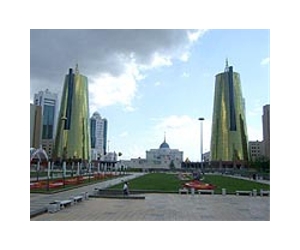
In what Russian Prime Minister Vladimir Putin called "the greatest tragedy of the 20th century," the Soviet Union peaceably imploded in 1991. Now the 15 new nations that emerged from the wreckage are forming bilateral relationships, many of which have two points of commonality -- a desire to avoid undue Russian influence and a desire to avoid Russian energy. As a rough rule of thumb, the farther west one traveled in the former "Evil Empire," the more slight the hydrocarbon resources. Accordingly, while Russia has its vast Siberian reserves and the former Soviet republics of Azerbaijan, Kazakhstan and Turkmenistan have been blessed by Allah with immense energy reserves along and under the Caspian Sea, Moldova, Belarus and the Baltic nations of Estonia, Latvia and Lithuania have very little, a shortage the Kremlin utilizes to play "pipeline politics." The Baltics were long the most restive of the Soviet Union's 15 constituent republics and have no wish, given their tangled history with Moscow, to be beholden to the Kremlin. Accordingly, they have striven to strike energy deals with their former Caspian compatriots, offering, among other things, their high-technology expertise in return. Estonia, Latvia and Lithuania are all members of NATO, a possibility that, since the August military confrontation between Georgia and Russia, remains for the present completely off the table for other former Soviet nations. That said, one of the Baltics' most seductive calling cards to their former Soviet Caspian compatriots is their membership in the European Union, a prosperous 27-member confederation free of the ideological and political baggage of either Russia or China. For Central Asian nations, the EU represents an unmatched cornucopia of markets, funding and high technology. Last year the EU's estimated gross domestic product was $16.4 trillion, an amount equivalent to 31 percent of the world's total economic output. It is potential access to this privileged membership that guarantees Baltic representatives a warm welcome in Central Asia. On Oct. 8 Latvian President Valdis Zatlers, in the first visit of a Latvian chief executive to Turkmenistan, met with Turkmen President Gurbanguly Berdimuhamedov. Increased energy cooperation was high on the agenda. Things went so well that Zatlers invited him to visit Latvia. The two presidents had cause for celebration, as last year Turkmen-Latvian trade was worth a paltry $1.7 million, but it has already exceeded $58 million during the first six months of this year. Now it is the Estonians visiting the shores of the Caspian. On Oct. 17 Estonian Foreign Minister Urmas Paet met in Astana with Kazakh President Nursultan Nazarbayev. Wasting no time, Nazarbayev and Paet discussed energy issues, after which Paet told reporters, "Both sides are interested in the creation of the Trans-Caspian Gas Pipeline and a crude oil pipeline connecting the Caspian and Baltic regions." In a delicately phrased allusion to Russia's dominance of the EU's natural gas market, Paet added that alternative energy sources are needed by both Kazakhstan as an exporter and European nations as importers. Paet did not come empty-handed, however, stating that Tallinn was interested in deepening its economic cooperation with Kazakhstan. "I see information technology and transit to and from Estonian harbors as primary areas of economic cooperation," said Paet. "There are very good opportunities for Kazakhstani goods in Estonian harbors as well." Clearly on a roll, the next day Paet met with Kazakh Prime Minister Karim Massimov and Foreign Minister Marat Tazhin. As the Estonian Ministry of Foreign Affairs press office modestly noted, "Economic matters were the primary topic in the meeting with Prime Minister Karim Massimov." Ever the diplomat, Paet congratulated Nazarbayev on one of Kazakhstan's proudest diplomatic accomplishments, noting that Kazakhstan assuming the presidency of the 56-nation Organization for Security and Cooperation in Europe in 2010 is recognition of Kazakhstan's growing presence in the international arena and will give the nation significant responsibilities and opportunities to shape international development. Presidency of the OSCE, the world's largest intergovernmental organization focusing on security, will not necessarily be an unmixed blessing for Astana, as its mandate includes issues such as arms control, human rights, freedom of the press and fair elections, all topics on which Kazakhstan has been criticized in the past. What is most interesting about Estonia's minuet with Kazakhstan is how it sidesteps many thorny issues surrounding their mutual concerns with Russian sensitivities and fears of isolation. On the issue of military alliances, while Estonia is in NATO, Kazakhstan is affiliated with the organization, as is Russia, through its Partnership for Peace program. Looking eastward, Kazakhstan, along with Russia, is also a founding member of the Shanghai Cooperation Organization. Last but hardly least, all three nations are members of the OSCE, which is concerned overall with Eurasian security issues, providing a neutral platform where all three can discuss issues of mutual concern. Such flexibility is also present in the Estonian-Kazakh energy discussions. While Moscow has made clear its displeasure over proposals for a Trans-Caspian Gas Pipeline, it would be far more amenable to Paet's proposed "crude oil pipeline connecting the Caspian and Baltic regions," as a simple glance at a map makes obvious that the majority of any such pipeline would traverse Russian territory, allowing Russia to collect transit fees. Unlike Russian pipelines crossing Ukraine or Belarus, both of which struggle to pay their energy bills, the Baltics, as the most prosperous of the former Soviet republics, would not suffer from fiscal shortages. Furthermore, such a pipeline, unlike the West's Baku-Tbilisi-Ceyhan pipeline, would include Russia, not exclude it. Accordingly, the growing Estonian-Kazakh nexus, so unlikely from a quick glance at a map, provides tangible rewards for both partners. Unlike BTC, the relationship does not impinge significantly upon Russian interests or pride, something of no small import as some hawkish neocons both east and west strive to revive the Cold War in the midst of global economic turmoil.
Related Links Powering The World in the 21st Century at Energy-Daily.com
|
|
|
| The content herein, unless otherwise known to be public domain, are Copyright 1995-2014 - Space Media Network. AFP, UPI and IANS news wire stories are copyright Agence France-Presse, United Press International and Indo-Asia News Service. ESA Portal Reports are copyright European Space Agency. All NASA sourced material is public domain. Additional copyrights may apply in whole or part to other bona fide parties. Advertising does not imply endorsement,agreement or approval of any opinions, statements or information provided by Space Media Network on any Web page published or hosted by Space Media Network. Privacy Statement |
 del.icio.us
 Digg
Digg Reddit
 Google