


|
|
|
|
|
|
|
|
|
|
|


| . |  |
. |
|
|
|
 by Andrei Chang Hong Kong (UPI) Mar 18, 2009
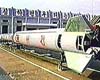
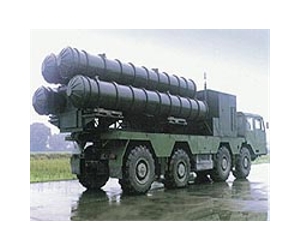
China has put its HQ-9 surface-to-air missile on the export market under the name FD-2000. Brochures advertising China's latest missile appeared at the most recent African Ground Force Equipment Exhibition in Cape Town, South Africa, and also at the International Defense Exhibition in Karachi, Pakistan, last November. The China Precision Machinery Import-Export Corp. is the exporter of the long-range SAM. The name FD-2000 was first revealed by the Kanwa Information Center in 1998 as the export name of the HQ-10; more than 10 years later, China has finally introduced this missile system to the international market. The People's Liberation Army Air Force has already deployed the HQ-9 at its bases in Xi'an and Lanzhou. The HQ-9/FD-2000 unveiled at those exhibitions included its guidance radar. A model of this phased array guidance radar was put on display at the PLA equipment exhibition in Hong Kong last summer. The four-celled HQ-9 launcher is very similar to that of the Russian S-300 SAM. The Chinese introductory brochure said the missile's range for aircraft targets is 7 to 125 kilometers, much lower than the 150-kilometer range of the Russian S-300 PMU1. This is the main reason China continues to import Russia's S-300 PMU2, which has a range of 200 kilometers. The HQ-9/FD-2000's firing altitude is 25 meters to 27 kilometers. The HQ-9's range for missile targets, or air-to-ground missiles, is 7 to 50 kilometers, with a firing altitude of 1 to 18 kilometers. Its range for cruise missiles is 7 to 15 kilometers, at a firing altitude of 25 meters. The range for ballistic missiles is 7 to 25 kilometers at a firing altitude of 2 to 15 kilometers. The HQ-9's guidance system is composed of inertia plus uplink and active radar terminal guidance systems. The manufacturer said that its response time is 15 seconds, and it is capable of dealing with 48 targets simultaneously. The brigade-level combat system is composed of one command vehicle, six control vehicles, six track-radar vehicles, six search-radar vehicles, 48 missile-launch vehicles and 192 rounds of missiles. In addition, there is one positioning vehicle, one communications vehicle, one power supply vehicle and one support vehicle. The composition of the combat system indicates that one HQ-9 battalion is equipped with eight missile-launch vehicles, which is consistent with what satellite photos of the system have shown. One industry source said that China has also developed a new version of the HQ-9/FD-2000 for naval ships, which can be installed on the export versions of combat ships. However, the source did not disclose the firing rate of the HQ-9. A careful comparison of the Chinese FT-2000 anti-radiation missile and the FD-2000 launch system reveals that the transport vehicles of the two missile systems are quite different in exterior structures. Nonetheless, both have 8X8 wheels, and their launch tubes both have 11 reinforcing bands. The FT-2000 has a maximum range of 12 to 100 kilometers, a firing altitude of 3 to 20 kilometers, a missile length of 6.8 meters and a diameter of 466 millimeters. These figures indicate that the FT-2000 and FD-2000 use different types of missiles. At present, only Pakistan is believed to have expressed an interest in purchasing the FT-2000. But according to a source from Islamabad, even Pakistan is not considering importing the missile system at this stage. The FD-2000 may be able to compete with the Russian S-300 PMU SAM, which has only a 90-kilometer range, on the international market because of the lower cost of the China-made missile. But the effective ranges alone show that a substantial technological gap must be overcome before the HQ-9 can replace the S-300 PMU2. Nonetheless, the Chinese designers said that in terms of the technological standard of its computer design and display and control systems, the HQ-9 is superior to the Russian S-300 PMU1. Given the fact that the HQ-9 has already been approved for export sales, there is a possibility that China has upgraded the missile system on the foundation of the original, bringing it closer to the standard of its Russian competitor. (Andrei Chang is editor in chief of Kanwa Defense Review Monthly, registered in Toronto.)
Related Links Learn about missile defense at SpaceWar.com All about missiles at SpaceWar.com
|
|
|
| The content herein, unless otherwise known to be public domain, are Copyright 1995-2014 - Space Media Network. AFP, UPI and IANS news wire stories are copyright Agence France-Presse, United Press International and Indo-Asia News Service. ESA Portal Reports are copyright European Space Agency. All NASA sourced material is public domain. Additional copyrights may apply in whole or part to other bona fide parties. Advertising does not imply endorsement,agreement or approval of any opinions, statements or information provided by Space Media Network on any Web page published or hosted by Space Media Network. Privacy Statement |
 del.icio.us
 Digg
Digg Reddit
 Google