|
|
|
|
|
|
|
|
|
|
|


| . |  |
. |
|
|
|
 by Shaun Waterman Washington (UPI) Nov 11, 2008
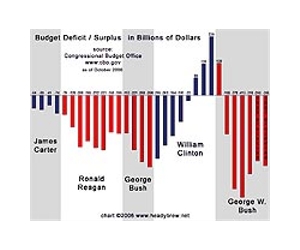
As the nascent administration of President Obama moves into transition mode, some of the scariest briefings incoming officials will get will not be about al-Qaida plots or Iranian nukes, but about the ballooning federal budget deficit, which some analysts now say could reach $1 trillion this year and keep on growing. Projections by two U.S. government audit bodies, the Government Accountability Office and the Congressional Budget Office, "show that there's a pattern of deficits over the next several decades," acting U.S. Comptroller General Gene Dodaro, head of the GAO, told United Press International. "Absent policy change, a growing imbalance between expected federal spending and tax revenues will mean escalating and ultimately unsustainable federal deficits and debt," Dodaro said, adding the problem was "driven largely by rapidly increasing healthcare costs as well as changing demographics." GAO figures show federal government spending rising from about a fifth of U.S. Gross Domestic Product in 2008 to more than a third of it by 2040. Even in the short term, the incoming administration is likely to face a federal deficit that could balloon as high as $1 trillion this year, Fiscal Year 2009. This would be more than double the figure for just-ended Fiscal Year 2008 -- $455 billion or so. Congressional Budget Office Director Peter Orszag has acknowledged the deficit could rise to $750 billion in 2009, according to the National Journal, but this estimate does not include the costs of a stimulus package, nor does it account for any tax revenue lost to a shrinking economy in a recession. Any estimates also have to find a way to budget for the $700 billion Wall Street bailout package, formally known as the Troubled Asset Relief Program, which could recoup some of its costs over time. The National Journal reported that the first group to claim the 2009 deficit might rise to $1 trillion was the Committee for a Responsible Federal Budget, or CRFB -- a bipartisan Washington advocacy group that seeks to educate the public about budget problems. President-elect Obama "is being handed an immense challenge, which could impact many of his campaign promises," said Leon Panetta, CRFB co-chair and chief of staff to President Clinton. Panetta recalled that Clinton "had to drop his plans for middle-class tax cuts in his first year due to fiscal concerns -- and he faced deficits of well under $300 billion." Representatives of the Obama campaign did not return e-mails requesting comment for this story; and -- in common with his GOP rival, Sen. John McCain of Arizona -- the president-elect generally fudged questions about the impact the federal budget squeeze would have on his administration's policy priorities. "Does that mean I can do everything that I've called for in this campaign right away? Probably not. I think we're going to have to phase it in," Obama said in an interview in September for NBC. "And a lot of it's going to depend on what our tax revenues look like." Dodaro acknowledged that, short term, the threatened meltdown in the global financial system would be at the top of the incoming president's in-tray. "There are very important immediate issues that need attention as a result of the financial market situation," he said, adding, "But once those matters are addressed, the long-term fiscal imbalance of the federal government is an area that policymakers need to turn their attention to." For the long term, the incoming administration needs to take "a broad-based look �� at the entitlement programs that are largely driving this situation, particularly in the healthcare area -- that's Medicare and Medicaid -- but also Social Security, to make sure they are sustainable," said Dodaro. "Healthcare costs are definitely the principal cost driver to the long-term fiscal condition of the federal government, and it has an impact on the state governments because they share in the costs of the Medicare program," he added. Unlike Social Security expenditures, "healthcare costs keep growing exponentially, largely driven by the increased costs of technology," he said. As a result, the new administration has to "make sure that the (national) debt doesn't grow disproportionally to the economy, because you have interest payments that you need to make on that debt," which can make the borrowing unsustainable. Dodaro urged the new president and his staff to jump on these structural issues -- and a series of immediate management challenges GAO had identified -- right away. "The message to the incoming administration will be to deal with these urgent and time-critical issues ... they're all very important and need to be dealt with during this prefatory transition period as well as during the early months of the incoming administration," he said.
Related Links The Economy
|
|
|
| The content herein, unless otherwise known to be public domain, are Copyright 1995-2014 - Space Media Network. AFP, UPI and IANS news wire stories are copyright Agence France-Presse, United Press International and Indo-Asia News Service. ESA Portal Reports are copyright European Space Agency. All NASA sourced material is public domain. Additional copyrights may apply in whole or part to other bona fide parties. Advertising does not imply endorsement,agreement or approval of any opinions, statements or information provided by Space Media Network on any Web page published or hosted by Space Media Network. Privacy Statement |
 del.icio.us
 Digg
Digg Reddit
 Google