


Subscribe free to our newsletters via your
. 24/7 Space News .


FROTH AND BUBBLE
Alarm raised over chemical dispersants used in US oil spill
by Staff Writers
Hopedale, Louisiana (AFP) May 10, 2010


BP, US govt search for solution in Gulf of Mexico oil spill
New Orleans, Louisiana (AFP) May 10, 2010 - BP officials desperately searched Monday for a new way to stop an enormous Gulf of Mexico oil spill after efforts to cap a gushing leak with a containment dome hit a snag. British energy giant BP, which owns the lion's share of the leaking oil and has accepted responsibility for the clean-up, was facing the possibility that, failing a swift fix with the containment dome, the crisis could spiral into an even worse environmental calamity The White House also was scrambling to contain fallout from the disaster threatening to take a toll on President Barack Obama's political and energy agenda. In Washington Obama on Monday would meet with Cabinet members and senior staff "to review BP efforts to stop the oil leak, as well as to decide on next steps to ensure all is being done to contain the spread, mitigate the environmental impact and provide assistance to affected states," a White House statement said.

The Minerals Management Service also said it "continues to work with BP to explore all options that could stop or mitigate oil leaks from the damaged well." The BP-leased Deepwater Horizon rig sank some 80 km (50 miles) southeast of Venice, Louisiana, on April 22, two days after an explosion that killed 11 workers. The riser pipe that had connected the rig to the wellhead lies fractured on the seabed a mile below, spewing out oil at a rate at some 5,000 barrels, or 210,000 gallons, a day. Sheen from the leading edge of the slick has surrounded island nature reserves off the coast of Louisiana and tar balls have reached as far as the Alabama coast, threatening tourist beaches further east. Sea life has been affected in a low-lying region that contains vital spawning grounds for fish, shrimp and crabs and is a major migratory stop for many species of rare birds.

The 2.4-billion-dollar Louisiana fishing industry has been slapped with a temporary ban in certain areas due to health concerns about polluted fish. BP, facing a barrage of lawsuits and clean-up costs soaring above 10 million dollars a day, had pinned its hopes on a 98-ton concrete and steel containment box that it successfully lowered 5,000 feet (1,500 meters) down over the main leak. But the contraption lay idle on the seabed as engineers furiously tried to figure out how to stop it clogging with ice crystals. BP officials were said to be considering using a smaller container that might be less prone to clogging. Capping the leak with a smaller box would ensure the oil and seawater mixture inside the container is warm enough to prevent the formation of a slush that had clogged the larger container, according to geochemist David Valentine of the University of California at Santa Barbara.

Untold damage is already being done by the 3.5 million gallons estimated to be in the sea so far, but the extent of that harm will rise exponentially if the only solution is a relief well that takes months to drill. Admiral Thad Allen, head of the US Coast Guard, suggested a "junk shot" was being considered to plug the main leak. "They're actually going to take a bunch of debris, shredded up tires, golf balls and things like that and under very high pressure shoot it into the preventer itself and see if they can clog it up and stop the leak," Allen, who is leading the US government's response, told CBS television. But experts have warned that excessive tinkering with the blowout preventer -- a huge 450-ton valve system that should have shut off the oil -- could see crude shoot out unchecked at 12 times the current rate.

Alarm over the use of dispersants to combat the huge US oil leak is being raised by Gulf fisherman and scientists alike, warning that even if the spill is held at bay, the chemicals used to do so may do untold damage.

Approximately 325,000 gallons of dispersant have been deployed so far in BP's effort to break up the spreading oil slick before it hits the fragile Gulf coast, and over 500,000 gallons more are available.

But the effects it will have on marine life, the shoreline and people spraying the chemicals are largely a mystery -- an issue raising concerns in itself.

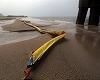
"It's an unknown quantity," marine biologist Clarence Laquet admitted to AFP on Sunday as he surveyed the deployment of booms on Lake Machias, one of dozens of marshy inlets along Louisiana's porous coast threatened by the gushing Gulf wellhead that is spewing some 5,000 barrels of oil, or 210,000 gallons, a day.

The dispersant effort is meant to break down the oil so that over time, the slick is reduced to smaller particles that biodegrade instead of being left as chunky, thick globs that can choke both wildlife and vegetation.

"From what we understand, everything we do in this clean-up process is some sort of trade-off... the dispersant is not as toxic as the oil and it's better to deal with it out there (in the Gulf) than here," Laquet said.

For commercial fishers, however, the prospect of any toxic chemicals in waters they rely on for their living seems just as bad as the incoming oil.

"(It's) going to kill it all off," 45-year-old shrimp boat captain Ray Nehlig told AFP, referring to his threatened catch.

Nehlig's crewmembers scrambled Sunday to unload boom from his peeling square-bottomed vessel Barbara Jean, named after his mother, on the windy waters of Lake Machias.

"We got tons of shrimp here right now, but here we are laying boom," he lamented.

"I've been doing this for near 25 years, but the stuff (dispersant) they're putting in the water to get the oil, it's going to do just as much damage," he said.

The oil has been gushing freely for over two weeks, since the BP-leased Deepwater Horizon rig sank some 80 km (50 miles) southeast of Venice, Louisiana on April 22, two days after an explosion that killed 11 workers.

Since then, efforts to contain the spread have hinged on ways to cap the leak and the use of C-130 cargo planes carpeting chemicals on vast swaths of the slick.

NALCO Energy Services of Sugar Land, Texas, manufactures the chemical dispersant for BP, which is known by its product name "Corexit."

The dispersant is a low-level hazardous chemical, posing risks for eye and skin irritations and "chemical pneumonia" but not cancer, according to NALCO data posted on the Deepwater Horizon web site.

The chemicals have been used on oil spills for years, including the notorious Exxon Valdez disaster in Alaska in 1989.

However, LuAnn White, a toxicologist at Tulane University, noted that what is being used now "is a new generation of dispersants, but we don't know what is in them because it's a trade secret.'"

Over the weekend, three top Louisiana officials from the departments of health, environmental quality, and wildlife & fisheries published a letter to British Petroleum CEO Tony Hayward requesting more information on the chemical dispersants.

The state secretaries said they had "serious concerns about the lack of information related to the use of dispersants in fighting the oil spill," as they asked for details on "what impact it could have on our people, water and air quality, as well as the wildlife, fisheries and vegetation."

Pending test results, the Environmental Protection Agency last week even mandated a complete halt to BP's unprecedented underwater use of dispersants near the well source -- almost a mile down (1.6 kilometers) in the chilly Gulf waters.

"There's a lot of stuff they're not telling us" about the dispersent, George Barasich, president of the Louisiana Commercial Fishermen's Association, warned environmental activists gathered in New Orleans on Saturday, who were rallying against the calamity facing the Gulf coast.

One of the main threats, Barasich said, was the chemicals sterilizing the produce -- a catastrophe for the industry in offshore and coastal Louisiana that supplies 41 percent of seafood consumed in the United States.

"The economic impact these people are looking at -- they can't fathom how far it's going to reach," he said.

.


Related Links
Our Polluted World and Cleaning It Up


Comment on this article via your Facebook, Yahoo, AOL, Hotmail login.

Share this article via these popular social media networks
del.icio.usdel.icio.us DiggDigg RedditReddit GoogleGoogle


FROTH AND BUBBLE
Louisiana begs for more boom as oil slick laps coastal islands
Hopedale, Louisiana (AFP) May 7, 2010
Louisiana begged for more protective booms and urged the federal government not to repeat the mistakes of Hurricane Katrina Friday as a massive oil slick lapped coastal islands. More than two weeks after a BP-leased rig sank spectacularly 50 miles offshore and started hemorrhaging an estimated 200,000 gallons of oil a day into the Gulf of Mexico on April 22, vast swaths of the US coast remai ... read more


FROTH AND BUBBLE
LRO Team Helps Track Laser Signals To Russian Rover Mirror

Lunar Polar Craters May Be Electrified

Seed Bank For The Moon

Craters Around Lunar Poles Could Be Electrified

FROTH AND BUBBLE
Opportunity Drives Twice This Week

New Martian Views From Orbiting Camera Show Diversity

Countdown begins to 520 day 'Mars mission'

Mars Rover Sees Distant Crater Rims On Horizon

FROTH AND BUBBLE
'Starving yogi' astounds Indian scientists

NASA Tests Orion Launch Abort System

NASA Studies Find Omega-3 May Help Reduce Bone Loss

Engineers Diagnosing Voyager 2 Data System

FROTH AND BUBBLE
China Signs Up First Female Astronauts

China To Launch Second Lunar Probe This Year

China, Bolivia to build communications satellite

China To Complete Wenchang Space Center By 2015

FROTH AND BUBBLE
Russian Space Freighter Undocked From ISS

Researchers To Send Bacteria Into Orbit Aboard Atlantis

Russian Space Freighter Ready To Leave Orbital Station

NASA And DARPA Seek Satellite Research Proposals For ISS

FROTH AND BUBBLE
Integration Of Soyuz' First And Second Stages Is Complete

Arianespace Signs Contract With HUGHES To Launch Jupiter

Energia Overseas Limited Assumes DIP Financing For Sea Launch

Iran To Launch Two Satellites This Year

FROTH AND BUBBLE
Planet discovered lacking methane

'This Planet Tastes Funny,' According To Spitzer

Small, Ground-Based Telescope Images Three Exoplanets

Wet Rocky Planets A Dime A Dozen In The Milky Way

FROTH AND BUBBLE
Designed Biomaterials Mimicking Biology

New Metamaterial Device May Lead To See-Through Cameras And Scanners

Omnifocus camera set to sweep industry

Apple: iPad on sale internationally from May 28


The content herein, unless otherwise known to be public domain, are Copyright 1995-2014 - Space Media Network. AFP, UPI and IANS news wire stories are copyright Agence France-Presse, United Press International and Indo-Asia News Service. ESA Portal Reports are copyright European Space Agency. All NASA sourced material is public domain. Additional copyrights may apply in whole or part to other bona fide parties. Advertising does not imply endorsement,agreement or approval of any opinions, statements or information provided by Space Media Network on any Web page published or hosted by Space Media Network. Privacy Statement