


|
|
|
|
|
|
|
|
|
|
|


| . |  |
. |
|
|
|
 by Staff Writers El Segundo CA (SPX) Jun 04, 2009
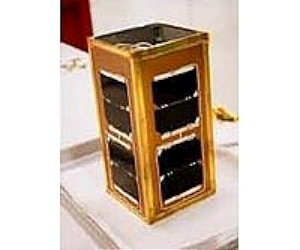
Scientists at The Aerospace Corporation are analyzing data received from a 6.4 kg nanosatellite they developed to test a new generation of solar cells. The Aerospace Corporation engineers, in collaborating with Dr. Henry Yoo of the Air Force Research Laboratories, designed, built and operated a 5 x 5 x 10-inch nanosatellite, called the Picosatellite Solar Cell testbed, to test the latest generation of high efficiency solar cells from Spectrolab and Emcore under conditions in outer space. "Development and test of state-of-the-art, technologically challenging systems such as those being tested in our miniature satellite program showcases what we do best at The Aerospace Corporation," said Aerospace president and CEO Dr. Wanda Austin. "With our diverse engineering expertise we are able to advance the current state of technology and provide the data and technical expertise that our DOD and NASA customers have come to expect - critical insight into science and technology that pushes the envelope and holds extraordinary promise for the future design of space systems and capabilities." Scientists at The Aerospace Corporation have pioneered the use of small satellites for a variety of space missions. Small satellites, some as small as a coffee cup, require careful engineering for their power source, payload circuitry, and communications equipment. But they have the advantage of being much cheaper to launch and operate than the larger variety. The PSSC testbed was launched Nov. 29 from the space shuttle Endeavour (STS-126), and went silent 110 days later after transmitting 17 MB of data consisting of 698 pictures, sensor data and state-of-health data. Aerospace scientists characterized the mission as a success. "We're very pleased with the satellite's overall performance and, in particular, with the communication link to our El Segundo ground station," said David Hinkley, PSSC testbed project manager. "Our three-month experience operating the PSSC testbed, tasking its cameras for pictures all over the world, has been tremendous." The nanosatellite is expected to re-enter the atmosphere in November. A follow-on PSSC testbed mission is planned for several years in the future and will place an updated version of this nanosatellite into a highly elliptical orbit so that the solar cells will undergo accelerated radiation damage by traversing through the radiation belts. The degradation of solar cell performance in that high radiation environment will provide timely information that will be helpful in predicting and improving the end-of-life solar array efficiency for much larger and more valuable satellites. The PSSC testbed was testing other subsystems that will advance the state-of-the-art for this size of satellite, including sun sensors, Earth sensors, an inertial rate measurement unit with rotation rate sensors and magnetic field sensors and three orthogonal torque coils for changing the orientation of the nanosatellite using open-loop control only. In a future flight, these subsystems will combine to provide a closed-loop attitude control system. The PSSC testbed nanosatellite also has four 640 x 480-pixel miniature color cameras on board with lenses providing 40 fields of view. These cameras photographed the Earth, sun, and moon and thereby provided additional spacecraft attitude data and interesting photographs of the Earth, including pictures of the space shuttle Endeavour, the Channel Islands off the coast of Los Angeles and a storm over the Mediterranean Sea.
Related Links The Aerospace Corporation Space Technology News - Applications and Research
|
|
|
| The content herein, unless otherwise known to be public domain, are Copyright 1995-2014 - Space Media Network. AFP, UPI and IANS news wire stories are copyright Agence France-Presse, United Press International and Indo-Asia News Service. ESA Portal Reports are copyright European Space Agency. All NASA sourced material is public domain. Additional copyrights may apply in whole or part to other bona fide parties. Advertising does not imply endorsement,agreement or approval of any opinions, statements or information provided by Space Media Network on any Web page published or hosted by Space Media Network. Privacy Statement |
 del.icio.us
 Digg
Digg Reddit
 Google