


|
|
|
|
|
|
|
|
|
|
|


| . |  |
. |
|
|
|
 by Staff Writers Sacramento CA (SPX) Nov 23, 2010
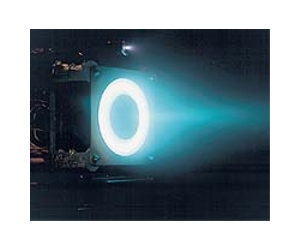
Aerojet has announced that its high-power Hall Thruster Propulsion System (HTPS) has successfully initiated operation on the Advanced Extremely High Frequency (AEHF) Space Vehicle #1 (SV#1) that was launched on an Atlas V rocket on Aug.14. The system is now providing thrust to raise the orbit of SV#1 to its final geosynchronous orbit location. Aerojet's 4.5kW HTPS was developed to dramatically increase the payload capacity of both military and commercial geosynchronous communications satellites (GEO Comsats) and was originally planned to provide a significant portion of the orbit-raising for the AEHF satellites. However, with the recent anomaly with the SV#1 apogee engine, the Aerojet HTPS, along with other Aerojet hydrazine thrusters on the vehicle, now will provide the full orbit-raising function for SV#1. The Aerojet HTPS provides a unique dual-mode capability to operate in both a high-thrust mode and a high specific impulse (Isp) mode. The HTPS orbit-raising operations were originally planned to be performed in the high-thrust mode to minimize orbit raising duration. However, for SV#1, the HTPS now will be operated in the high Isp mode which will take longer to complete the orbit-raising operations, but will enable SV#1 to still meet its full on-orbit life requirements. The dramatic performance improvements offered by the Aerojet HTPS result in a propellant mass savings in excess of 2,000 lbs for each AEHF satellite compared to the use of all chemical propulsion and, as evidenced on SV#1, also provide a truly unique capability for mission recovery. The dual-mode capability also offers a high degree of mission flexibility, enabling a broad range of mission applications within a single propulsion system. For future GEO Comsat mission designers, the significantly enhanced performance capabilities offered by the Aerojet HTPS can allow the same communication payloads to be launched on smaller/less-expensive launch vehicles, or with the same launch vehicle, it can enable a significantly higher payload capacity and therefore a substantially higher revenue stream. Additionally, Aerojet has successfully demonstrated the ability to scale Hall thruster designs up to much higher power levels for future 100-kW class space transportation systems. High-power electric propulsion can enable a more cost-effective NASA exploration architecture. The HTPS was qualified for firing durations in excess of 10,000 hours; ensuring broad applicability for future mission users, including NASA exploration missions. An extension of the ground qualification test is being conducted at Aerojet to validate the new orbit-raising approach for SV#1 at the high Isp operating condition. Aerojet has delivered the flight hardware for the next two AEHF space vehicles and is now on contract for AEHF SV#4. "The successful operation of Aerojet's Hall Thruster Propulsion System on AEHF SV#1 sets a new record for in-space propulsion with the highest-power/highest-efficiency Hall propulsion system flown to date," said Aerojet's Vice President of Space and Launch Systems, Julie Van Kleeck. "Aerojet is extremely pleased to provide this unique capability to recover full operational life capability for AEHF SV#1."
Related Links Aerojet Rocket Science News at Space-Travel.Com
|
|
|
| The content herein, unless otherwise known to be public domain, are Copyright 1995-2014 - Space Media Network. AFP, UPI and IANS news wire stories are copyright Agence France-Presse, United Press International and Indo-Asia News Service. ESA Portal Reports are copyright European Space Agency. All NASA sourced material is public domain. Additional copyrights may apply in whole or part to other bona fide parties. Advertising does not imply endorsement,agreement or approval of any opinions, statements or information provided by Space Media Network on any Web page published or hosted by Space Media Network. Privacy Statement |
 del.icio.us
 Digg
Digg Reddit
 Google